
Gazebo in the main square, Canary Falls
I’ve asked around, and it seems normal not to want to look at something you’ve created after it’s finished—though I’d hate to think Shakespeare read Hamlet just the once. The subtext here is that I finally completed a writing project! My creative coach, Ziva, had tasked me with entering the Writer’s Digest Short Short Story Competition. I was still drafting, editing, and proofreading thirty minutes before the deadline.
After I submitted the piece, I never wanted to see it again—which didn’t stop me from tossing and turning that night as I reflected on its flaws. These gyrations were purely mental, as there was a 45-pound dog lying across my legs. While my feet fell asleep, I lamented numerous aspects of the work I had delivered with my entry fee:
- Length. The composition was based on a synopsis I had written for a story intended to be 3,000 to 5,000 words. Contest entries, however, were limited to 1,500 words (hence, “short short”). Telling the tale was like trying to squeeze a size-ten foot into a size-six shoe.
- Word choice. Every time I proofed the story, I would change certain words—and then change them back in the next pass. I should have changed them one more time.
- Perfectness. I had only two weeks to write the story, so I wasn’t able to craft it to the level I desired. Ziva had advised me to take my perfectionism down to 70 percent, even speculating that 70 percent could turn out to be 100 percent. I still don’t get the math.
The result of the exercise described above appears below. Should you decide to read it, please forget the negative things I just said about it. To pique your interest (or save you seven minutes), the story is about a combat journalist who experiences a close call in the field and returns to her hometown.
Canary Falls
Thirty-seven-year-old Leigh Forrester had been scared before: When she started prep school mid-semester. When her first boyfriend asked her to have sex. When a 1974 Ford Cortina collided with a black bear, making her an orphan. But as a cable news reporter from the globe’s conflict zones, she possessed a preternatural composure. Untrained to deal with dangerous situations, and protected only by a helmet and bulletproof vest, she never considered she could die. Her determination to capture major world events, sustained by adrenaline, insulated her mind from such thoughts. Nor did she worry when her lover, Michel, a war photographer, hadn’t made contact since Christmas; he always resurfaced.
Embedded with U.S. Marines in the volatile Helmand province of Afghanistan, Leigh confronted her vulnerability. On a bright, brisk morning, as she recorded footage outside a reopened clinic in a district liberated from the Taliban, rocket fire from the city limits spread mortar bombs over the area. One landed on the hunter-green Afghan police truck in which she had traveled, sending shards of metal and glass in all directions. Shaken, Leigh realized she needed a respite from peril. She didn’t even wait for the network’s approval. Rather than return to the Notting Hill flat she shared with other combat journalists, however, she wanted to feel the comforts of home.
Leigh walked into town carrying her duffel bag as the sun, still below the horizon, started to color the sky. She barely remembered arriving in Canary Falls, though she knew she must have taken planes, trains, and a bus to get there. She feared she had a concussion from the blast and made a mental note to visit the physician—for as much as a mental note was worth to a person with a brain injury. She had heard Dr. Starr passed a while back and was replaced by a young woman.
The local diner, Logan’s, hadn’t opened yet, but Leigh noticed activity inside. Approaching, she marveled that the business looked just as it had in her youth: mint-green walls, mismatched tables and chairs, tchotchke-stuffed shelves. The eponymous proprietor, who already seemed old when she was a girl, unlocked the door and led her to a hickory stool at the counter, next to an antique cash register. He gave her a big breakfast free of charge.
Leigh set off toward the Dandelion Inn, where she planned to spend a week under a floral quilted bedspread. The breeze carried spring’s freshness, with a hint of summer’s warmth. “I used to love a day like this,” she thought. “In this picturesque New England burg,” the correspondent in her added. After a few minutes, she stopped in front of a two-story, sky-blue house with a wraparound porch. Fifteen years earlier, she had sold the dwelling, furnished, to a young family. She wondered if the Kims still lived there and, if so, why “FORRESTER” still appeared in faded black letters on the white mailbox. Aware she might be committing a felony, Leigh eased the metal door toward her; it creaked a tune she recalled from childhood. Inside was an envelope bearing a single word in a graceful hand: “Leigh.” She slid her thumb beneath the barn-red wax seal, impressed with a calligraphic C. A shiny key fell into her palm. She must have sent word ahead and forgotten.
The walls were still buttercup yellow with white molding. Vintage rugs still dotted the maple floors. Leigh recognized her grandfather’s cushioned rocking chair, beside the brick fireplace with a built-in niche for logs. Her gaze lingered on a framed photograph of a radiant couple on a beach, holding hands as they ran in the surf; she always thought of her parents this way. Leigh crossed the living room to a lampshade painted with violets, which she recalled “improving” with a purple crayon; she fingered the fabric, which was unmarked.
Upstairs, Leigh filled the claw-foot cast-iron tub from a faucet mounted on the rim. She stripped, lowered herself into the steaming water, and closed the pink pinstriped curtain around her. Settling back, she sought to understand how her home from ages eight to eighteen had remained intact and immaculate since she exchanged it, following her grandmother’s death, for enough cash to leave her comfortable. Did the Kims never move in? Do they rent the place out to vacationers? She would go into town and question the selectman or the gossip, whichever she encountered first. Back downstairs, in her old bedroom off the kitchen, she dressed in khakis and a white button-down shirt; in the field, she would add a scarf or jacket as necessary.
Through the textured glass of the double front door, Leigh thought she saw a carriage, drawn by two white horses, waiting at the curb. Indeed, roses, tulips, irises, and dahlias filled the spokes of the wheels. A plume of white feathers adorned each steed’s head. “Welcome home, Leigh!” the townsfolk shouted upon seeing her. When the team reached Main Street, Leigh found herself in a parade. The thoroughfare was lined with people displaying congratulatory signs and shaking ribbons on sticks; they smiled, waved, and yelled her name as she passed. Leigh viewed a truck-drawn float decked with streamers up ahead, and heard a marching band behind. She never expected such a reception, despite being a television personality. She laughed, her eyes filling with tears, and blew kisses to the crowd.
The procession ended in the main square, where lemonade was served, and a three-piece band played Dixieland. Leigh joined former friends and acquaintances, though none could provide insight into the old Forrester cottage. A message spread that a community barbecue would take place at five o’clock. Exhausted, Leigh excused herself; she was hoping to see the new doctor. On the walk over, she mused at the demographic shift in Canary Falls. The inhabitants seemed generally older, with a smattering of middle-aged folks and hardly any children. Perhaps others of her generation had also moved away.
The name on the shingle confused her: “Dr. Richard Starr.” She should have checked her sources; the doc’s wavy hair was still carrot-colored, without a trace of gray. “You’re the picture of health,” he announced, after examining her, “and will probably live forever.” He attributed her mental lapses to the trauma she suffered. Strolling home, Leigh noticed a familiar-looking dog with a curly brown coat. “Babette!” she called out. The mutt trotted over for an ear scratching and went on her way.
Burgers, ribs, chicken, trout, and vegetable kebabs cooked on innumerable grills. Side dishes—corn on the cob, zucchini, asparagus, sweet potatoes, coleslaw, baked beans, biscuits, ambrosia—were ubiquitous. Assorted pies, cakes, and cookies blanketed a long table. Donning the sleeveless plaid-print red dress she wore under her gown at her high school graduation, Leigh wondered if this cookout was being held in her honor. Her answer came after sundown, when Zack St. James, the town selectman, invited her up to the central gazebo, its columns wrapped in garlands of white stargazer lilies. Zack directed everyone’s attention to a theatrical screen hung on a building bordering the square. “Leigh Emily Forrester, this is your life!” his voice boomed over the mic.
The highlight reel mesmerized her: Running around the house in Dad’s gigantic shoes. Getting a shot, slurping a milkshake. Swinging on the veranda with Gramp while it rained. Riding in a car, blindfolded, with members of a secret society. Crossing into Darfur on a moonless night. Making love with Michel in his Paris apartment. Lying on the dusty ground in Bost, bloody, unmoving.
The final image faded, but Leigh remained transfixed. “Could I be dead?” she murmured, staring at the blankness.
Zack held the microphone to her lips.
“Am I dead?” she demanded.
“As a doornail, dodo, or mutton,” he replied, garnering laughs from the audience.
Someone squeezed Leigh’s right hand. She turned to see her mother’s sparkling eyes. When her knees gave way, her father caught her on the left. Behind each parent stood a set of grandparents. A sweeter reunion could not be imagined.
“While you get reacquainted,” Zack interjected, “I’d like to thank the former residents of Canary Falls for making this homecoming possible. You all got together and, through collective concentration, created this remarkable replica of the hamlet we cherished on earth. Sudden transitions can be difficult, but as you can see, Leigh is doing wonderfully.” The assembled souls applauded. “Soon you will be returning to your usual forms and roles, but for now, enjoy the party!” They cheered. To Leigh, he added perfunctorily, “Your guides will be in touch.”
Assuming she had eternity to catch up, Leigh took her leave after a while. In her mind, she still needed sleep. As she neared the house, she was startled by a shadowy figure on the steps.
“The village is adorable.” He used the French pronunciation. “Just as you described.”
“I am a journalist,” she responded. “Or was. You know you’re dead, right?”
Michel grinned. “C’est la vie.”
Hand in hand, they went inside.

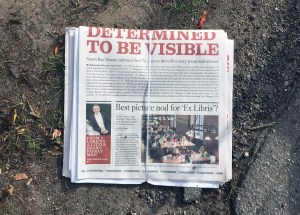
 Fast-forward forty-one years, and I finally have a book of my own! (God forbid a student should ever have to write a report on it.) Determined to Be Visible features thirty-six of my blog posts, as well as some new material tying everything together. I considered using a pseudonym, since there is already an established author with my first and last names and middle initial. But instead of becoming Carrie, Kerry, or Kari, I chose to stick with the moniker by which I am known. I’ll do my best to stand out from the other Karen R. Greenfield.
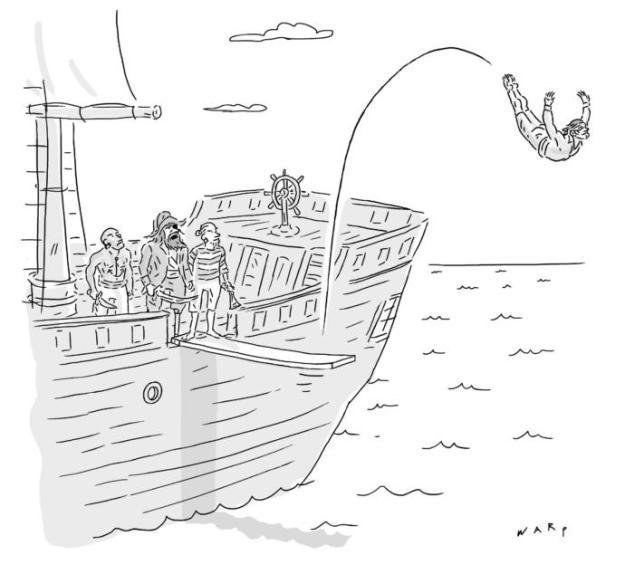
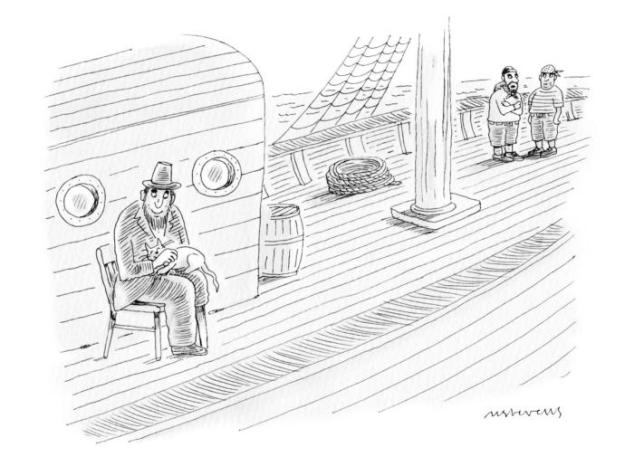
 It was Jessica (not her real name, because if she said it, I can’t remember it) from the New Yorker. And yes, my caption was a finalist! Jessica wanted to confirm the spelling of my name, and where I’m from, for accuracy; as an editor, I appreciated that. She said some logistical things I hope weren’t important, because I don’t recall a word. As far as my end of the conversation, I believe I blathered like an idiot.
 I was not completely unfamiliar with the components of book design—margins, font sizes, line spacing, indents, page numbers, chapter openers. In my role as an in-house editor for a publishing company almost half a lifetime ago, one of my tasks was to create “design memos” identifying and describing the items in a manuscript that needed to be prettified (by a hired professional) for publication. I don’t mean to brag, but one designer said my design memo was the best she had ever received.
 Still, during the process of laying out Determined to Be Visible, I experienced both pros and cons, presented below (with the cons listed first, since I’m a bad-news-first kind of person):

 February is my least favorite month for writing a blog post, because it’s the shortest—month, not post. I know what I want to write about: a current obsession. The current obsession: the 1970s version of the TV program Match Game. But what angle should I take? If you write without a point, that’s journaling, and I hate journaling. Apparently, however, I’m a fan of stream-of-consciousness blogging.
 What I’d really like to know is why watching grainy YouTube videos of this forty-year-old comedy/game show makes me so happy. (I launched a similar
  a. The campy host, Gene Rayburn
 a. The retro (then au courant) hair and clothing styles
 I (barely) remember watching Match Game as a kid; I’m sure I didn’t understand much of the banter. My clearest recollection is of the audience saying, for example, “How dumb is she?” in response to a question that started, “Dumb Dora is so dumb . . . .” Seeing the show now gives me self-perspective: “I was six, or eight, when this was filmed. The dated references reflect the world in which I grew up, and of which I was just beginning to become aware. I am a product of this time.”










 Novel-Gazing