Today I am sharing the first song I ever wrote. “Bettina” (listen below!) is unique in that it has two different choruses: one in English, and one in English and German. I don’t speak German, so I’m afraid I might be singing something truly ridiculous!
Here is the chorus that contains some German:
Bettina Meine kleine Liebe I love you So sehr, umso mehr
Here is my intended meaning:
Bettina My little love I love you So much, even more
And here is the probable meaning:
Bettina I would like to buy a lemon I love you Where is the library?
“Bettina” is a lullaby of sorts, so it’s fitting that I composed it on a children’s toy—a plastic keyboard purchased for $14.99 from the local drug store. Although I wrote “Bettina” over two years ago, the inspiration that was in my heart remains. I hope you will enjoy it.
Bettina
Profile
Title: “Bettina”
Number: 1
Length: 2:34
Vibe/inspiration: Julie Andrews, Brahms’s lullaby, “Somewhere Over the Rainbow,” music box
Key: F major
What I imagine German speakers might say:
“If there was any German in that song, I think I may have missed it.”
“You should at least watch a few YouTube videos before you start writing in another language.”
“Stick to English. Just stick to English.”
“My dog speaks better German, and before you ask, he’s not even a German shepherd.”
Lyrics:
Bettina Bright-eyed as Athena Hmm-hmm-hmm I love you So sweetly and completely Hmm-hmm-hmm
Bettina Meine kleine Liebe I love you So sehr, umso mehr
[Bettina My little love I love you So much, even more]
I’m sorry that I put you on a shelf I simply haven’t been myself It seems a lifetime since I went away I’ve waited all these years to say
Bettina Meine kleine Liebe I love you So sehr, umso mehr
[Bettina My little love I love you So much, even more]
Although we may be half a world apart You stay with me inside my heart I can’t believe I lived to see this day I’ve made it all these years to say
I love you
[Instrumental chorus]
[Instrumental interlude]
My lucky stars, I have a second chance To set aright this chaste romance Oh, my desire is nourished by delay I’ve traded all my tears to say
Bettina Meine kleine Liebe I love you So sehr, umso mehr
[Bettina My little love I love you So much, even more]
And I have waited all these years to say I love you
“Ma Belle” (listen below!) is the kind of song that happens when your heart takes a walk around Paris. Last May, I visited the French capital for the first time. I didn’t realize I had never tasted bread before. Or butter!
In this song, I wanted the name Ma Belle to repeat like the bells of Norte Dame—the medieval Catholic cathedral in Paris known for its French Gothic architecture, colorful rose windows, and massive bells. Notre Dame means “Our Lady,” a reference to the Virgin Mary.
For the record, I know that belle is French for “beautiful,” not “bell.” It’s just a coincidence that I wanted “belle” to sound like a bell!
I do not speak French, let along sing French. I did not intend for “Ma Belle” to have more than a simple refrain in French. But it ended up with three different choruses en français. If my grammar and pronunciation are terrible, please go right ahead and blame Google Translate!
I viewed or visited all the places mentioned in “Ma Belle.” To prove it, I made a music video! It’s a slide show of vacation photos, with a very personal soundtrack.
I’m dusting off a personal favorite from the archive, for new visitors to this blog. “Your Old Acoustic” (listen below!) was the fourth song I ever wrote. I played guitar on it, too, and my old acoustic hasn’t quite forgiven me yet.
I tend to go overboard with verses; it’s not unusual for my songs to have as many as six of them! But “Your Old Acoustic” contains only two verses. It focuses instead on repetition of lines from the chorus. I wanted people to be able to sing along the first time they heard it.
Toward the end of “Your Old Acoustic,” we discover it is being performed in what sounds like a pub. When the song is over, the patrons return to talking and joking. Any intimacy engendered between the singer and the audience has evaporated. The singer has poured her heart out into a void: Her song is meant for one person, who isn’t there. Whom she has no way of reaching.
Your Old Acoustic
Profile
Title: “Your Old Acoustic”
Number: 4
Length: 3:34
Vibe/inspiration: Michael Nesmith
Key: F major
What people have said:
“I LOVE this vibe! This is a song I would love to sing myself. I’m sure I’m going to have it in my head over the next days!”
“Love it! It made me cry! So beautiful.”
“Very nice! I did not cry, but…it was still pretty.”
“Loved it! I especially like the end where you make it seem like it’s a recording in front of an audience. Very clever! I have ‘my son’ running through my head.”
“Fun song! I like the ‘live’ touches at the end.”
“Your collection of hits amazes me. Well done!”
Lyrics:
You came the night all eyes were watching me— A pretty boy footloose and fancy-free Toes a-tapping to my song Rows a-clapping right along But you could find me only on TV
And I walk But I cannot go And I talk Just so you will know
Dust off your old acoustic And join the band Bust out and make some music With your old man Gone when you wore baby shoes And now I only play the blues Dust off your old acoustic And join the band
A middle name was all you got from me A pittance of a rich man’s legacy (legacy) Thought I’d look you up one day But I took too long to say And you inherited a mystery
And I bring (yes, I bring) All my loving, dear And I sing (yes, I sing) Just so you will hear
Dust off your old acoustic And join the band (my son) Bust out and make some music With your old man (my son) Didn’t try on daddy’s suits I never saw you fill your boots Dust off your old acoustic And join the band
[Instrumental verse]
And I walk (yes, I walk) But I cannot go And I talk (yes, I talk) Just so you will know
Dust off your old acoustic And join the band (my son) (come on) Bust out and make some music With your old man (my son) (all right) Gone when you wore baby shoes And now I only play the blues Dust off your old acoustic And join the band
Dust off your old acoustic And join the band (my son) Dust off your old acoustic And join the band (my son) Dust off your old acoustic And join the band (my son) Dust off your old acoustic And join the band
I have a spring in my step today because I am springing a new song on you. It’s called “Spring’s Out.” You don’t have to spring for it because it’s free for the listening. (Spring into action and click below!) Even if you’re no spring chicken, I hope this song makes you spring to your feet and dance a little jig. Punxsutawney Phil predicted six more weeks of winter, but it looks like an early spring to me!
Disclaimers: I am not a musician. I don’t “play” an instrument. I never practice. But that doesn’t stop me from trying to learn a tune for the sake of a song. For “Spring’s Out,” I managed to strum a ukulele, both up and down. In the same vein, I don’t pretend to be a singer. My recordings are demos, waiting to be sung by someone who can actually sing. My songs are, however, invitations into my heart.
“Spring’s Out” contains four sound effects, from Zapsplat.com.
Spring’s Out
Profile
Title: “Spring’s Out”
Number: 14
Length: 1:53
Vibe/inspiration: Nostalgia
Keys: F major and B-flat major
What I imagine people might say if they had to use the word spring:
“Maybe the next one will be a winner; hope springs eternal.”
“I’d like to spring to the defense of this song, but I can’t.”
“If I was doing spring cleaning, this song wouldn’t make it.”
“My springer spaniel could produce something better, if you know what I mean.”
“Spring forward, fall on your face.”
Lyrics:
Who needs stuff When we’ve got love?
Spring’s out in the armchair If you do your crossword there Beware It’s gotten rather threadbare— It could snare Your derrière
Sixteen across Is albatross
Spring’s out, spring’s out Shimmy down the downspout, baby No doubt, no doubt Jimmy’s bedroom light is out!
Who needs stuff When we’ve got love?
Spring’s out in the ceiling Give the roofing man a ring- A-ling You’d better move your six-string Could you bring A bucket-thing?
Come rain or shine The weather’s fine
Spring’s out, spring’s out Shimmy down the downspout, baby No doubt, no doubt Jimmy’s bedroom light is out!
[Instrumental chorus]
Who needs stuff When we’ve got love?
Spring’s out in the garden Hollyhock and hyacinth Are in Here’s Nora with a clothespin— How’ve you been? Your kith and kin?
Forget me not If I should rot
Spring’s out, spring’s out Shimmy down the downspout, baby No doubt, no doubt Jimmy’s bedroom light is out!
Spring’s out, spring’s out Scurry up the downspout, baby Don’t pout, don’t pout Hurry up, the sun is out!
I thought it was time for a progress report on my “hot” list—songs I have written, or at least conceived of, that are currently inspiring me but are not yet recorded.
I feel lucky (and lazy) to have three songs written and just waiting to be recorded on my living room couch. I know what you’re thinking: “Slow down, Karen! Leave some songs for the rest of us.” I consider a song “written” if it has complete lyrics, a melody, a solid arrangement, and a title that seems likely to stick around. (These elements are subject to change, of course, and often do.)
The first song waiting to be warbled into a mike is the very first one I wrote. It was inspired, in equal parts, by Brahms’s lullaby and “Somewhere Over the Rainbow.” I wanted the chorus to be in German—and to rhyme. But the extent of my knowledge of German was, and essentially remains, “Gesundheit.” As the song involved no sneezing, I was stuck. After a little research, I managed to compose a few brief lines in German. Do they rhyme? That’s not for me to say.
The second song poised to become noise pollution is an upbeat ditty called “Spring’s Out.” It’s about sneaking out of (or into) the house when you’re a kid—which is pure fantasy, as I never left (or returned to) the homestead without my parents’ knowledge, not even once! True to form, the first verse has snuck out:
“Spring’s Out” (first verse)
Spring’s out in the armchair If you do your crossword there Beware It’s gotten rather threadbare— It could snare Your derrière
The third song champing at the bit is “If I Roam.” With hymnlike verses and a rousing chorus, “If I Roam” is an anthem to the enduring allure of “home”—whatever that means to you. Speaking of the chorus, have a look at it before it gallops off:
“If I Roam” (chorus)
If I roam, roam, roam My soul will call me home If I roam, roam, roam My heart will lead me home Lead me home
I would also like to take a moment to recognize the seventy-nine song ideas that are currently languishing on my computer. For example…
Last October, a dining companion told me a completely charming story from his days as a college student in Vermont. When summer came, he decided to cross Canada by train. I think you can guess what happened next: he met a girl! Her final destination was Alaska; his was California. I knew it had to be a song. Still in the conceptual stage, “Each Time She Hangs a Picture” will probably be narrative in style, with a country flavor.
Hopefully, at least some of the tunes mentioned in this post will be coming your way in 2023—but please don’t misconstrue this as a New Year’s resolution. Twelve months from now, I don’t want anyone asking, “Hey, where’s that number with the grammatically incorrect German?”
I don’t know what you did this year, but you must have been naughty, because you’re getting my Christmas song (listen below!). Though I tend to be a very private person, I granted a rare interview with myself—to myself—so that you might learn more about this seasonal ode.
Q: Okay, that stops right there. A: What? Q: Flowery language like “seasonal ode.” A: What if I’m talking about a poinsettia? Wouldn’t flowery language be appropriate then? Even necessary? Q: This is going to be a long interview.
On celebrity cameos… Q: What are a few of your favorite things about “The Christmas After This”? A: Hey, I like what you did there! Q: I’m not a total grinch. A: One of my favorite things about this song is that it contains celebrity voices. Q: Such as? A: Such as Betty White quoting Robert Browning. Q: How did you manage that? A: I have my ways. Q: Don’t pretend I don’t know your ways! I’m aware of everything you think, say, or do. A: There are fifteen celebrity voices in all. Q: Any more answers to questions I never asked?
On fanfare… A: Another of my favorite things about this song is that it opens with literal fanfare. Q: A short and lively sounding of trumpets? A: Yes. Not to toot my own horn. Q: Are you saying that you didn’t play trumpet on the recording? A: No. Q: So, you did play trumpet on the recording? A: No. I’m saying yes, I didn’t play trumpet on the recording. Q: I’m glad we cleared that up. A: I’m not good with wind instruments. I don’t have enough hot air, if you can believe that. Q: I really can’t. A: I tried to learn the flute, when I was a kid, but I was awful. I kept going to the lessons, though, because I liked the orange soda in the vending machine. Q: I’m pretending not to know you.
On Christmas love songs… Q: What is “The Christmas After This” about? A: It’s about getting engaged at Christmas, to be married the following Christmas. Q: So, it’s a love song. A: I think all Christmas songs are love songs. Q: How so? A: They woo the perfect Christmas—which remains sweetly out of reach. Q: What did I say about flowery language? A: Sorry. Q: Do you think getting married on Christmas would be romantic? A: I do. Just family and close friends. Big red bows everywhere, and pinecones. Candles burning. It’s perfect because everyone’s already in a festive mood. Q: What’s your favorite part of Christmas? A: Eggnog! Q: Do you make it yourself? A: I buy it at the store—apologies to the purists out there. Q: Brandy, rum, or whiskey? A: Neither, nor, nor. I find that alcohol impairs the nogginess of the flavor. Though I’m not opposed to an eggnog martini, as history has shown.
On three kinds of choruses… Q: As you were recording this song— A: And thanks for not lifting a finger to help— Q: I noticed you included three different kinds of choruses. A: I didn’t know you could count that high. Q: Can you elaborate? A: I thought your feeble intellect would prevent you— Q: About the kinds of choruses! A: Well, the first is a spoken chorus that introduces the song and provides a running commentary. Q: How about the second kind? A: That’s a regular old pop chorus that repeats the song’s main message. Q: You mean, something like, “She loves you, yeah, yeah, yeah”? A: Yes, but not that erudite. Q: And the third kind? A: It’s a choir-type chorus that offers an angelic counterpoint to my own terrible sound. Q: Tell me more about the spoken chorus, which is something you don’t really see outside Greek or Elizabethan drama—perhaps with good reason. A: It took me a while to figure out what the spoken chorus was doing. The song itself covers the marriage proposal, which takes place this Christmas. The spoken chorus spans from this Christmas to next Christmas, narrating from the engagement through the wedding ceremony. Q: That’s almost interesting. A: The spoken chorus is written in iambic tetrameter, if you must know—my God, you’re persistent!
On the Bard… Q: Where’s the Shakespeare? A: Here, there, and everywhere. Q: As usual. A: The whole idea of waiting exactly a year to get married was lifted from Love’s Labour’s Lost. There are two direct quotes from that play in the song. Q: Is it the line about snogging under the mistletoe? A: Do you even know what “snogging” means? Q: Hey, I ask the questions around here. A: To me, the song’s spoken chorus is reminiscent, in purpose and tone, of the prologue in the play-within-the-play in A Midsummer Night’s Dream. Q: Congratulations. Maybe one person in the world knows what the heck you’re talking about. A: Then at least I’ve reached another person. Q: I was talking about you. A: I picked up the word “glistering” from The Merchant of Venice. Q: Sure, just keep going. A: There’s the famous line, “All that glisters is not gold.” I love how “glister” seems to be a combination of “glitter” and “glisten.” Q: I applaud your use archaic language that hasn’t been heard since the late sixteenth century and, even then, was outdated. A: I’ll take your sarcasm as a compliment. Q: It’s the closest you’re going to get.
On other influences… Q: Did you steal from anyone besides Shakespeare? A: I once saw the comedian Gallagher smash a watermelon with a sledgehammer as part of his act. Q: And that somehow inspired this song? A: Not at all. What a strange question. But Christmas was a big influence. And music. Q: Christmas and music. Can you be more specific? A: Johnny Mathis is one of my favorite Christmas crooners. For the very last line of the song, I asked myself, “How would Johnny Mathis sing this?” I tried to channel his style. Q: Were you successful? A: I have no idea, but my dad once did Johnny Mathis’s taxes! That’s almost a tongue twister: “Mathis’s taxes.” Q: Your father was an accountant? A: No, a plumber.
“The Christmas After This” contains two sound effects, from Zapsplat.com.
The Christmas After This
Profile
Title: “The Christmas After This”
Number: 13
Length: 3:53
Vibe/inspiration: Christmas, “The First Noël,” “Deck the Halls,” Johnny Mathis, Greek and Elizabethan choruses, Love’s Labour’s Lost and other Shakespeare
Key: F major
What I imagine Santa might say:
“This song is the musical equivalent of a lump of coal.”
“Frankly, I would have preferred an unspoken chorus.”
“I can’t believe I didn’t even get a mention.”
“Believe me, I’ve heard all the songs about Christmas, and let me tell you, this is one of them.”
“I’m a sucker for sleigh bells.”
Lyrics:
All hark ye, park thee round the tree To mark this merry comedy
Since we met I’m in your debt Now lend me your ear
Take my word Let it be heard How I need you here
Next Christmas We’ll reminisce this As both Our troth Do swear
The Christmas after this one The Christmas after this, hon The Christmas after this
A halo round a moonless stone A glistering to gild your own
Take this ring We’ll do our thing For just one more year
Take a chance On our romance Forge a new frontier
Next Christmas We’ll reminisce this As both Our troth Do swear
The Christmas after this one The Christmas after this, hon The Christmas after this
An old guitar, romantic jargon To seal a world-without-end bargain
[Hummed verse]
Take this song And dream along With your balladeer
[Instrumental pre-chorus and chorus]
A dress of wool, a suit of lace (“That’s backwards!”) An oath beside the fireplace (“Egad, that’s hot!”) Some nog for toasting, “Cheerio!” A snog beneath the mistletoe
Take my hand And it is planned Yea, our day is near
Take my heart We’ll never part Nay, nor never fear
Next Christmas We’ll reminisce this As both (as both) Our troth (our troth) Do swear
I will be thine Take all that’s mine
The Christmas after this one The Christmas after this, hon The Christmas after this
The Christmas after this kiss The Christmas after this bliss The Christmas after this
I recorded my latest song (listen below!) last week, while recovering from Covid. Please enjoy the nasal, throaty, almost feverish quality of the vocals. A few days into being sick, as I lay in bed with one of the most impressive headaches I’ve ever had (and I’ve had quite a few), I thought, “Is this the day I die?” Clearly, it wasn’t.
“The Day We Never Met” is unusual, I think, in that it doesn’t have a chorus, and the title appears only in the very last line. For the recording, I utilized my latest (and greatest) stringed acquisition, a parlor-size acoustic/electric guitar from Zager. A gorgeous instrument of solid African mahogany, it’s designed to be easy to play; I haven’t noticed this feature yet, but I’ve heard practicing can be very good for that.
My mother is my most devoted fan, along with her cat, Asher. (You might argue that Asher has no choice but to listen, especially since his favorite spot is on my mother’s legs, but he could hide in the closet if he wanted to.) Mom likes to know what my songs are about, even if I don’t always know myself, so I will try to provide a little background here.
If you’re a longtime lurker of this page, and even managed to keep up during the two-and-a-half-year hiatus (kudos!), you will likely have noticed that I once trafficked in the published word, as a writer, editor, and proofreader. Yet even I am amazed at the sheer volume of words being produced today for public consumption. People look at their screens for hours on end, and they need something to read—in the form of e-books, news stories, magazine articles, social media posts, blogs, advertisements, and the like.
“The Day We Never Met” is about considering the source of what you read—and being a considered, and considerate, source yourself. More specifically, the song’s theme is to be careful when you talk about someone you don’t know. But a theme doesn’t make a song—or, for that matter, a poem or a play or an essay about the queen. So, I crafted a story around my chosen theme, set it to music, and ta-da!
The Day We Never Met
Profile
Title: “The Day We Never Met”
Number: 11
Length: 2:36
Vibe/inspiration: Patsy Cline
Key: C major
What I imagine people might say:
“I wish I never met this song. Come on, it was too easy.”
“If this song had a chorus, my disappointment would only have been compounded.”
“Have I stumbled into the rhyming Olympics?”
“I’d worry this song might glamorize smoking, but you’d have to have an audience for that to be a problem.”
Lyrics:
Well, you’ve been writing about me About the man you claim to be Filling pages For the ages Is it fact or fantasy?
What makes you think you know so much? You’ve never even been in touch ’Stead of knocking You kept walking Now you’re saying such and such
[Instrumental verse]
You flew in on a private jet You lit another cigarette I was waiting ’Ticipating On the day we never—
You were late ’n’ Hesitating On the day we never—
You’re narrating Punctuating The story of the day—
I was waking Mind was aching On the day we never—
You were making Plans forsaken On the day we never—
Now you’re taking Bows for breaking The story of the day—
Monday night ’n’ Not a sighting On the day we never—
Tuesday quiet ’n’ Nail-biting On the day we never—
Wednesday light ’n’ You’re a-writing The story of the day—
A day I can’t forget I haven’t seen you yet We won’t sing a duet
“The Clues Are There” (listen below!) has the makings of a hot mess. My latest recording features two time signatures (3/4 and 4/4), four tempos (ranging from 87 to 135 beats per minute), and four keys (A major, G major, C major, and F major, in order of first appearance). As the song opens, a train whistle—a steamy A6 chord—screams in harmonica and flute. The click-clack of the accompanying locomotive sounds as if it has been lifted from a black-and-white movie (with good reason). Add piano, piccolo, guitar (strummed by yours truly), violin, cello, timpani, and cymbal. Cram it all into two-and-a-half minutes. You can decide if everything works together, but let’s be honest—the odds aren’t good.
Think of “The Clues Are There” as Mary Poppins meets Murder on the Orient Express. With simple lyrics about perceiving the world around us, it started out as a children’s song that a magical nanny might sing (à la “A Spoonful of Sugar”). The idea of “clues” reminded me of having seen a lively stage adaptation of Agatha Christie’s celebrated whodunnit set aboard a luxurious train en route from Istanbul to Calais. Doesn’t life seem like a mystery sometimes, full of intrigue and suspense? You need to be Hercule Poirot just to figure out what’s going on.
The Clues Are There
Profile
Title: “The Clues Are There”
Number: 10
Length: 2:34
Vibe/inspiration: Mary Poppins, Murder on the Orient Express
Keys (in order of first appearance): A major, G major, C major, F major
Random perceptions:
“The best way to perceive this song is not with the ears.”
“I’m looking through this song to the pure idiocy within.”
“To quote Hamlet, ‘There is nothing either good or bad, but thinking makes it so.’ Guess what I’m thinking.”
“Sometimes, two plus two equals five. Or in this case, twenty-seven.”
“I tried to feel this song with my heart. I got heartburn.”
Lyrics:
I have two eyes So, I can see A photograph that’s not of me
I have two ears So, I can hear A difference that’s very clear
The clues are there If you care And I do And I do
The clues are there If you dare And I do And I do
I have a brain I can construe The summing up of two and two
I have a will I can pursue The sussing out of who is who
The clues are there In the air Give me more Give me more
The clues are there Everywhere Give me more Give me more
[Instrumental interlude]
I have a mind And I can muse ’Bout life in someone else’s shoes
I have a heart And I can feel If something is or isn’t real
The clues are there If you care And I do Yes, I do
The clues are there If you dare And I do Yes, I do
The clues are there In the air Give me more More and more
The clues are there Everywhere Give me more More and more
“The Factory” (listen below!) is a strange song. There, I said it, so you don’t have to. Perhaps its strangeness comes from the fact that it was inspired, in equal parts, by (1) an abandoned brick factory, (2) the song “Sixteen Tons,” (3) the Romantic poet Lord Byron, and (4) the musical Hadestown.
Why an abandoned brick factory?
Ruins are hauntingly cool.
Last November, I saw a photo of an old brick factory located in the Hudson River Valley of New York. At the end of the 19th century, this region was the largest brick manufacturer in the world. In the photo, the factory’s front wall (made of brick, naturally) was overgrown by trees, plants, and vines. It had no idea it was about to become a metaphor in a strange song.
Why the song “Sixteen Tons”?
It’s gritty and refers to arduous manual labor.
When I thought about the back-breaking business of brickmaking, Merle Travis’s 1947 folk classic about a coal miner came to mind. I was familiar with a modern cover of the song, which appears in the opening credits of one of my favorite movies, Joe Versus the Volcano. I wrote my song to the melody of “Sixteen Tons,” interjecting my own melody later.
Why the Romantic poet Lord Byron?
I was an English major.
In the song’s third verse, “Way back in eighty-eight” refers to 1788, the year in which Lord Byron was born—not to the ’88 in which padded-shoulder power suits were popular.
Why the musical Hadestown?
It depicts the underworld as a machine shop.
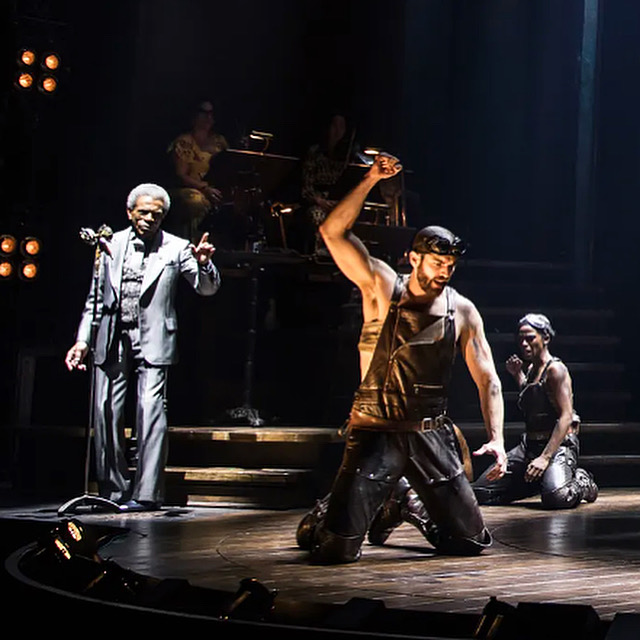
As the mood for “The Factory” developed, I thought, “Why does this feel familiar?” I realized my supremely unique creation was reminiscent of Hadestown, the Tony-winning musical that retells two Greek myths related to the underworld. The orchestra in the Broadway production I saw several years ago had included seven musicians, playing piano, violin, cello, guitar, trombone, glockenspiel, double bass, and percussion. So, that’s exactly the instrumentation you will find in “The Factory”—with the addition of regular old bass guitar.
What? No Shakespeare?
“The Factory” contains references to The Merchant of Venice, Much Ado about Nothing, and Julius Caesar.
What? No sound effects?
“The Factory” contains four sound effects, from Zapsplat.com.
The Factory
Profile
Title: “The Factory”
Number: 7
Length: 3:35
Vibe/inspiration: An abandoned brick factory, “Sixteen Tons,” Lord Byron, Hadestown
Key: A minor
What I imagine a brick might say:
“I can guarantee you not one brick was consulted in the making of this song.”
“The ‘bricky’ sound effects in the bridge are just insulting.”
“I resent the use of bricks as a metaphor. Much prefer a nice brick fireplace. Or even mailbox stand.”
“‘Pile of bricks’? Pile of s#*t.”
Lyrics:
The way you double-cross me got me tied up in knots Your mama was a leopard, get a look at those spots You never did a thing—but to bring me pain Your mercy don’t come like a summer rain
There’s a pile of bricks (oh) this side of your heart Pump them out just to keep us apart Ain’t glad to report from what I can see It’s business as usual at the factory
You squeezed my little fingers as you planted your horns The perfume of a rose though you were only the thorns You judge me guilty of—keeping love from you And, oh, did your maker forsake you, too?
There’s a pile of bricks (oh) this side of your heart Pump them out just to keep us apart Ain’t glad to report from what I can see It’s business as usual at the factory
It’s like talking to a wall Will it take a ton of bricks to fall? Are you hearing me at all?
Way back in eighty-eight the Fates made merry your birth A wanderlust would carry you all over God’s earth Before you wore a beard you got yourself some fame But mine’s the rhyme that got you to a household name A Hero and a Brutus—got to look the same Cuz, Lord, I’m Judas in your book of blame
There’s a pile of bricks (oh) this side of your heart Pump them out just to keep us apart Ain’t glad to report from what I can see It’s business as usual—
There’s a pile of dust (oh) that used to be bricks Wonder how you’re gonna get your kicks I’m sad to report from where I can see Ain’t nothing no more of your factory
I don’t have a new song to share (just a snippet), but I thought I would report on some compositions that have a chance of being recorded on my living room couch sometime soon.
I get ideas for songs all the time. Most of them offer a moment of amusement as they float in and out of my mind. The ones that stick get a working title and a file on my computer. A few of these continue to claim my attention as I go about trying to be a productive citizen. Typically, there’s an initial burst of inspiration, resulting in some rough lyrics—followed by the hard work (and pure joy) of fleshing out the “story,” hammering out the meter and rhyme scheme, and puzzling out the words. Sometimes, a tune that naturally undergirded the lyrics as they formed becomes the final melody. Otherwise, I listen. And wait.
Here are some song ideas that have stuck, in various stages of being realized. (All titles are working titles.)
“The Factory”
Current form: Partial recording
Inspirations: An abandoned brick factory in the Hudson River Valley, the song “Sixteen Tons,” the Romantic poet Lord Byron, the musical Hadestown
Sample lyric: Your mama was a leopard, get a look at those spots
Musings: Intrigued by a photo of the ruins of an old brick factory, I began writing the lyrics for “The Factory” in New Orleans last November—to the melody of “Sixteen Tons.” Merle Travis’s 1947 folk classic about a coal miner evoked a vibe that felt apropos for a song about a brick factory. My lyrics were largely intact within three weeks. Then came the excruciating task of extracting the iconic “Sixteen Tons” melody and replacing it with my far, far, far lesser one. I am in the midst of recording “The Factory,” but you can listen to the preliminary bridge here.
Preliminary Bridge for “The Factory”
“Ma Belle”
Current form: Preliminary lyrics
Inspirations: The sights and sounds of Paris
Sample lyric: When you were learning how to spell Did you ride this carousel?
Musings: I penned the lyrics for “Ma Belle” (French for “my beautiful”) about six weeks ago, in Paris and on the flight home. So far, every line either repeats or rhymes with belle. The song contains a complete sentence in French, and I don’t speak French at all, so I’m preparing myself for total humiliation. (I might have done better with a song inspired by Madrid. Or London.) “Ma Belle” is presently sans mélodie.
“The Christmas After This”
Current form: Partial lyrics
Inspirations: Christmas, the play Love’s Labour’s Lost
Sample lyric: Next Christmas We’ll reminisce this
Musings: About two weeks ago, I started writing a Christmas song! I have hardly kept my fondness for Christmas music a secret from this blog. (See Christmix Tape and Please Have Snow and Mistletoe.) I am thrilled by the idea of contributing to this timeless canon, even if only a few people will ever hear “The Christmas After This”—which is based on a monologue from one of Shakespeare’s early comedies. The best part is that I have almost half a year to finish it!
“Isaiah’s Bucket List“
Current form: A few notes jotted down
Inspiration: An Uber driver in Dallas
Musings: Isaiah gave me a ride from a hotel in downtown Dallas to DFW. He told me that before retiring, he had driven a bus for thirty years—winning a trip to Jamaica as bus driver of the year (twice). Isaiah wants to visit three places before his time on earth is up: Alaska (because he’s amazed that people can live where it’s so cold), New York City (because you can get a pizza there at three in the morning), and Hawaii (because the air smells like flowers). Isaiah has a wife and two grown children. He thinks the big houses on the highway are too close together. His voice is like molasses.
Finally, a few songs that are just working titles at this point:









 Novel-Gazing