
Category Archives: Rhyme

Comfort Cold

William Shakespeare (1564–1616) was barely literate, but he could not have died more poetically: on the same day and month he was born, April 23. Today would have been his 461st birthday (if people lived for centuries), as we commemorate the 409th anniversary of his death.

I’m not ready to lay out a case for who wrote the works attributed to William Shakespeare, because I don’t think the world is ready to entertain the idea that the individual widely regarded as the greatest writer in the English language (according to Wikipedia, anyway) was a woman—let alone one who grew up on a farm, in a rigidly patriarchal society that didn’t educate girls.

This is a woman whom scholars claim to know very little about, outside public records. They dismiss her as a footnote in the life of a literary genius—not realizing it was she who wrote the plays and poems they study, teach, and publish criticism on.

No, the time just doesn’t feel right—though perhaps it is ripe. We probably need this information now, if only to expand our thinking a bit—to encompass the fact that the configuration of sex organs within the human body has no bearing on the soul’s depth to feel or on the mind’s capacity to learn, imagine, or create. Ultimately, the sex of the person who wrote Hamlet, Romeo and Juliet, and A Midsummer Night’s Dream shouldn’t matter—which, perhaps, is all the meaning in answering the authorship question once and for all.

Today, I am sharing a sonnet that might have been penned by Anne Hathaway, William Shakespeare’s wife of thirty-three years, upon the death of her husband. It follows the sonnet form that was popularized, though not invented, by the writer of Shakespeare’s works—but I have leveled up the difficulty a bit. (I’m a bookish kind of daredevil.) Here’s the rhyme scheme of the traditional Shakespearean sonnet:

ABAB CDCD EFEF GG

The different letters represent pairs of lines that rhyme with each other: so, the first and third (A an A), the second and fourth (B and B), the fifth and seventh (C and C)—all the way to the closing couplet (G and G). Today’s sonnet, however, uses the following, somewhat more ambitious rhyming pattern:

ABAB ACAC ADAD AA

What this means is that over half the lines in the poem (eight out of fourteen) rhyme with each other: specifically, lines 1, 3, 5, 7, 9, 11, 13, and 14. This more demanding rhyme scheme, which requires additional craft from the poet, pays homage to the profound specialness of the subject.

From Anne Hathaway…
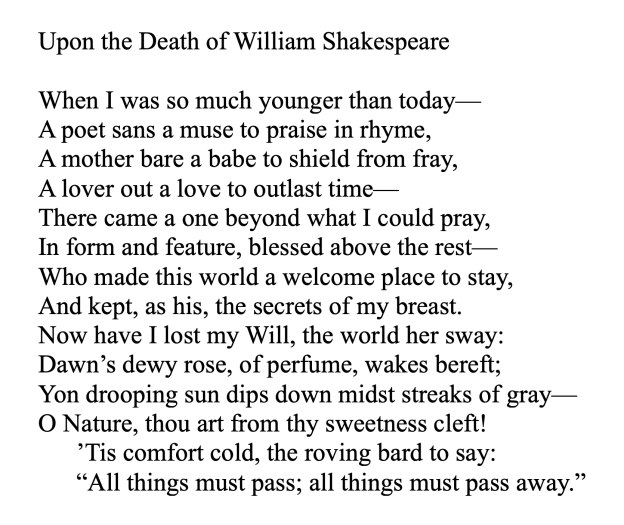
Each sonnet in my series concludes with lyrics written by the original Paul McCartney (who died in 1966). I took the last line of today’s sonnet from the title track of George Harrison’s triple album All Things Must Pass (1970). I suspect Paul was inspired to write “All Things Must Pass” (the song) by his mother’s passing, when he was fourteen; or by the death of the Beatles’ first bassist, Stuart Sutcliffe, when Paul was nineteen. The song offers words of comfort from the deceased, using natural phenomena (sunrise, sunset, a cloudburst) as metaphors.

In previous posts, I have noted Paul McCartney’s systematic use of meter in his lyrics. In fact, Paul employs enough of the metrical “feet” (rhythmic units) required for Shakespearean sonnets that I have gleaned about two hundred possible last lines for sonnets so far. (Fans might also notice that today’s sonnet opens with a nod to the Beatles’ 1965 classic “Help!”)

It should probably come as no surprise that English student Paul McCartney wrote at least one Shakespearean-style sonnet. This poem has survived, mostly intact. Paul’s replacement published it in his memoir, as his own—but modified two lines to refer to his wife Linda, who died in 1998. While I do not wish to diminish the sentiment of those lines by omitting them below, they are not Paul’s. And Paul would have been mortified to take credit for words he did not write (especially when they contained a punctuation error and a questionable rhyming choice). So, here is the greater part of a Shakespearean sonnet written by young Paul McCartney following the death of his mother:

She was the source of all that life could bring.
Each day her glory woke the morning rays.
Her voice was first of all the birds to sing.
It was her calling to ignite the days.


An advocate for every beating heart,
She would defend each child and each mouse.
But now her face and song are not as clear.
Her image and her voice are in a haze.
Though still she whispers guidance in my ear,
Don’t see her ’round the house as much these days.
The more delight we find in love and song,
The more we’re left to miss them when they’re gone.

Regarding the subject matter of the two missing lines, I can only speculate. Perhaps they refer to Mary McCartney’s work as a midwife and as the head nurse of a hospital maternity ward—hence the words “advocate,” “beating heart,” “defend,” and “child” in the two remaining lines of the quatrain.

In closing, I can attest that a sonnet, like a song, makes a pretty little container to put one’s grief in.
Fall Me Out of Love

Today is Mother’s Day, and I hope my mother will like my latest song (listen below!). No one has heard this ditty yet, but I have anticipated the feedback (conjectured below), and it isn’t great.

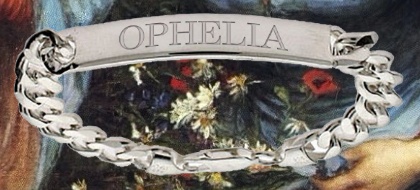
You might think of “Silver Bracelet” as an imagining of the romance between Hamlet and Ophelia. If you look (not that) hard, Hamlet does not appear to be a very good boyfriend. “I did love you once,” he says, but in the next breath: “I never loved thee.” Then: “Get thee to a nunnery.” Also: “Thou shalt not escape calumny.” (Calumny just sounds bad, doesn’t it? It means slander.)

Apologies for the song’s somber-sounding final line (“I’ll wear this silver bracelet when I’m dead”), but Ophelia drowns in the end, after all. When she attempts to hang floral wreaths on a willow growing over a brook, the branch she is grasping (or standing on) breaks, and she falls into the water. As she sinks, she chants “snatches of old tunes,” perhaps one like this, about her rotten (in the state of Denmark) boyfriend.

Speaking of Shakespeare, in the last line of the third verse, I lifted the phrase “winged Cupid” from A Midsummer Night’s Dream. A modern-day song probably shouldn’t require footnotes, but I want to explain another reference in that line. It is said, perhaps in classical mythology or perhaps by a random individual with a fertile imagination and Internet access, that Cupid has two arrows: a barbed, gold-tipped one to make people fall in love, and a blunted, silver-tipped one to make people fall out of love. This information will serve you as you listen to “Silver Bracelet” but probably never again.

I was attracted to the idea of writing a song about a silver bracelet for the perverse reason that nothing rhymes with silver. Or with bracelet, for that matter, but that didn’t stop me from providing off rhymes for it. (An off rhyme, or near rhyme, is a rhyme in which the words sound the same but do not rhyme perfectly. Example: “bracelet”/“chase it.”) Because I couldn’t rhyme anything with silver, I decided to repeat the word until it lost all meaning. In fact, it appears in every line of every verse, in the same position (beats 6 and 7), as well as in the chorus. (Let’s just say you won’t be wondering what this song is about!)

A sound effect appears in the recording of “Silver Bracelet,” and I am honor-bound to credit the source. Thank you, Zapsplat.com.

Silver Bracelet

Profile

Title:
“Silver Bracelet”

Number:
8

Length:
3:06

Vibe/inspiration:
Dolly Parton

Key:
C major

What I imagine people might say:

  • “What’s with all the references to Shakespeare? Is it 1622?”
  • “This is her eighth song? Maybe she should have stopped at seven.”
  • “Cupid makes people fall in love, not out. Dumb.”
  • “Good Lord! If I never hear the word silver again, it will be too soon.”
  • “I have a silver bracelet, and this song has ruined it.”

NEW! What people have actually said, now that people have actually heard it:

  • “Very clever, fun.”
  • “Cool!”
  • “I love it!”
  • “Never been a fan of breakup songs, but this is a good one.”
  • “I loved it! I definitely heard the Dolly influence and think she would love it.”
  • “I played it in the car and it’s so catchy, I found myself happily singing along.”
  • “I LOVE THIS! (And there’s no such thing as too many Shakespeare references, IMHO.)”
  • “Bravo!! Brilliant all around.”
  • “This could be a Dolly Parton song for sure! I’m always so impressed by your clever lyrics!”
  • “I love the double-dubbing of your voice. Very effective. And I love the song.”
  • “OMG, OMG. Dolly, Shakespeare, fun, tristesse, all at once. More, more!” [I had to look up tristesse, and it’s the perfect word; it means “a state of melancholy sadness.”]
  • “Another great song!“
  • “You have a good country sound to your voice!”
  • “Got a lil Dolly happening here!”

Lyrics:

I used to think this silver bracelet meant that you were mine
The day you placed that silver chain on me I felt so fine
We kissed beneath a silver moon, away from all the crowd
I missed that every silver lining has to have a cloud

Silver bracelet
Why’d I chase it
Right into your hands?
Silver bracelet—
Try to face it—
Won’t become two bands
This silver bracelet won’t become two bands

I guess I thought this silver bracelet meant you’d be around
You’ve got me on a silver platter, but you can’t be found
I sit and fret each silver letter etching out my name
Unstrung by when your silver tongue is whispering the same (Ophelia)

Silver bracelet
Why’d I chase it
Right into your arms?
Silver bracelet—
Count the ways it
Hooks me with your charms
This silver bracelet hooks me with your charms

[Instrumental verse]

Silver bracelet
Why’d I chase it
Right into your hands?
Silver bracelet—
Try to face it—
Won’t become two bands
This silver bracelet won’t become two bands

And now I know this silver bracelet means that I am yours
You’ve thrown away the silver key that opens up the doors
Alone behind your silver bars, I call to one above:
Winged Cupid, with your silver arrow, fall me out of love! 

Silver bracelet
Why’d I chase it
Right into your bed?
Silver bracelet—
Can’t erase it—
Wear it ’til I’m dead
This silver bracelet, wear it ’til I’m dead (oh-oh)
I’ll wear this silver bracelet when I’m dead