
Category Archives: Music

Christmas in July

I don’t have a new song to share (just a snippet), but I thought I would report on some compositions that have a chance of being recorded on my living room couch sometime soon.

I get ideas for songs all the time. Most of them offer a moment of amusement as they float in and out of my mind. The ones that stick get a working title and a file on my computer. A few of these continue to claim my attention as I go about trying to be a productive citizen. Typically, there’s an initial burst of inspiration, resulting in some rough lyrics—followed by the hard work (and pure joy) of fleshing out the “story,” hammering out the meter and rhyme scheme, and puzzling out the words. Sometimes, a tune that naturally undergirded the lyrics as they formed becomes the final melody. Otherwise, I listen. And wait.

Here are some song ideas that have stuck, in various stages of being realized. (All titles are working titles.)


“The Factory”

Current form:
Partial recording

Inspirations:
An abandoned brick factory in the Hudson River Valley, the song “Sixteen Tons,” the Romantic poet Lord Byron, the musical Hadestown

Sample lyric:
Your mama was a leopard, get a look at those spots

Musings:
Intrigued by a photo of the ruins of an old brick factory, I began writing the lyrics for “The Factory” in New Orleans last November—to the melody of “Sixteen Tons.” Merle Travis’s 1947 folk classic about a coal miner evoked a vibe that felt apropos for a song about a brick factory. My lyrics were largely intact within three weeks. Then came the excruciating task of extracting the iconic “Sixteen Tons” melody and replacing it with my far, far, far lesser one. I am in the midst of recording “The Factory,” but you can listen to the preliminary bridge here.

Preliminary Bridge for “The Factory”


“Ma Belle”

Current form:
Preliminary lyrics

Inspirations:
The sights and sounds of Paris

Sample lyric:
When you were learning how to spell
Did you ride this carousel?

Musings:
I penned the lyrics for “Ma Belle” (French for “my beautiful”) about six weeks ago, in Paris and on the flight home. So far, every line either repeats or rhymes with belle. The song contains a complete sentence in French, and I don’t speak French at all, so I’m preparing myself for total humiliation. (I might have done better with a song inspired by Madrid. Or London.) “Ma Belle” is presently sans mélodie.


“The Christmas After This”

Current form:
Partial lyrics

Inspirations:
Christmas, the play Love’s Labour’s Lost

Sample lyric:
Next Christmas
We’ll reminisce this

Musings:
About two weeks ago, I started writing a Christmas song! I have hardly kept my fondness for Christmas music a secret from this blog. (See Christmix Tape and Please Have Snow and Mistletoe.) I am thrilled by the idea of contributing to this timeless canon, even if only a few people will ever hear “The Christmas After This”—which is based on a monologue from one of Shakespeare’s early comedies. The best part is that I have almost half a year to finish it!


Isaiah’s Bucket List

Current form:
A few notes jotted down

Inspiration:
An Uber driver in Dallas

Musings:
Isaiah gave me a ride from a hotel in downtown Dallas to DFW. He told me that before retiring, he had driven a bus for thirty years—winning a trip to Jamaica as bus driver of the year (twice). Isaiah wants to visit three places before his time on earth is up: Alaska (because he’s amazed that people can live where it’s so cold), New York City (because you can get a pizza there at three in the morning), and Hawaii (because the air smells like flowers). Isaiah has a wife and two grown children. He thinks the big houses on the highway are too close together. His voice is like molasses.

Finally, a few songs that are just working titles at this point:

“The Day We Never Met”

“Turn Your Back”

“R Kid”

Stay tuned!
A Familiar Ring

I wrote my latest song (listen below!) while vacationing in France last month. I worked out the lyrics for the chorus during a drive through the French countryside, between Champagne and Paris; the melody for the chorus came to me that evening, while wandering the Musée d’Orsay. (I realize the construction of that sentence makes it sound like the melody was wandering the Musée d’Orsay. Actually, that’s pretty much how it happened. “Funny running into you! I was looking for a melody.”)

The verses for “Do You Know Me? (Getting By)” came together the following day, after a visit to the Picasso Museum. (To be clear, it was I, not the verses, who visited the Picasso Museum and later had a cucumber martini.) Below, you can read the famed artist’s imagined comments regarding the song he partially inspired. Spoiler alert: they’re scathing!

What should I tell you about this song? I would like to think the opening idea, of being unfamiliar with one’s own face, was entirely original. But I believe it was informed, at least subconsciously, by the lyrics of three of my favorite musicians, in songs I have listened to many dozens of times:

Freedy Johnston, “Radio for Heartache”
He was so alone
He wouldn’t have recognized his face

Neil Finn, “Try Whistling This”
If I can’t be with you, I would rather have a different face

Elvis Costello, “Stranger in the House”
There’s a stranger in the house
Nobody’s seen his face
But everybody says he’s taken my place
There’s a stranger in the house
No one will ever see
But everybody says he looks like me

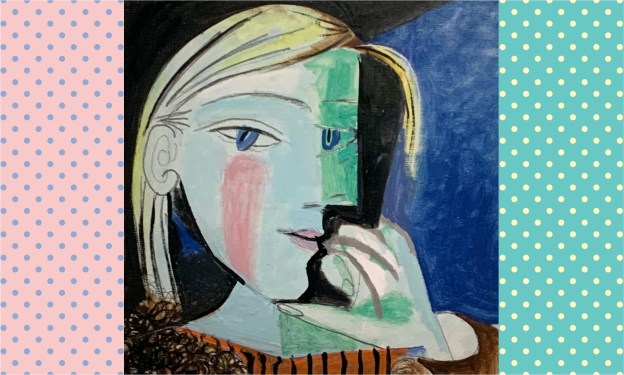
Perhaps these lines have stuck with me because they are so startlingly surreal, like Picasso’s surrealist portraits. The face is so intimately connected to identity that if you were not to recognize your own, or to feel detached or dissociated from it, that could be cause for an existential crisis, indeed! In a dream, have you ever looked in a mirror and seen someone else looking back? For me, that discovery is typically accompanied by a scream. Or imagine the unease of sitting for Picasso, only to discover, upon viewing the finished work, that your eyes are arranged diagonally, your nose is in your hair, and your lips are blue!

You would probably not be surprised to learn that the second line of the song’s third verse (“The salad days weren’t meant to last”) contains a reference to Shakespeare. In Act I, Scene 5, of Antony and Cleopatra, the Egyptian queen refers to her “salad days,” when she was “green in judgment.” The phrase has come to mean a time of youthful inexperience, or the peak or heyday of something.

CREDITS: The featured image for this post is Pablo Picasso, Portrait of Marie-Thérèse Walter (1937, polka dots mine), photo taken by me at the Picasso Museum in Paris. Neil Finn wrote “Try Whistling This” with Australian musician Jim Moginie. “Do You Know Me? (Getting By)” contains two sound effects, from Zapsplat.com.

Do You Know Me? (Getting By)

Profile

Title:
“Do You Know Me? (Getting By)”

Number:
9

Length:
2:24

Vibe/inspiration:
Freedy Johnston, Neil Finn, Elvis Costello, Pablo Picasso

Key:
G major

What I imagine Picasso might have said:

  • Surreal is a polite word for these lyrics.”
  • “This is not pop art. See what I did there?”
  • “I apologize for being a muse on this one.”
  • “This song has sent me right back to my Blue Period.”

Lyrics:

Woke up—I didn’t know my face
I left it in another place
I disappeared without a trace
But I’ve been getting by

Went out—I didn’t know my name
I couldn’t play or sing the same
I’ll never climb the heights of fame
But I’ve been getting by (bye, bye)

Do you know me? (Do you know me?)
Do you recognize a thing?
Do my words have a familiar ring? (oh-oh)
Do you know?

Got back—I didn’t know my past
The salad days weren’t meant to last
And yet the end came on so fast
But I’m still getting by (bye, bye) (bye, bye)

Do you know me? (Do you know me?)
Do you recognize a thing?
Do my words have a familiar ring? (oh-oh)

Do you know me? (Do you know me?)
Do you recognize a thing?
Do these words have a familiar ring? (oh-oh) (oh-oh)
Do you know?

Woke up—I didn’t know my face
I left it in another place
I kept it in a crystal vase
But I’ve been getting by (bye, bye) (bye, bye) (bye, bye)

Fall Me Out of Love

Today is Mother’s Day, and I hope my mother will like my latest song (listen below!). No one has heard this ditty yet, but I have anticipated the feedback (conjectured below), and it isn’t great.

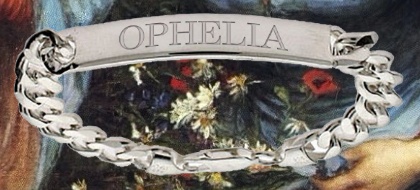
You might think of “Silver Bracelet” as an imagining of the romance between Hamlet and Ophelia. If you look (not that) hard, Hamlet does not appear to be a very good boyfriend. “I did love you once,” he says, but in the next breath: “I never loved thee.” Then: “Get thee to a nunnery.” Also: “Thou shalt not escape calumny.” (Calumny just sounds bad, doesn’t it? It means slander.)

Apologies for the song’s somber-sounding final line (“I’ll wear this silver bracelet when I’m dead”), but Ophelia drowns in the end, after all. When she attempts to hang floral wreaths on a willow growing over a brook, the branch she is grasping (or standing on) breaks, and she falls into the water. As she sinks, she chants “snatches of old tunes,” perhaps one like this, about her rotten (in the state of Denmark) boyfriend.

Speaking of Shakespeare, in the last line of the third verse, I lifted the phrase “winged Cupid” from A Midsummer Night’s Dream. A modern-day song probably shouldn’t require footnotes, but I want to explain another reference in that line. It is said, perhaps in classical mythology or perhaps by a random individual with a fertile imagination and Internet access, that Cupid has two arrows: a barbed, gold-tipped one to make people fall in love, and a blunted, silver-tipped one to make people fall out of love. This information will serve you as you listen to “Silver Bracelet” but probably never again.

I was attracted to the idea of writing a song about a silver bracelet for the perverse reason that nothing rhymes with silver. Or with bracelet, for that matter, but that didn’t stop me from providing off rhymes for it. (An off rhyme, or near rhyme, is a rhyme in which the words sound the same but do not rhyme perfectly. Example: “bracelet”/“chase it.”) Because I couldn’t rhyme anything with silver, I decided to repeat the word until it lost all meaning. In fact, it appears in every line of every verse, in the same position (beats 6 and 7), as well as in the chorus. (Let’s just say you won’t be wondering what this song is about!)

A sound effect appears in the recording of “Silver Bracelet,” and I am honor-bound to credit the source. Thank you, Zapsplat.com.

Silver Bracelet

Profile

Title:
“Silver Bracelet”

Number:
8

Length:
3:06

Vibe/inspiration:
Dolly Parton

Key:
C major

What I imagine people might say:

  • “What’s with all the references to Shakespeare? Is it 1622?”
  • “This is her eighth song? Maybe she should have stopped at seven.”
  • “Cupid makes people fall in love, not out. Dumb.”
  • “Good Lord! If I never hear the word silver again, it will be too soon.”
  • “I have a silver bracelet, and this song has ruined it.”

NEW! What people have actually said, now that people have actually heard it:

  • “Very clever, fun.”
  • “Cool!”
  • “I love it!”
  • “Never been a fan of breakup songs, but this is a good one.”
  • “I loved it! I definitely heard the Dolly influence and think she would love it.”
  • “I played it in the car and it’s so catchy, I found myself happily singing along.”
  • “I LOVE THIS! (And there’s no such thing as too many Shakespeare references, IMHO.)”
  • “Bravo!! Brilliant all around.”
  • “This could be a Dolly Parton song for sure! I’m always so impressed by your clever lyrics!”
  • “I love the double-dubbing of your voice. Very effective. And I love the song.”
  • “OMG, OMG. Dolly, Shakespeare, fun, tristesse, all at once. More, more!” [I had to look up tristesse, and it’s the perfect word; it means “a state of melancholy sadness.”]
  • “Another great song!“
  • “You have a good country sound to your voice!”
  • “Got a lil Dolly happening here!”

Lyrics:

I used to think this silver bracelet meant that you were mine
The day you placed that silver chain on me I felt so fine
We kissed beneath a silver moon, away from all the crowd
I missed that every silver lining has to have a cloud

Silver bracelet
Why’d I chase it
Right into your hands?
Silver bracelet—
Try to face it—
Won’t become two bands
This silver bracelet won’t become two bands

I guess I thought this silver bracelet meant you’d be around
You’ve got me on a silver platter, but you can’t be found
I sit and fret each silver letter etching out my name
Unstrung by when your silver tongue is whispering the same (Ophelia)

Silver bracelet
Why’d I chase it
Right into your arms?
Silver bracelet—
Count the ways it
Hooks me with your charms
This silver bracelet hooks me with your charms

[Instrumental verse]

Silver bracelet
Why’d I chase it
Right into your hands?
Silver bracelet—
Try to face it—
Won’t become two bands
This silver bracelet won’t become two bands

And now I know this silver bracelet means that I am yours
You’ve thrown away the silver key that opens up the doors
Alone behind your silver bars, I call to one above:
Winged Cupid, with your silver arrow, fall me out of love! 

Silver bracelet
Why’d I chase it
Right into your bed?
Silver bracelet—
Can’t erase it—
Wear it ’til I’m dead
This silver bracelet, wear it ’til I’m dead (oh-oh)
I’ll wear this silver bracelet when I’m dead

Gone When You Wore Baby Shoes

Last June, I took an online songwriting course, and it changed my life forever! Just kidding—but didn’t that sound dramatic? Well, maybe it did change my life a little. Before the class, I had two songs floating around in my head. After the class, I had recordings of one of those songs, and two others, floating around on my computer. And I haven’t looked back! Again, just kidding.

One song to come out of that course was “Your Old Acoustic” (which you can listen to now! link below!). It was the final project, intended as a collaboration with somebody I knew. Following my inspiration rather than the letter of the assignment, I did an imaginary collaboration—with Michael Nesmith, undoubtedly the tallest member of the Monkees, perhaps aided by his wool cap. I was influenced by the country vibe of many of his tunes, particularly “Listen to the Band.”

Nesmith’s passing last December prompted me to refine the recording. Over the past week, I have redone the vocals and added acoustic guitar throughout. (Yep, that’s yours truly, plucking away on my Little Martin, pushing the bounds of my rudimentary skills.) Unfortunately, I wrote the song to suit Nesmith’s vocal range, not mine; but I have done my best. The comments from listeners, below, are based on the original version. (If you have any feedback, and I find it sufficiently flattering, I will add it to the list!)

Your Old Acoustic

Profile

Title:
“Your Old Acoustic”

Number:
4

Length:
3:34

Vibe/inspiration:
Michael Nesmith

Key:
F major

What people are saying (SPOILERS):

  • “I LOVE this vibe! This is a song I would love to sing myself. I’m sure I’m going to have it in my head over the next days!”
  • “Love it! It made me cry! So beautiful.”
  • “Very nice! I did not cry, but…it was still pretty.” [updated version]
  • “Loved it! I especially like the end where you make it seem like it’s a recording in front of an audience. Very clever! I have ‘my son’ running through my head.”
  • “Fun song! I like the ‘live’ touches at the end.”
  • “Your collection of hits amazes me. Well done!” [updated version]

Lyrics:

You came the night all eyes were watching me—
A pretty boy footloose and fancy-free
Toes a-tapping to my song
Rows a-clapping right along
But you could find me only on TV

And I walk
But I cannot go
And I talk
Just so you will know

Dust off your old acoustic
And join the band
Bust out and make some music
With your old man
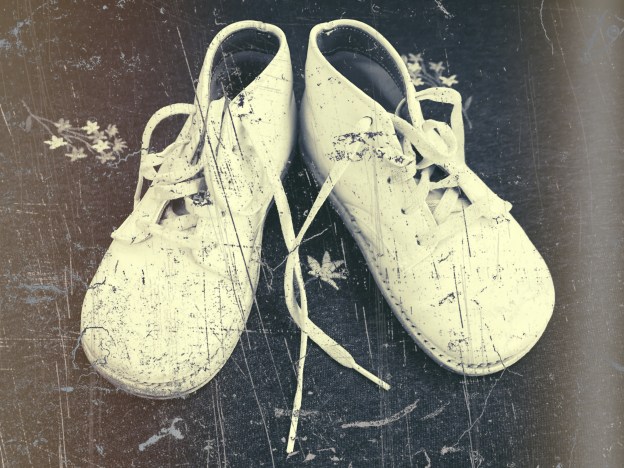
Gone when you wore baby shoes
And now I only play the blues
Dust off your old acoustic
And join the band

A middle name was all you got from me
A pittance of a rich man’s legacy (legacy)
Thought I’d look you up one day
But I took too long to say
And you inherited a mystery

And I bring (yes, I bring)
All my loving, dear
And I sing (yes, I sing)
Just so you will hear

Dust off your old acoustic
And join the band (my son)
Bust out and make some music
With your old man (my son)
Didn’t try on daddy’s suits
I never saw you fill your boots
Dust off your old acoustic
And join the band

[Instrumental verse]

And I walk (yes, I walk)
But I cannot go
And I talk (yes, I talk)
Just so you will know

Dust off your old acoustic
And join the band (my son) (come on)
Bust out and make some music
With your old man (my son) (all right)
Gone when you wore baby shoes
And now I only play the blues
Dust off your old acoustic
And join the band

Dust off your old acoustic
And join the band (my son)
Dust off your old acoustic
And join the band (my son)
Dust off your old acoustic
And join the band (my son)
Dust off your old acoustic
And join the band

You’ve been lovely
Thank you

Business as Usual

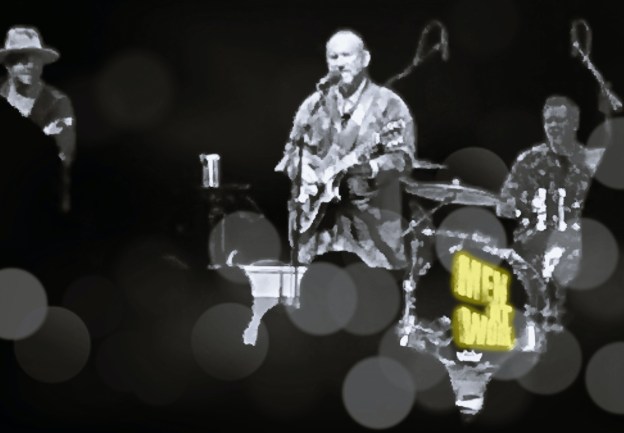
Last night, I saw Men at Work. No, this isn’t a journal entry from 1983. Yesterday evening, I attended my first concert since the pandemic began, right here in Santa Barbara, at the Lobero Theatre. (To clarify, the Lobero Theatre is where the concert took place, not where the pandemic began.) Tapping my toe to a group I enjoyed as a teenager was a festive way to spend the eve before Christmas Eve. Not all the musicians onstage were from the original, Melbourne-born band. In fact, only one: lead singer Colin Hay. Not all the musicians were even men! In fact, the “woman at work,” who played saxophone, flute, and keyboard, may have stolen the show.

Over the years, I have been fortunate to see a handful of my favorite musical artists, including Freedy Johnston, Marshall Crenshaw, and Michael Nesmith, at that selfsame theater. Perhaps the most unique act I witnessed there, however, was a one-man Hamlet, in which balloons were used to represent the various characters. (They were popped with a long pin when they died.)

Speaking of Michael Nesmith, the famous country-rocker died two weeks ago today, on December 10, 2021. Mike had been my favorite member of the Monkees, along with Davy, Micky, and Peter. Since his passing, I have been working on improvements to a song I wrote and recorded with him in mind. I am planning to add acoustic guitar (which I am currently practicing) and to redo the vocals (which no amount of practicing will help). I hope to be done by the first anniversary of Nez’s death, if not nine or ten months sooner.

A few days ago, I also completed the lyrics and melody for a new song. But when it comes to translating what’s in my head into a production that can be shared, I feel quite daunted. Last night, as Men at Work filled the Lobero with glorious sound, I tried to distill out each musician’s contribution. I listened for the plunk of the bass, for the higher-pitched tones of the lead guitar. What was each accomplishing? How did the drummer know when to add those flourishes that make the heart flutter? Why was the timing of that rousing sax solo so effective?

Sadly, I think I learned very little. There was just too much going on at once. All I know is that I want to spend the rest of my days writing piano solos for three hands.

Stay tuned for new and improved tunes in ’22!

No Diamond in the Rough

“Cherry Pony Car” (listen below) has been bouncing around in my head for months, and I was finally able to finish it today! I granted an exclusive interview about the song—to myself. Warning: it got a bit contentious. Here are some excerpts:

On recording the vocals…
Q: What’s it like to record vocals when you can’t sing very well?
A: Wow. You don’t pull any punches.
Q: Well, I’ve heard everything you’ve ever recorded.
A: The worst part is listening back to the vocals on their own. It’s like looking at yourself in a dressing-room mirror.
Q: “Does this chorus make my butt look big?”
A: Exactly.
Q: Do you ever think about having your songs performed by an actual singer?
A: All the time.

On early feedback…
Q: What’s the early feedback on this one?
A: There isn’t any. I’m the only person who has ever heard it.
Q: I’ve heard it, too. Ad nauseam.
A: Of course. The dogs were also in the room when I recorded it. Sometimes on my lap.
Q: What did they think?
A: They would tune out after the first line of the first verse.
Q: Why is that?
A: That’s where they’re mentioned.
Q: So, the first person to click “play” in this post will be the first person to hear “Cherry Pony Car,” aside from its creator. Is that fair to say?
A: It’s fairer than most of the things you say.

On the title…
Q: So, what is a “pony car”?
A: I’m not entirely clear on that myself. It’s a classification of American car. I kind of love the inherent contradiction. Is it a small horse? Is it a motor vehicle? It’s like an oxymoron.
Q: Yes, moron. That makes sense. Does “cherry” mean the car is red?
A: Possibly. But “cherry” could also refer to the condition—like the car is in perfect shape.
Q: Is this a literal car? Or is it a metaphor for something else?
A: That’s up to the listener.
Q: Is that a copout?
A: Yes.

On the piano solo…
Q: Let’s talk about that piano solo in the middle of the track.
A: Sure. What would you like to know?
Q: You know.
A: Excuse me?
Q: The thing.
A: What thing?
Q: The thing you wanted people to know!
A: I just like seeing you squirm. I inadvertently wrote the piano solo for three hands. In other words, it could never be performed in real life, at least not by a single pianist. I thought I could remedy the situation by adding another piano. The first piano sounds like a grand piano being played on stage. The second is an old-timey, saloon-sounding piano.
Q: Did adding the second piano solve the problem of needing three hands to perform the solo?
A: No, it only compounded it. Now I’m short two hands instead of one.

On Adele…
Q: Are you concerned about “dropping” new music when the British superstar Adele is due to release her fourth album in a matter of weeks?
A: Not at all.
Q: Can you be so cavalier?
A: It’s easy to be cavalier when your blog has only a few dozen followers.

Cherry Pony Car

Profile

Title:
“Cherry Pony Car”

Number:
6

Length:
3:12

Vibe/inspiration:
Nancy Sinatra, Johnny Cash

Key:
D minor

What dogs are saying:

  • “We loved our cameo in the first line of the first verse. We don’t know what happens after that.” —Sophie and Grace

Lyrics:

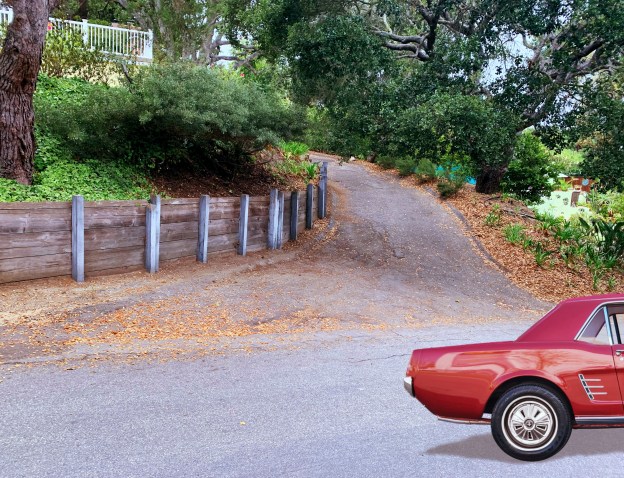
Cherry pony car
Arrived in sixty-five
Cherry pony car
Just going for a drive

I let the dogs out in the yard
One peaceful Sunday morn
I heard your V-8 breathing hard
As sure as I was born
You might as well have laid in on that horn

Cherry pony car
I swore you off before
Cherry pony car
Low rumble by my door

I pictured sitting in that coupe
Hands held across the seat
We’d listen to our favorite group
Heads bouncing to the beat
I dared to dream that life could be so sweet

Cherry pony car
Stop hiding your good side
Cherry pony car
Don’t take me for a ride

[Piano solo]

Cherry pony car
Arrived in sixty-five
Cherry pony car
Just going for a drive

You treat me cool and run me down
As if I’m not enough
I’ve been your fool, I’ve played the clown
It’s time to call your bluff
Cuz, babe, I ain’t no diamond in the rough

Cherry pony car
Too late to catch your plate
Cherry pony car
Keep rolling ’til you reach that Golden Gate

Keep rolling ’til you reach that Golden Gate

Still Pretty as a Flower

You might wonder how I went from talking about writing a novel to actually writing and recording songs. I suppose it all began on November 12, 2019, when I paid $20 for a classical guitar in a marketplace in Mexico City. I felt very cool bringing my guitarrita home on the plane, slung over my shoulder in its soft case. I later determined the instrument was more diminutive than a half-size version of a standard guitar—essentially making it a toy.

I had purchased a small-body, steel-string acoustic a year earlier, taken three or four lessons, and quit. My hands were just too tiny. Or my pinkies too petite. Or my arms too long. But the nylon strings of my souvenir from south of the border were forgiving. The scale length was short. The frets were narrower, increasing my reach. I was on my way.

Cut to two months ago, when I enrolled in an online class for writing and producing songs: three of them, in thirty days. Today I am sharing my second submission, which was the second song I had ever written and the second I had ever produced. “Your Sister Rose and You” is a retro-sounding ditty about reincarnation, with a chorus referencing Shakespeare. (I know, so cliché.) The “reviews” below came from my peers in the class.

Your Sister Rose and You

Profile

Title:
“Your Sister Rose and You”

Number:
2

Length:
3:24

Vibe/inspiration:
The Monkees

Key:
B-flat major

What people are saying:

  • “I really like the way you’ve made such an interesting recording. Has kind of vaudeville roots to it.”
  • “Dig it! Brass always gets me.”
  • “So clever! Well done. It’s really a pleasure to listen to this.”
  • “Your lyrics are great. I can see why you’re a writer! I love the vocal treatment. Very interesting. Fun to hear. And original as a whole approach.”
  • “Very cool vibe. Reminds me of songs from the end of the 20th century—that’s a compliment, as I love that genre!”

Lyrics:

I ran into your sister Rose
Still pretty as a flower
I’m well, and you? and so it goes
We spoke for half an hour

I told her I was wondering
If she remembered anything
Ah-ah-ah

She locked you in her memory
(Feeding penguins at the zoo)
And you yourself would keep the key
(Pointing at a caribou)
It’s such a lovely place to be
Your sister Rose and you, ooh, too

I mentioned you were up the coast
And not too hard to find
She looked as if she’d seen a ghost
She almost lost her mind

I told her I was wondering
If she remembered anything
Ah-ah-ah

She locked you in her memory
(Flying kites into the blue)
And you yourself would keep the key
(Playing Battleship and Clue)
It’s such a lovely place to be
Your sister Rose and you, ooh, too

We never lose the ones we love, and here’s the reason why:
They keep on coming round until there is no more goodbye

[Instrumental interlude]

He’s changed a lot since he’s been dead—
You’d take him for another
I’d know him in my heart, she said
I love him—he’s my brother

I told her I was wondering
If she remembered anything
Ah-ah-ah

She locked you in her memory
(On a train to Waterloo)
And you yourself would keep the key
(To the north of Katmandu)
It’s such a lovely place to be
Your sister Rose and you, ooh

Your sister Rose and you, ooh, too

I See Us in the End, Dear

It’s alive! My blog is back, and it’s bigger and better than ever! Or smaller and worse; that’s the other possibility. In this reboot of the little-known blog that spawned a lesser-known book, I will be sharing songs I have written! Gone are the dreary musings on metaphors, semicolons, and New Yorker cartoons. Banished are the pretentious quotes from Shakespeare. (Oh, who are we kidding? I pilfer most of my lyrics from the Bard.) I never expected to be making music at this point in my life—and by golly, you’re going to hear about it!

For this first post of Novel-Gazing 2.0, I thought I would start slowly and dive right in. Directly below this paragraph, if my calculations are correct, you will find a link to a recording of the fifth song I have ever written. “See Us in the End” (for that is its name) is my attempt at an early 1960s album filler. Directly below the link, you will find a brief profile of the song. Spoiler alert: the profile includes some (completely unbiased) early reviews. Enough said. Enjoy! Or not. No pressure.

See Us in the End

Profile

Title:
“See Us in the End”

Number:
5

Length:
2:35

Vibe/inspiration:
The Supremes

Key:
E-flat major

What people are saying:

  • “Love it! It’s the perfect song for the summer.”
  • “Big smile! Very catchy hook.”
  • “Fun! I bopped around in my chair.”
  • “Such a happy song. It will cheer up my day! LOVE, Mommy”
  • “Super cute!”
  • “Superlative pop ear candy!”

Lyrics:

And if I kiss you
I can’t miss you
I’m holding you the whole night through
But when you question
My intention
It makes me want to say to you
(About us two)

I see us in the end, dear
(See us in the end)
I see us in the end, dear
(See us in the end, ooh)
Our love will never end, dear

And as I wander
I grow fonder
I’m thrilled by everything you do
But when you query
Will we marry?
It makes me want to say to you
(About us two)

I see us in the end, dear
(See us in the end)
I see us in the end, dear
(See us in the end, ooh)
Our love will never end, dear

I will pray to have the end near
If you say this is the end here
I see us in the end, dear

And when I waken
Not forsaken
I have no cause for feeling blue
You want to know now
Where we go now
It makes me want to say to you
(About us two)

I see us in the end, dear
(See us in the end)
I see us in the end, dear
(See us in the end, ooh)
Our love will never end, dear

Oh, I’m not cavalier
No, I’m not insincere
I see us in the end, dear

Oh, we won’t disappear
No, we will persevere
I see us in the end, dear

The road ahead is clear

Who Was Lady Mondegreen?

Lady Mondegreen

Have you ever been shocked to discover that the words of a song you’ve heard countless times were not the actual lyrics—or even close? Would you also be shocked to know there is a term for this kind of error? A mondegreen is a word or phrase that results from mishearing or misinterpreting something auditory, such as a song. The listener substitutes words that sound similar to the misheard content and that seem sufficiently plausible in context.

A famous mondegreen is “Excuse me while I kiss this guy” (instead of “Excuse me while I kiss the sky,” a line from Jimi Hendrix’s song “Purple Haze”). Another oft-cited musical mondegreen is “There’s a bathroom on the right” (rather than “There’s a bad moon on the rise,” Creedence Clearwater Revival). Examples of mondegreens in everyday language include “for all intensive purposes” (“for all intents and purposes”), “deep-seeded” (“deep-seated”), and “one in the same” (“one and the same”). I am always surprised to find that someone thinks the name of the HBO series about Carrie Bradshaw and her friends is Sex in the City (not Sex and the City).

The word mondegreen is itself a mondegreen. American writer Sylvia Wright coined the term in Harper’s Magazine in November 1954. When Wright was a child, her mother would read to her from an eighteenth-century collection of ballads and popular songs. One of Wright’s favorite poems, “The Bonny Earl o’ Moray,” began as follows:

Ye Highlands and ye Lowlands,
Oh, where hae ye been?
They hae slain the Earl o’ Moray,
And Lady Mondegreen.

Wright envisaged Lady Mondegreen as a woman with dark curls and a green dress, her throat pierced by an arrow; she lay at the earl’s side, holding his hand. However, the real fourth line of the verse was not “And Lady Mondegreen” but “And laid him on the green.” In other words, there was no Lady Mondegreen! Wright memorialized her tragic yet nonexistent heroine in the name of the phenomenon she exemplified.

I believe I have proof that a musician succumbed to a mondegreen—in his own song! Duran Duran released the album Seven and the Ragged Tiger in November 1983. Here is the chorus of the second track, “New Moon on Monday” (scanned from the inner sleeve):

New Moon chorus
The first few times I heard the song, I mistook “firedance through the night” for “five days through the night”—words that romantically evoked a night so long and full of adventure that it was equivalent to five days. (This line has stumped others, as well.) I caught my mistake, however, while studying the actual lyrics. When the video for “New Moon on Monday” premiered, I was astonished to see that John Taylor, the group’s bassist, seemed to have the same misunderstanding! Near the end of the video, while enthusiastically lip-syncing “And a firedance through the night,” he twice held up his hand as if indicating the number five—as in “five days through the night”!

five days

“Five days through the night”?

It seems inconceivable that a guitarist would hear his own song incorrectly, so perhaps I misperceived the gesture and substituted my own interpretation—you know, a new moon.

Please Have Snow and Mistletoe

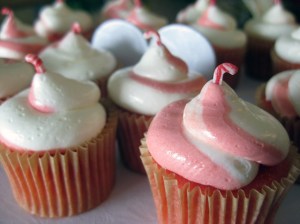
Let me start by saying that I observe December 25 with Chinese food and a movie. But that doesn’t mean I am immune to the Christmas spirit. In fact, I seem to be quite susceptible to it lately. One reason may be that I bake cupcakes, and the cupcake community promotes seasonal offerings. For "Candy cane" cupcakesexample, I made mini “candy cane” cupcakes this year. Another way I have succumbed to the most wonderful time of the year is by really noticing, for the first time, its omnipresent music.

Although I know the season’s songs are often as maligned as its fruitcake, I find myself getting pulled into the idyllic scenes they draw. For example, I want to take a sleigh ride together with you and then rock around the Christmas tree, have the corn you’ve brought for poppin’, and conspire as we dream by the fire. Our troubles will be miles away! (Although I have a terrible feeling that Frosty the Snowman will not be back again someday. The sun was hot that day . . .)

I am on the outside of Christmas, and maybe that’s the best distance from which to enjoy its soundtrack. I have read enough Dear Prudence to know that the actual celebration of the holiday is frequently far from perfect. In fact, according to the National Institutes of Health, the incidence of depression is greatest at Christmastime. I can’t help but wonder if these sentimental ballads foster expectations for festivity straight out of a Norman Rockwell painting, which can never be met—resulting in inevitable disappointment.

On the other hand, perhaps they are simply love songs, wooing the perfect Christmas—which remains sweetly out of reach. And I feel swept up in the romance. In that vein, the holidays represent ideals—such as brotherhood, home, peace, love, and joy—to which we aspire. I think I respond emotionally to the depiction of these themes. I can’t hear (Bing Crosby’s rendition of) “I’ll Be Home for Christmas,” written from the point of view of an overseas soldier during World War II, without getting a tear in my eye. Its melancholy twist (“If only in my dreams”) highlights our separation from cherished ideals.

Or maybe I just have Christmas envy. Fa la la la la, la la la la.