Read Me a Story

I have scant memories of being read to as a child. I recall that my sister and I once persuaded our father to read to us, possibly from Walt Disney’s Classic Storybook. The volume was thick and hardbound, with a sampling of characters depicted on its red cover (I think). In the fifth grade, Miss Brown read to us from Watership Down (all I remember is that it was about rabbits) as we worked on latch hook rugs (I believe mine showed a farm scene). Teachers couldn’t get away with this activity today, because there is nothing about latch hook rugs on standardized tests.

Audio BookPerhaps it makes sense, then, that I came to audio books late—specifically, last month. But I’m on a roll. I have already consumed two 500-plus-page novels as well as two books under 200 pages. And I’m several chapters into the next one. I listen while I walk the dogs, wash dishes, fold laundry, vacuum, blow-dry my hair, etc. I wonder if people “curl up” with a good audio book as they do with a printed one, or if multitasking is always involved.

I have been blown away by the talent of some of the narrators, especially how they are able to voice different characters, both male and female. Sometimes they must speak multiple languages or do accents. The audio book for Cloud Atlas featured six narrators alone, so I got a good sampling. In some cases, the readers are screen actors. For instance, Jeremy Irons recorded The Alchemist.

There are some technological pitfalls of listening to audio books, however. My iPod shuffle presented the two files for the novel Life After Life in reverse order—so I heard the second part first. “Wow!” I thought. “This author really throws you in there, introducing so many characters at once. But I’m game!” Ironically, the subject matter of the book (a woman continually reliving her life but making different choices each time) rendered the unintentional reorganization plausible.

I have a feeling my husband will rue the day he encouraged me to use some of his Audible credits . . .

Back to Square One

HopscotchIn a recent session, my writing coach, Ziva, blew my mind. When I stopped resisting her suggestion (after about 30 seconds), my mind was blown. So I am back to square one with my novel—sort of.

Some sources put a negative spin on the idiom: “If you are back to square one, you have to start working on a plan from the beginning because your previous attempt failed and the progress you made is now wasted.” Ouch. I prefer this kinder interpretation: “returned to the beginning.” It sounds almost poetic. As a side note, Square One was also a restaurant in Santa Barbara; it’s closed now, so no one can go back to it.

Actually, I don’t think we really can go back to square one, because we have learned what doesn’t work. For example, it is said that Thomas Edison made thousands of unsuccessful attempts to invent the electric light bulb. In the midst of these trials, a young reporter asked him if he felt like a failure and should just give up. Edison replied, “Young man, why would I feel like a failure? And why would I ever give up? I now know definitively over 9,000 ways that an electric light bulb will not work. Success is almost in my grasp.”

Indeed, returning to the beginning has exhilarated and energized me. Perhaps starting over appeals to the Aries in me—good at launching projects, not so good at finishing them. As I conceive of my novel anew, ideas from the first beginning start to find their proper places. I envision cozy compartments, in an expansive structure, for all the things I want to say. If everything goes as planned, this work could very well be my “magnificent octopus.”

Or maybe my incandescent new approach is just platinum wire on the road to a carbon filament.

Take Every Moment for Granted

Dante

I didn’t know it was the last time…

You would slurp noisily from the water bowl

You would crunch a stick in half

You would stumble into the bathroom to eat toilet paper

I would scoop your kibble out of the bin

I would take you on a walk around the backyard

I would give you your aspirin half an hour after lunch

Your little brother would snuggle up next to you

You would take a wrong turn trying to find the kitchen, while the others waited anxiously for the meal to be served

You would sniff the air

I would help you down the ramp

I would lead you to the fluffy bed in the living room

I would say, “Good dog!”

I would pick you up after you had fallen

If I had known, I would have paid attention to every detail, so I could always recall the moment with perfect clarity.

But if I had known, I wouldn’t have enjoyed the moment, because it would have been touched with a sense of loss.

Warning: This Personality Tool May Blow Your Mind

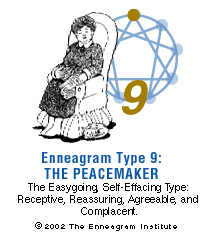
enneagramIn previous posts, I discussed unconventional approaches to character development, including Chinese face reading and numerology. Well, I’ve got another one for you: the enneagram. This system, which goes back at least as far as classical Greek philosophy, outlines nine basic personality types and their complex interrelationships. The name comes from the Greek words ennea (nine) and gramma (something written or drawn).

Very briefly, here are the enneagram’s nine personality types, with a few key descriptors for each:

  • One, “The Reformer”: rational, idealistic
  • Two, “The Helper”: caring, interpersonal
  • Three, “The Achiever”: success-oriented, pragmatic
  • Four, “The Individualist”: sensitive, withdrawn
  • Five, “The Investigator”: intense, cerebral
  • Six, “The Loyalist”: committed, security-oriented
  • Seven, “The Enthusiast”: busy, fun-loving
  • Eight, “The Challenger”: powerful, dominating
  • Nine, “The Peacemaker”: easygoing, self-effacing

I first heard about the enneagram on a radio show, though I couldn’t pinpoint my type. I took an online assessment, read the type descriptions, and determined that I was the poster child ninefor the Nine personality (“The Peacemaker”). I receive daily “EnneaThoughts”; these inspirational e-mails offer guidance for manifesting my strengths and overcoming my weaknesses. Here are some samples:

  • One of the greatest sources of strength for Nines is their profound patience: a deep “letting be” of other people that allows others to develop their own way. How can you express this rare quality today?
  • What would it be like to let go of your complacency and embrace your higher qualities of excitement and creativity today?
  • Remember that Nines can try not to stand out too much—putting themselves in the background so as not to upset themselves or others. Watch for this tendency today.

Now if you’ll excuse me, I’m going to slip into the background, settle into my routine, and squelch my creativity (at least until the next EnneaThought hits my inbox).

Carrie Bradshaw by the Numbers

Sarah Jessica Parker

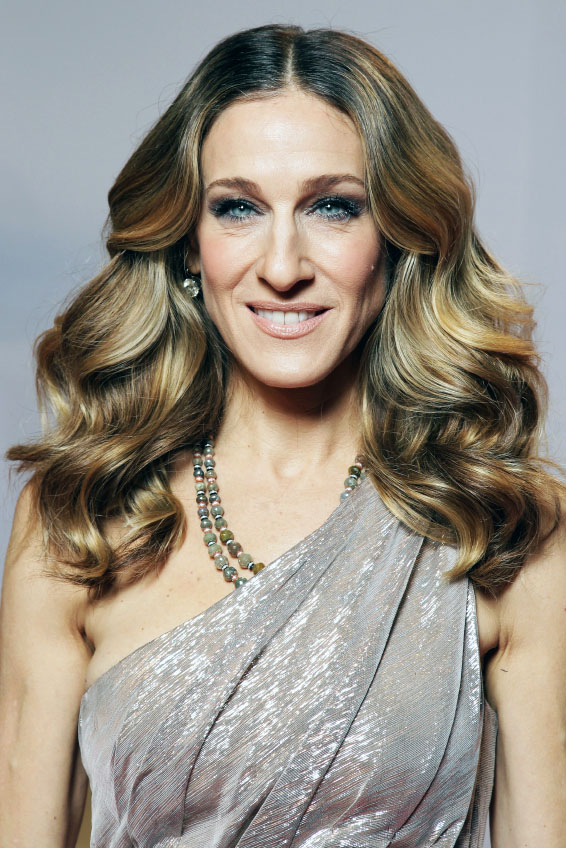
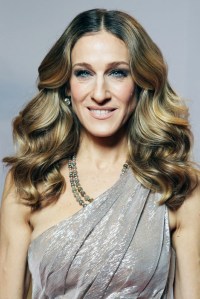
Sarah Jessica Parker, who plays Carrie Bradshaw on Sex and the City

According to numerologist Glynis McCants (and Greek mathematician Pythagoras), numbers possess a vibrational energy that forms the foundation of the universe. In numerology, the numbers associated with a person’s name and birthdate reveal his or her strengths, weaknesses, goals, and gifts. As I mentioned in an earlier post, I have considered using numerology as an aid in character development. So I was curious whether the qualities of successful fictional characters did, in fact, reflect their “numbers.”

I chose to examine Carrie Bradshaw, from HBO’s Sex and the City. Bravo ranked her eleventh on their list of the 100 greatest TV characters, and she came in second among TV Guide’s 25 greatest TV characters of all time. So I think it can safely be argued that she is an effective character. I located her birthdate on an infographic of fictional characters’ birthdays. Based on this date and her name, I calculated her basic numerology blueprint, below. (For an explanation of how the computations are made, please check out Glynis Has Your Number.)

Carrie Bradshaw, born 6/15/1966

Life path: 7

Birth day: 6

Attitude: 3

Soul: 8

Personality: 5

Power name: 4

So what do all these numbers mean?

Your life path number indicates the course your life must take in order for you to be satisfied. The 7 vibration is a truth-seeker, always asking, “Who am I?” In life and in her column, Carrie constantly tries to get to the truth about people. For example:

Later that day, I got to thinking about fairy tales. What if Prince Charming had never shown up? Would Snow White have lain in that glass box forever? I couldn’t help but wonder: inside every confident, driven, single woman, is there a delicate, fragile princess just waiting to be saved? Was Charlotte right? Do women just want to be rescued?

A recent article has compiled everything Carrie ever wondered about, season by season.

Your birth day number signifies how others see you. Someone born on a 6 day, like Carrie, “craves love, friends, and companionship.” Carrie’s character and the entire show are centered around this idea; the four protagonists remain inseparable. As Big observes, “You three know her better than anyone; you’re the loves of her life. And a guy’s just lucky to come in fourth.”

Your attitude number reflects your basic outlook on life. Carrie, as a 3 vibration, “values communication and creative energy”; her job as a writer is a perfect reflection of this aspect. A person with a 3 attitude “tends to be the joker. They have a sense of humor.” Indeed, Carrie uses self-deprecating humor to confront the issues in her life.

Your soul number represents what you feel inside. The 8 soul, like Carrie’s, is happy when it has “financial freedom, job security, and a nice home.” Accordingly, Carrie is very connected to her job and her apartment. She also lives on the dark side of the number 8, as shown in her lack of financial freedom: dismayed that she can’t afford to buy her apartment because of her excessive acquisition of expensive footwear, she laments that she will “literally be the old woman who lived in her shoes.”

Your personality number denotes what you show the world. The 5 personality “has an air of fun and energy” and “wants to know where the party is.” Indeed, Carrie has made appearances at countless parties—the Fleet Week party, the purse party, the party where someone steals her shoes, the all-couples party, and the black and white ball, to name a tiny fraction. The 5 personality is also known for having an addictive streak; Carrie is an on-again, off-again smoker who may have a dangerous shopping habit.

Your power name number represents the strength of your name. Carrie’s 4 vibration signifies “The Teacher.” And she really has made her name in the world by educating and enlightening others through her column and books. The people she meets often refer to her as their relationship guru.

Carrie Bradshaw seems to embody her numerology quite convincingly. Yet I can’t help but wonder: could I have made the numerology of any fictional character work? Am I just that good at twisting information for my own purposes?

Famous Last Words

Death Bed

The average person speaks millions of words in a lifetime, most of them mundane, but some, hopefully, profound. I don’t know about anyone else, but I think I’d like to go out on a high note. If I were on my deathbed and happened to say something pithy, wise, or clever, I might just shut up after that. Through the years, the last words uttered by famous people have been recorded and collected. Maybe we hope that those on the verge of death acquire an expanded vision of life, and we can learn from their final observations. Here is a sampling:

  • John Quincy Adams: “This is the last of earth! I am content.”
  • Bing Crosby: “That was a great game of golf, fellas.”
  • Louis XIV: “Why are you weeping? Did you imagine that I was immortal?”
  • Karl Marx: “Go on, get out. Last words are for fools who haven’t said enough.”
  • Sir Walter Raleigh: “I have a long journey to take, and must bid the company farewell.”
  • Salvador Dalí: “I do not believe in my death.”
  • Michael Jackson: “I love you more.”
  • Nostradamus: “Tomorrow, I shall no longer be here.”
  • P. T. Barnum: “How were the receipts today at Madison Square Garden?”
  • Emily Dickinson: “I must go in; the fog is rising.”
  • Dominique Bouhours (French grammarian): “I am about to—or I am going to—die: either expression is correct.”
  • Steve Jobs: “Oh wow. Oh wow. Oh wow.”

About two weeks before my father died, it was arranged that a hospice worker would be with him 24 hours a day. When Walter arrived, he checked the paperwork, which indicated that Dad was unconscious. Still, Walter approached him in the manner he would any patient: “Hello, Mr. Greenfield. My name is Walter. How are you today?” “I feel fine!” came the startling reply. Those were the last words anyone reported hearing my father speak. I may be biased, but I think they hold up to the ones attributed to famous people.

In fact, Mom is considering putting them on his gravestone.

Why Do I Love Bad Romantic Comedies?

Romantic ComedyModern classics like Annie Hall (rated 8.2 on IMDB) and When Harry Met Sally… (7.6) lend legitimacy to my favorite movie genre, romantic comedy. (I wonder if A Midsummer Night’s Dream and The Taming of the Shrew did the same for rom-coms in the 1590s.) There is no shame, I think, in being entertained by a solid, respectable romantic comedy, such as Forgetting Sarah Marshall (7.3) or Crazy, Stupid, Love. (7.5). But then there are the not-so-good lovey-dovey-funny films, the ones that give romedies a bad name. They’re predictable and limply humorous, with hackneyed characters and contrived plots. The thing is, I love these pieces of crap. But why?

I thought I might be able to find the answer by identifying what really draws me to view certain poorly rated romantic comedies over and over. I caution you against seeing any of these 10 films. Yet they have brought me many hours of pleasure. Please don’t waste your time on them. But I kind of love them.

Romantic Comedy IMDB Rating The Appeal
Along Came Polly 5.8 Great character names (Reuben Feffer, Polly Prince); best performance by a ferret; Hank Azaria as Claude, the scuba instructor.
Bride Wars 5.1 Some good lines (“If I were your wedding, I’d  sleep with one eye open,” “Miss Wang is a stern mistress,” “You’re like this very tall, very hot Smurf,” “The International Butter Club?”).
Fools Rush In 5.8 Love overcomes culture clash; the poor man’s My Big Fat Greek Wedding (6.5).
Ghosts of Girlfriends Past 5.7 Michael Douglas as a smarmy womanizer, Matthew McConaughey as his smarmy protégé.
Joe Versus the Volcano 5.5 I flatly reject the IMDB rating. This movie is offbeat awesomeness.
Sex and the City 5.2 I was such a fan of the show that I am compelled to embrace its “snuggly” offspring.
Someone Like You 5.9 Very likable and/or sexy stars: Ashley Judd, Greg Kinnear, Hugh Jackman.
Something Borrowed 5.7 The smart girl gets the hot guy.
The Wedding Planner 4.9 I’m a sucker for Jennifer Lopez (and apparently for smarmy Matthew McConaughey; see Ghosts of Girlfriends Past). The supporting characters are charming.
What’s Your Number? 5.8 The funny, creative girl gets the hot guy. Also, the protagonists are always eating (wedding cake, pizza, Chinese food, sandwiches, snacks).

So have I learned anything from this exercise? Not really. Perhaps the allure of the rom-com is that its ending is guaranteed to be happy—or at worst bittersweet. Maybe that’s why romantic comedies, even bad ones, are so satisfying.

Everything comes out perfect.

Heavily Metallic

The twinge of guilt lasted as long as it took the Kindle edition to download to my tablet. “Yet another book I will never find time to read,” I thought.  But I was pleased that the knowledge I desired was now safely in my library, if not yet in my brain. Besides, it was an important resource for my novel.

I had heard Jean Haner speak several times about her expertise in Chinese face reading, an ancient branch of Chinese medicine. Based on an issue of her excellent newsletter, I knew that my facial features indicated the personality type of Metal—the Perfectionist. The other four types are Water (the Dreamer), Wood (the Pioneer), Fire (the Fun-Lover), and Earth (the Nurturer).

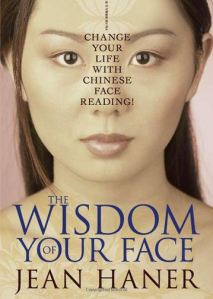
The Wisdom of Your FaceHaner’s The Wisdom of Your Face remained unread for about a day. I went straight to the Metal chapter and was amazed to discover that I possessed all eight of the defining qualities presented for that element. Haner says, “If you have all of these characteristics, which is rare, you’ll know that you’re a very Metallic person!” These features included

  • Large nose
  • Prominent upper cheeks
  • Fine bone structure, small wrists and ankles
  • Pale complexion for racial heritage

If you don’t know how accurate these descriptors are, check out my photo on the About page.

Sample observations of Metal that resonated for me:

  • “Your precision and care also create success in professions such as surgeon, software designer, accountant, editor, and artist.” (I am an editor.)
  • “The worst thing someone can do to you is to offer some ‘constructive criticism.’ You’re already so tough on yourself that knowing someone else noticed when you did something wrong can be too much to bear.” (Excruciatingly true.)
  • “Metal is more affected by visual clutter than any other Element, but this doesn’t mean that you’re a total neat freak. Open any drawer or closet, and you may find a chaos of confusion.” (It’s like she has a camera in my house!)

The book goes into depth about the meanings of various facial features. For example, the major indicator of Metal on the face is the nose, which represents the capacity for power. Furthermore, the larger your nose, the more you’ll feel driven to achieve in your 40s—and the more powerful a decade it will be!

What a great spin on having a big schnoz.

Conservation of Creative Energy

Light Bulb in the Sky

Last week, I calculated that I had written almost 6,500 words of my blog—on top of the 5,000 words I logged on my novel. At first, these statistics gave me a sense of accomplishment. I had met the goal I stated in my first blog post, on October 2, 2012: to put together at least a few paragraphs devoted to my novel on a regular basis, in order to convince it to “take a chance on me.”

Looking at the numbers, however, I couldn’t help but wonder if I should be devoting more time to my novel and less time to my blog. A session with my coach last week confirmed that I was channeling too much of my writing energy into the blog. Furthermore, my coach, Ziva, sensed that putting attention on myself via the blog was “distracting my energy.”

The objective of the session had been to figure out how I could regain my motivation on my novel. I hadn’t written anything new since November 30. In fact, I had lost 50 words to editing! Ziva advised that I could build momentum by “protecting and concealing the process”—which I think would preclude yacking about it on the World Wide Web.

Ziva provided me with profound insights into how to bring the first draft into form. I will take notes throughout this process and possibly report on it later. In the meantime, I’m not sure if I will continue to maintain this blog (but not talk explicitly about my novel), post less often (again, not about my novel!), or take a break.

Maya Angelou has remarked, “There is no greater agony than bearing an untold story inside you.” Right now, that sounds like the smartest thing anyone has ever said.

My Predictions for 2013

Frost Cupcakes According to statistics on New Year’s resolutions, 8 percent of people are “successful in achieving their resolution.” This figure seems dishearteningly low. Yet people who explicitly make resolutions are 10 times more likely to attain their goals than people who don’t. In other words, non-resolution-makers achieve their not-formally-expressed objectives only four-fifths of 1 percent of the time! This statistic would seem to support the time-honored tradition of making New Year’s resolutions.

Unfortunately, at least to me, a resolution connotes a dispiriting sense of responsibility, requiring a firmness of purpose to which I’d rather not have to commit. Therefore, in the spirit of self-fulfilling prophesy, I have decided to make predictions this year instead of resolutions. A prediction has an element of fate to it, as if it is inevitable and somehow supported by the universe. An individual might play a role in its occurrence, but there is the suggestion of co-participation with an invisible agent.

So here are my predictions, inspired by a combination of intuition and wishful thinking. In 2013, I will . . .

  1. Make good progress on the first draft of my novel.
  2. Schedule more sessions with my coach.
  3. Set up a writing studio.
  4. Really push myself to increase my belly-dance workout from 15 minutes to 20 minutes a day.
  5. Stop saving leftover frosting for snacking.
  6. Have a nice dinner with my husband in New York City.
  7. Resume drinking pumpkin spice lattes around October 1.

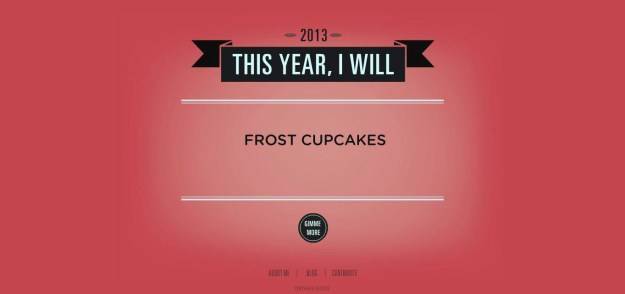
If you are looking for ideas for your own resolutions (or predictions), you might want to check out this generator I came across. One of the first suggestions it gave me was, “I will frost cupcakes”—so I think it might actually know something!