The Elusive En Dash

stadion

For several weeks, I have been wanting to dash off a post on this topic. So, what is an en dash?

a. a punctuation mark similar to a hyphen but the length of a lowercase n

b. a sprinting event in the ancient Olympic Games that was run from one end of the stadium to the other

c. a small quantity of a substance thrown into or mixed with something else, equivalent to approximately one thirty-second of a teaspoon

The Greek race was the “stadion,” and one thirty-second of a teaspoon is a “smidgen,” so an en dash must be that punctuation thing. (Sorry to dash your hopes that this post might have been about athletics or cooking.) I’m convinced that outside the worlds of publishing and printing, people have never heard of the en dash (highlighting a glaring gap in the Schoolhouse Rock library). And even then, it’s iffy: I have encountered professional editors who overlook en dashes.

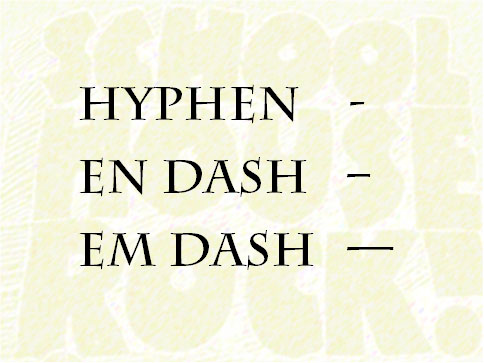
At this point, I’m sure you’re dying to know exactly what the en dash does, but for context, I first want to distinguish it from its more crowd-pleasing cousins, the hyphen and the em dash. The hyphen has various functions, such as in compound adjectives (“dog-eat-dog world”), as a separator (“867-5309”), and for end-of-line word breaks. You may not know the em dash by name, but it’s the long, elegant line (technically, the length of an uppercase M) that sets off a parenthetical thought—such as this one.

The bible (a.k.a. The Chicago Manual of Style) says the following about hyphens, en dashes, and em dashes: “Though many readers may not notice the difference—especially dashesbetween an en dash and a hyphen—correct use of the different types is a sign of editorial precision and care.” I interpret this to mean that the proper utilization of these punctuation marks is essential to the maintenance of a civilized society.
The en dash is used to connect numbers and words, implying up to and including, through, or to. Here are some examples:

  • The years 1929–1939 were difficult ones for economies throughout the world.
  • For homework, read chapters 1–3 of The Great Gatsby.
  • The recipe for gluten-free brownies appears on pages 9–12.
  • Join us on Monday, 5:00–6:30 p.m., for a champagne reception.
  • The Paris–Vienna train leaves at ten o’clock.
  • St. Louis defeated San Francisco, 42–6.
  • The chess club voted 17–5 to make Wendy its president.

En dashes are also used with compound adjectives (adjectives consisting of more than one word) in which at least one element is an open compound (a compound word with spaces in it, such as ice cream). For instance:

  • the post–Cold War years
  • a romantic comedy–influenced script
  • the New York–New Jersey border
  • a Frank Gehry–designed museum
  • a White House–backed proposal

In these cases, the en dash is meant to indicate a more comprehensive link than a hyphen would. Think of it this way: if you replaced the en dash with a hyphen in any of these examples, only the words closest to the hyphen would appear to be part of the adjective. For instance, if a hyphen was substituted for the en dash in the second example, the meaning would change to a romantic, comedy-influenced script. Regarding this usage of the en dash, Chicago states, “This editorial nicety may go unnoticed by the majority of readers.” But I think it’s important to be nice.

Since you surely want to start using the en dash right away, it’s available now in the Symbol dialog box of your version of Word or Outlook. If nothing else, remember that en is an acceptable two-letter word when you get down to those last few letters in Words With Friends.

Thanks for reading. Gotta dash!

Life Is But a Dream

HouseA few weeks ago, I saw photos of the house where I spent my formative years. The residence had been expanded, gut-renovated, and impeccably appointed. Among the things I clearly recognized were the nook in the kitchen, where my family had shared a decade of meals, and the tree out back, which had often been the focal point of our imaginative play. But the tree, instead of being surrounded by untamed plants and uneven rocks, was now paved in with bricks and encircled by manicured shrubs.

Just a few days ago, after I had already started writing this post, my best friend from when I lived in that house texted me from the property! She described it as “totally different, but so familiar.” I could identify with her statement, based on the photos I saw—and on my own regular visits. You see, although I haven’t set foot in the house in over 30 years, I dream about it every few weeks. My unconscious mind returns there to weave new stories. And while the action is different from what actually happened in my childhood, the setting remains deeply familiar.

Action and setting are just two of the classic story elements present in our nocturnal adventures; others include character, plot, and mood. In this sense, we are all master storytellers! Last week, my husband relayed a vivid dream that could easily become a short story (or an episode of The Twilight Zone): Aliens abducted him and a group of people, imprisoning them as livestock to be eaten. As the captives realized there was a hero among them who could engineer their escape, our real-life dog insisted on her breakfast, and the dream ended. I wish I knew how the story ended! (Dogs must be amazing storytellers, too, given how they twitch, whimper, growl, snort, and yip in their sleep.)

The scenarios in dreams feel very real to us at the time. Only after we awaken do we have the perspective to say, “I had the weirdest dream!” Then we seek more stories, both fiction (movies, novels, television dramas) and nonfiction (news stories, friends’ stories, stories we tell ourselves and others about our own experiences). We invest ourselves in these stories as we do in our dreams, and then pull ourselves out in order to carry on with our day.

When you think about it, our lives are essentially stories in progress, bookended by birth and death. We wonder, “What’s next?” (in the plot) and “How will all this end?” (on the last page). Being unable to answer these questions with certainty makes us anxious, and perhaps we find comfort in the worlds of stories that have defined beginnings, middles, and ends. Some belief systems maintain that life itself is a dream, which would suggest that we author our lives just as we author our dreams. Maybe, eventually, we will awaken to the real reality and have no more dreams and seek no more stories.

Whether life is reality, a story, or a dream, we may as well row our boats gently (and merrily) down its stream.

What I Have Learned from Cupcakes

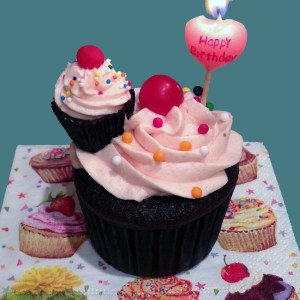
Birthday Cupcake

“Mini me” cupcake

Pumpkin Pie Cupcakes

Pumpkin pie cupcakes

If someone who knows me were to play word association with my name, he or she might come up with editor, blonde, or short, but not before cupcakes. My obsession with cupcakes started five or six years ago. I blame artist Wayne Thiebaud, whose thickly painted pastries really captured my imagination. (I even wrote a short story about his piece Pies, Pies, Pies.) Though not a cook or even a baker, I follow recipes, hope for the best, and post photos of the results.

Unicorn Poop Cupcake

Unicorn poop cupcake

Today is my birthday, so it seems an appropriate occasion to reflect on my relationship with these classically celebratory confections. Here are some lessons that cupcakes have taught me about life and dessert:

  1. Sometimes, the icing on the cake is literally the icing on the cake.
  2. Making a mess is much more fun than cleaning it up.
  3. Our creations inevitably fall short of our imaginations.
  4. Even if you visualize something over and over, it will never happen exactly that way.
  5. Having an obsession makes it easy for people to buy you gifts you’ll love (“Oh my God! Cupcake dish towels!”).
  6. Measure twice, bake once.
  7. Always keep chocolate in the house.
  8. Think on your feet (and wear comfortable shoes).
  9. Push yourself beyond what you know you can do.
  10. There’s no shame in having an entire drawer of sprinkles (or an entire cupboard, room, or wing of the house of whatever you treasure or collect).
Graduation Cupcake

Graduation cupcake

Ultimately, for me, cupcakes are about spreading joy. As I say on my neglected Twitter page, I love baking cupcakes for family, friends, friends of friends, friends of family, and anyone who will make yummy sounds while eating them.

And I always bake a few extras for myself.

“Aardvark Bowling” and Other Poems

aardvark bowling

While on a plane this week, I perused a year-old issue of Writer’s Digest. (I’m a little behind on my reading.) An article about a type of poem called the glosa, which originated in Spain in the 15th century, caught my attention. The author had made his own attempt at the form, which reminded me of how much I used to like writing poetry—imaginatively articulating thoughts and emotions through rhythm and heightened language, seeking and (hopefully) finding the words that most perfectly expressed my subject’s essence.

Aardvark Bowling

“Aardvark Bowling”

Scrabble

“Scrabble”

When I arrived home, I pulled out a black three-ring binder containing materials from a class I took over a dozen years ago, called “Writing from the Collective Unconscious.” I vaguely remembered composing most of the pieces (for example, “Scrabble”) per a number of inspiring assignments. For instance, in an exercise on surrealism, we were instructed to write the letters A to Z on a piece of paper and then record the first word that came to mind for each. We were then asked to choose two consecutive words from the list to serve as the title of a poem. (See “Aardvark Bowling.”)

At my instructor’s invitation, I read the following poem, “Luxor,” at a community arts event. I began writing it in the food court of the Las Vegas hotel of the same name.

Luxor

As an English major, I “explicated” (interpreted and explained) countless poems. It occurred to me years later that analyzing a poem was like dissecting a frog—examining the parts in order to understand the whole. In a high school classroom, a frog is dead when it is taken apart; I wondered if the life left a poem when it was analyzed. To be on the safe side, I decided not to cut up any more poems.

Now I just enjoy their music and experience their meaning.

Authors Should Need a License to Write Metaphors

And I mean that literally, not figuratively. The author of a manuscript I edited recently loved metaphors, but she used them poorly. Her implied resemblances between unrelated things tended to be convoluted and to confuse more than clarify. Moreover, they were trite (life is a tapestry) and often mixed (life is a race and a puzzle, at the same time). I rewrote the metaphors that could be salvaged and deleted the ones that had no hope of making a positive contribution to the text.

I got to thinking that maybe only writers as masterful as Shakespeare should be allowed to use figurative language.

But, soft! What light through yonder window breaks?

It is the east, and Juliet is the sun.

See? Nice.

But maybe I was being too restrictive. Metaphors, similes, and analogies can elicit a deeper understanding of a concept when they are original, apt, and clear. They can also convey meaning quickly, vividly, and memorably, whether in writing or in speech. For example, my husband uses a number of effective analogies—relating to Mrs. Fields cookies, ordering in a restaurant, and getting highlights at the salon—in business negotiations.

So if you really want to compare your beloved to a summer’s day, I won’t stop you. You might consider the following steps for creating your very own fancy talk:

  1. Select the concept you want to illustrate through a metaphor, simile, or analogy. Example: life.
  2. Identify the point you’d like to make about the concept. Example: Life is full of surprises, and you never know what will happen next.
  3. Think of an unrelated idea that has the same qualities as your concept and the point Box of Chocolatesyou are trying to make. Example: In a box of assorted chocolates, the candies look similar on the outside, but inside there might be nougat, ganache, caramel, lemon, cherry, raspberry, key lime, coconut, mocha, mint, pineapple, marshmallow, marzipan, fudge, almond crunch…sorry, where was I? Until you bite into one of the chocolates, you won’t know what’s inside.
  4. Formulate and refine your simple and stunning figure of speech. Example: Life is like a box of chocolates; you never know what you’re going to get.

A bad metaphor can obscure even the most obvious idea. But a good metaphor, according to poet Pablo Neruda, can reveal the mysteries of the world.

Christmix Tape

This year, thanks to Spotify, my fondness for Christmas music has escalated to something of an addiction. I was born Jewish but raised less observant than probably any other Jewish person I have ever met, with the possible exception of my sister. Still, why Christmas music, Mix tapewhen I could be listening to alternative hits of the 80s? I think I enjoy the ultimate content of the songs—peace, joy, love, celebration, and togetherness. Besides, many of the classic Christmas songs were written by Jews, so maybe my affection isn’t that odd.

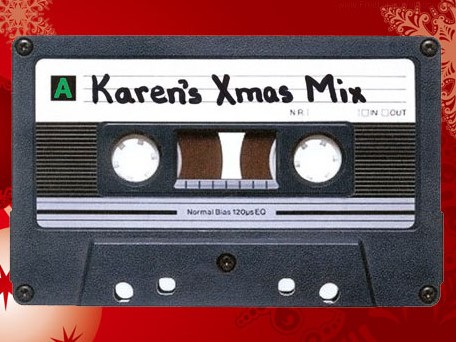
I have listened to so much Christmas music since the day after Thanksgiving that I can now tell the difference between the voices of Perry Como, Dean Martin, and Frank Sinatra. Some artists, like Bing Crosby, Johnny Mathis, Nat King Cole, and Elvis Presley, are naturals at belting out Christmas tunes. Often, as I listened, I would find myself thinking, “You know, I have heard 20 or 30 versions of this song, but this one is really special.” The marriage of performer and material was just right. Such recordings were no longer Christmas songs but good songs, even great songs. For example, the only natural response to Josh Groban’s live performance of “O Holy Night” is “Oh, holy s#*t!” It’s that phenomenal. I began to formulate a fantasy “mix tape” (sorry, young’uns, if you don’t get the reference) of standout renditions:

Side A

  • Michael Bublé, “Santa Claus Is Coming to Town”
  • Sammy Davis, Jr., “Jingle Bells”
  • Dean Martin and Martina McBride, “Baby, It’s Cold Outside”
  • She & Him, “The Christmas Waltz”
  • Brenda Lee, “Rockin’ Around the Christmas Tree”
  • Amy Grant, “It’s the Most Wonderful Time of the Year”

Side B

  • Kelly Clarkson, “Blue Christmas”
  • Lady Antebellum, “A Holly Jolly Christmas”
  • Mary J. Blige, “My Favorite Things”
  • The Drifters, “White Christmas”
  • Harry Connick Jr., “Let It Snow, Let It Snow, Let It Snow”
  • Josh Groban, “O Holy Night”

These festive songs, thoroughly vetted by a discerning Jew, are worth seeking out. Happy Holidays!

A Thanksgiving Roast

Have you ever seen a roast on Comedy Central? The “roasted” individual typically sits in a throne-like chair on a raised platform, as comedians take turns making fun of him (and of Turkey on a throneeach other) in front of a live audience. The guest of honor then has the opportunity to rebut the merciless put-downs that have been hurled at him throughout the event.

In honor of Thanksgiving, I thought it might be fun to put the holiday itself on the dais. Over the years, comedians have certainly viewed Turkey Day as fair game, and the Internet is a veritable cornucopia of their insults. So, if you will, please imagine a plump turkey (possibly wearing a Pilgrim hat and holding an “Eat Chicken” sign) on a stage, gobbling graciously as it is lambasted.

  • Johnny Carson: “Thanksgiving is an emotional holiday. People travel thousands of miles to be with people they only see once a year. And then discover once a year is way too often.”
  • David Letterman: “Thanksgiving is the day when you turn to another family member and say, ‘How long has Mom been drinking like this?’ My mom, after six Bloody Marys, looks at the turkey and goes, ‘Here, kitty, kitty.’”
  • Jay Leno: “Thanksgiving: when the Indians said, ‘Well, this has been fun, but we know you have a long voyage back to England.’”
  • Jon Stewart: “I celebrated Thanksgiving in an old-fashioned way. I invited everyone in my neighborhood to my house, we had an enormous feast, and then I killed them and took their land.”
  • Dylan Brody: “You know that just before that first Thanksgiving dinner there was one wise, old Native American woman saying, ‘Don’t feed them. If you feed them, they’ll never leave.’”
  • Roseanne Barr: “Here I am 5 o’clock in the morning stuffing breadcrumbs up a dead bird’s butt.”
  • Kevin James: “Thanksgiving, man. Not a good day to be my pants.”

Unlike the ordinary “roastee,” a holiday cannot defend itself. Yet many eloquent individuals have, in effect, told the aforementioned comics to shut their pie holes:

  • H. U. Westermayer: “The Pilgrims made seven times more graves than huts.  No Americans have been more impoverished than these who, nevertheless, set aside a day of thanksgiving.”
  • Robert C. Linter: “Thanksgiving was never meant to be shut up in a single day.”
  • Edward Sandford Martin: “Thanksgiving Day comes, by statute, once a year; to the honest man it comes as frequently as the heart of gratitude will allow.”
  • Wilbur D. Nesbit: “Forever on Thanksgiving Day / The heart will find the pathway home.”

Stick a fork in me, I’m done.

Why Do We Watch Scary Movies?

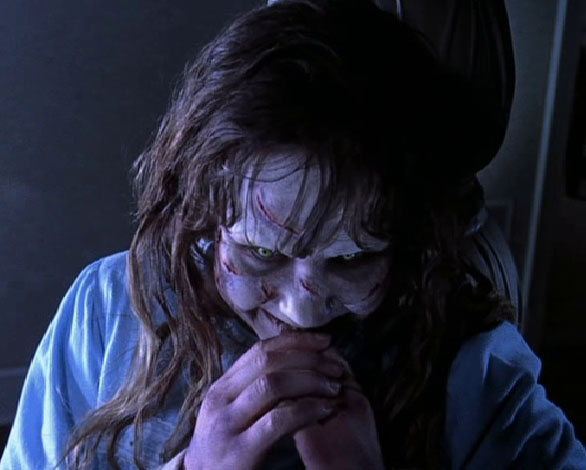
The Exorcist

I am not a big fan of horror movies. The Exorcist, which turned 40 this year, scared the Andersen’s pea soup (the actual brand used in that iconic projectile-vomiting scene) out of me when I was a little girl. Each time I approached my room, I was sure I would find Linda Blair on my bed, head spinning around. Ironically, when I do watch a scary movie, I tend to go for one about exorcism. Of all the horror ghouls, zombies frighten me the most; even the comedy Shaun of the Dead was too much for me. (Okay, even Michael Jackson’s “Thriller” video gave me chills.) And I will not watch a home-invasion movie, especially if the bad guys are in masks. One relatively recent film I found deliciously chilling was The Fourth Kind, about alien abduction. I wish I had the courage to see it again (although most viewers would prefer to have their 98 minutes back).

Many filmgoers regularly put themselves in the position to be shocked by the gore, violence, and supernatural activity characteristic of the horror genre. (Of course, some don’t, and they are less likely to sleep with a night light.) Here are some of the more popular theories as to why horror movies appeal to us:

  1. They demystify the unknown.
  2. They distract us from our everyday concerns.
  3. They give us the opportunity to prove that we can master something threatening.
  4. They have fantastic visual effects.
  5. They induce catharsis.
  6. They allow us to face our greatest fear, the knowledge that we are all doomed.
  7. They provide an adrenaline rush in a safe environment.
  8. They satisfy our desire to feel intense emotions.
  9. They show us things we don’t see in our daily lives.
  10. They take us on a psychological ride.

I am intrigued by two additional theories, which are based on diametrically opposed views of our normal mental state (sane or crazy):

  • Horror movies reaffirm that we are healthy and well-adjusted.
  • We are all mentally ill, and horror movies appease our insanity, keeping it in check.

I tend to favor the second explanation, especially considering its source: horror master Stephen King. I figure he should know.

Hashtags: An Index to the Human Experience #LoftyTitle

Twitter HashtagI recently completed a 10-day liver detox (trumpets and fanfare). It consisted of swallowing Chinese herbs three times a day and excluding all the best foods from my diet: coffee, wine, chocolate, heavy cream, steak, etc. I challenged myself to tweet each day about the cleanse’s deprivations—which were apparently so severe that one night I dreamt about cheesecake. It was Marisa Tomei’s cheesecake, but we don’t have time to analyze that now.

Here is a sampling of my detox-related tweets:

  • I want cookie dough. #DetoxDay2
  • Subsisting on rice cakes and peppermint tea. #DetoxDay6
  • Looks like I picked the wrong week to stop eating most of the major food groups. #DetoxDay7

As you can see, I appended a hashtag consisting of “DetoxDay” and a number representing the day to each post. I was surprised to find that numerous other people had tweeted using the same tag:

Detox Day 5

Detox Day 7

Detox Day 8

Reading these posts made the world seem just a little bit smaller. (Impressively, the entries continue through day 28; that’s a long time to go without cheesecake.) I started doing Twitter hashtag searches on all sorts of things pertinent to my life: #ButtercreamFrosting, #WritersBlock, #CrazyDogs. It was fun getting different perspectives on inane subjects relevant to my existence.

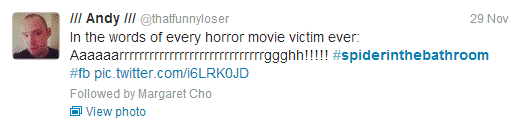
I will leave you with a few takes on a daily occurrence in my house, #SpiderInTheBathroom:

Spider 1

Spider 2

Spider 3

So what are you waiting for? Try it! Warning: You will probably want to make spelling corrections to the search results.

I Am Not Silently Correcting Your Grammar

The word editor has been in my job title for over 20 years. People seem to think I am always editing, even in my spare time. But when the clock is off, I remove my editor’s hat. It looks like this:

Copy Editor Hat

(Not really, but I might order it.) Aside from authors who pay me, the only people whose grammar I might summon the energy to correct are TV newscasters.

It’s another story, however, when I have that proverbial red pen in my hand. It looks like this:

Track Changes

Indeed, when I am asked to make a manuscript as morphologically and syntactically sound as possible, I take no prisoners. Here are some of the errors I eradicate most frequently:

  1. Two spaces between sentences. The number of spaces used between sentences has a fascinating history (if you’re into typography—who isn’t?), but single spacing has been the accepted printing convention since the mid-twentieth century. For instance, the following spacing is incorrect: “I like cupcakes.  They are yummy.” Fortunately, this gaffe is easily fixed with a little “find and replace” action.
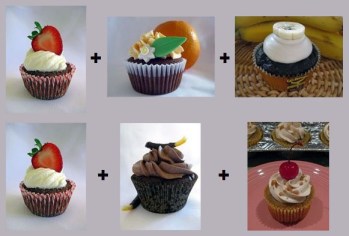
  2. Missing serial comma. It says in the bible (The Chicago Manual of Style), “When a conjunction joins the last two elements in a series of three or more, a comma—known as the serial or series comma or the Oxford comma—should appear before the conjunction.” Here is an example of the profound confusion caused by a missing serial Cupcakescomma: “I am making the following flavors of cupcakes: strawberry, orange and chocolate and banana.” So, in addition to strawberry cupcakes, am I making cupcakes that are (1) orange and (2) chocolate and banana? Or (1) orange and chocolate and (2) banana? Either way, it looks like I’m making cupcakes.
  3. Random capitalization. I wish I could get inside the head of the writer who, without warning, capitalizes words that should be lowercase. If I were editing a book on baked goods (please send me manuscripts on baked goods—or just baked goods), I might find a sentence like this: “A Cupcake is a small cake designed to serve one person, which may be baked in a paper or Aluminum Cup.”
  4. Dangling modifiers. A dangling modifier is a word or phrase that describes a word not clearly stated in the sentence—often to humorous effect. For example, “Standing at the dessert counter, my eyes took in the rows of colorful cupcakes.” In other words, my eyes were standing at the dessert counter—which is absurd, because eyes don’t even have feet! Here is a possible reworking: “Standing at the dessert counter, I ogled the rows of colorful cupcakes.”
  5. Pronouns with unclear antecedents. I often encounter pronouns that could refer to more than one noun in a sentence. For example, “After putting sprinkles on the cupcakes, I sealed them in a container.” We don’t know if “them” refers to “sprinkles” or “cupcakes.” We only know it refers to something good.

The law of irony dictates that if you write about editorial pet peeves, you will make a stupid mistake and have it pointed out to you—which is where a comforting cupcake comes in.