Category Archives: Writing

Is Responsibility the Enemy of Creativity?

fortunes raccoons

Last week, raccoons knocked over one of the trash cans. I had made chicken soup from scratch, and the local nocturnal carnivores couldn’t resist the bones. Among the scattered contents of the clawed-open bag, I came across something intriguing: the little strips of paper from two fortune cookies. There was no sign of the cookies themselves, which I had discarded intact. I imagined the scene that took place the night before: two satiated raccoons leaning back, cracking open the crisp cookies, and comparing the vague prophecies inside.

Who could blame them? It’s hard to resist finding out what a baked good has to say about your life. I dare you not to go to this site and open a virtual fortune cookie for yourself. (It’s gluten-free!) I clicked through a few:

  • “You will be called upon to help a friend in trouble.”
  • “You are cautious in showing your true self to others.”
  • “Go confidently in the direction of your dreams.”
  • “Love comes quickly, whatever you do.” (Thank you, Pet Shop Boys.)

The predictions, observations, recommendations, and aphorisms found in fortune cookies are ingeniously general; they can be interpreted as applying to almost anyone’s life. Even if we don’t take these messages seriously (with the possible exception of those who have played the “lucky numbers” and won), their allure reflects our desire to understand ourselves and to anticipate the future. Some people may seek this kind of insight through more formal divinatory tools, such as astrology, numerology, and the tarot. I recently had a meaningful experience in this regard.

I have written about Jean Haner before. She is an expert in Chinese face reading, an ancient branch of Chinese medicine. She also has the ability to read the patterns in a person’s birthdate. Several weeks ago, I submitted a written question to her monthly call-in show. As I had done for the previous several months, I asked what my date of birth said about being a creative writer. Unlike in previous months, however, she chose my question! Here is her reading, excerpted for brevity:

You’re talking about writing creatively. There’s a huge part of you that will resist that. It [that part] feels overly responsible; it feels like first you have to pay attention to the practicalities and making sure everything’s in order, so it can kind of block the creative juices. I think that a lot of your focus has been on that up until now, and what I want to do is turn your direction into the second major influence in your life, which is an incredibly creative person. I want you to open to that and allow yourself to do that. There’s some perfectionism here, there’s some issues of self-confidence and worry about—you think you’re not creative.

There’s such a creative person here. In order to let that girl come out, you have to be much more light-hearted about it. You have to allow yourself to goof up. You have to allow things to get messy. You have to be more of a free spirit. That’s a big part of who you are, but I think that you’re such a responsible person that you kind of shoved the creative girl to the side and focus on being responsible. We never have to worry about you being responsible. We always have to worry about you having fun. And you’re meant to have fun with your writing, with your life. The creative process in the beginning and for a long time is messy; you don’t know what’s going to come out of that. And you like things nice and tidy. And so you’re going to have to tell that girl to go stand in the corner.

When I played the full reading for my husband, he asked how long Jean and I had been best friends. Indeed, she had accurately framed my current situation as a conflict between the impulses of responsibility and creativity; specifically, my exaggerated sense of duty to various things in my life is keeping me from accomplishing the writing I know I am meant to do. But there’s no point in marveling at amazingly astute advice—you have to act on it.

I haven’t told the responsible girl to go stand in the corner. But I think I’ve engineered a meeting in the middle with the creative girl: a short-story-writing class that starts tomorrow.

Avoid Clichés Like the Plague

fire hydrantMy dog Cota regularly pees on a particular fire hydrant during our daily walks. Each time he reenacts the hackneyed image of a pooch relieving himself on the faucet that allows firefighters to tap into the municipal water supply, I shake my head and mutter, “So cliché.” A cliché can be a theme, characterization, or situation—such as man’s best friend urinating on a “Johnny pump”—that appears so often in film, television, literature, or art that it becomes boring.

Another type of cliché, which I encounter frequently in my work as an editor, is a sentence or phrase that conveys a common thought or concept—but that has become stale through overuse. An example would be “man’s best friend” in the previous paragraph. While such expressions may have been clever or compelling when they were introduced, they have long since lost their novelty and impact. Because clichés are dull by definition, I will offer just a sampling for illustration:

  • The whole ball of wax
  • The bee’s knees
  • Break the ice
  • Bury the hatchet
  • The elephant in the room
  • A fly on the wall
  • Jump the gun
  • Know the ropes
  • Barking up the wrong tree
  • Raining cats and dogs
  • Run circles around
  • Turn on a dime

Like me, you may have rolled your eyes, snickered, or experienced chest pains at the banality of these sayings. But I encourage you to pause and consider them. At one time, these word combinations colorfully and inventively captured ideas.

To demonstrate this point, I have collected clichés from outside the United States. Unfamiliar to us, they sound more exciting than our own clichés. Yet to the people who live in the originating countries, they are undoubtedly corny and tired.

  • Box of fluffy ducks (New Zealand, meaning, “I am fine; I am happy or doing well.”)
  • In fine fettle (Canada, meaning, “in good health” or “in good condition”)
  • Don’t piss on the chips (England, meaning, “Don’t put a damper on things.”)
  • There is no cow on the ice (Sweden, meaning, “There is no need to panic yet.”)
  • A face like a dropped meat pie (Australia, self-explanatory)

You should ditch clichés because they are unoriginal, ineffective, and lifeless—undesirable qualities for written and oral communication. As Oxford Dictionaries explains, “When you’re writing on a more formal level, it’s better to try to avoid using clichés. They tend to annoy people, especially if they’re overused, and they may even create an impression of laziness or a lack of careful thought.” To me, clichés are instances of imprecise language; as such, they undermine the authority of the author, who appears unable or unwilling to state a point directly. Further, I have in mind the difficulty of translating clichés into other languages (i.e., if the book is enormously successful!), as they may not be understood by other cultures.

There are exceptions. I think clichés are generally acceptable in casual writing and conversation, social media posts, jokes, headlines, book titles, and blog posts about shunning them.

How do you remove a cliché from a business letter, college essay, public speech, work intended for publication, or other piece of formal writing? The first step is to recognize it. Clichés are so ingrained in how we express ourselves that integrating them into what we say is natural. When I identify a cliché in a manuscript, after weeping inwardly, I take the following steps to eradicate it:

  1. I think about the cliché’s meaning.
  2. I think about what the author is trying to say.
  3. If the cliché, despite its imprecision, reflects what the author is trying to say, I “translate” it back into the notion it represents.
  4. I rewrite the content accordingly.

Here are some examples (with clichés and their replacements in bold):

  • Before: After you win the lottery, former acquaintances tend to come out of the woodwork.
  • After: After you win the lottery, former acquaintances tend to appear suddenly or unexpectedly.
  • Before: The new company was in the fast lane and picking up speed.
  • After: The new company was taking aggressive action toward success.
  • Before: My sister made an ordinary remark, but it stopped me in my tracks.
  • After: My sister made an ordinary remark, but it struck me as profound.

At the end of the day, people are sick and tired of clichés. Give the people what they want—a breath of fresh air.

Should Authors Also Be Writers?

Last year, I received an assignment to edit a self-help book. The goal was to prepare the manuscript for acceptance by the publisher that had contracted with the first-time author to write it—although the expectation was that it would come back for further revision. The job included both developmental editing and copyediting. Developmental editing involves modifying a book’s structure and content; copyediting consists of fixing punctuation, spelling, grammar, and style. I introduced extensive changes at both levels, making the organization more reader-friendly and rewriting virtually every sentence.

After the manuscript was submitted to the publisher, I awaited word of its reception. Five months later, having heard nothing, I checked Amazon: the book would be coming out in November 2014. I took satisfaction in the fact that the manuscript had apparently been accepted. I checked back this month and was able to preview parts of the book (which had received all five-star reviews); I was gratified to see that my changes were intact, from the table of contents to the section heads to the text. Not to overinflate my role, but I made the author seem like a capable writer. Ironically, she never knew my name or that I, as a ghost editor, even existed.

Jane AustenThe situation brought to mind some news that emerged in 2010 about Jane Austen—that the words of the revered novelist did not, in fact, come “finished from her pen,” as her brother Henry asserted in 1818. As NPR reported, she “may have simply had a very good editor.” According to Austen authority Kathryn Sutherland, of Oxford University, “The English that she is known for is this polished, printed Johnsonian prose. And it’s not there in the manuscript.” (“Johnsonian” refers to the literary style of distinguished English writer and critic Samuel Johnson, best known for his influential Dictionary of the English Language.)

If Austen was a “sloppy writer” whose books were “heavily edited for publication,” does that mean authors—even beloved ones—don’t have to know how to write well? And it’s the editor’s job, if necessary, to create that illusion? Consider the portrayals of writers in film and literature. They typically experience writer’s block or some other setback related to their writing, become inspired by the struggles in their lives, and triumphantly complete their manuscript. As they type “THE END,” do we think, “Now it’s off to a good editor!”? Rather, we think it’s the end of the story.

We don’t really want to know how the sausage is made.

I Don’t Really Like Talking about My Flair

suspenders

This post is dedicated to anyone who has asked me about my job and received a perfunctory answer.

(I would also like to take this opportunity to apologize to anyone who has inquired politely about my hobby, only to have me babble on about coconut flour, baking times, and buttercream, while gesticulating wildly and searching my phone for cupcake photos.)

In the cult classic Office Space [interject your favorite quote here], Jennifer Aniston’s character, Joanna, works at a T.G.I. Friday’s–inspired restaurant called Chotchkie’s, where the servers are required to wear 15 “pieces of flair” (buttons). Joanna dons the bare minimum, to the disappointment of her boss. He compares her unfavorably to her overly eager coworker Brian, who wears 37 pieces. When Peter, the movie’s protagonist, questions Joanna about her buttons, she replies, “I don’t even know what they say. I don’t really care. I don’t really like talking about my flair.”

When people ask me what I do for a living, I tend to shut down the conversation in a similar way. Gritting my teeth, I mutter, “I’m a writer and editor.” In response to the follow-up question about the kinds of materials I work on, I sputter, “Anything that needs to be written or edited.” (It’s a good thing the work seems to flow in, because can you imagine how successful I’d be in a job interview?) Why am I reluctant to talk about what I do? Am I afraid I’ll bore people? Is it hard to explain what I do? Do I not know what I do?

Since going freelance 10 years ago, I have worked on a range of published things, including textbooks, nonfiction books, novels, and Web sites. My regular tasks include writing, rewriting, researching, developmental editing, copyediting, fact-checking, proofreading, and production proofing. While major institutions offer courses and certification programs for those seeking employment in editing, I continue to learn through observation and experience. (Besides, according to my first boss almost 25 years ago, publishing is the “accidental profession.”) I can’t say much more along these lines, for fear of becoming tiresome to myself. (That’s what LinkedIn is for, right?) But I do want to talk a little about how I approach my projects.

My efforts start with trying to see beyond the material to its perfection. Then I attempt to bring the words I am writing or editing as close as possible to the ideas they represent. The disheartening news is that because each word is a choice, and perfection would require all correct choices, perfection appears to be mathematically improbable. Still, I want the final product to reflect very nearly exactly what the author (or I) was trying to say, in its most eloquent form. Ultimately, however, I am the reader’s advocate. With every sentence, I ask myself, will the reader understand, benefit, and be engaged? Authors want to reach people, and I am responsible for facilitating that.

As a final note, if you can’t stand when people drone on and on about their jobs, I am the perfect dinner companion.

“Aardvark Bowling” and Other Poems

aardvark bowling

While on a plane this week, I perused a year-old issue of Writer’s Digest. (I’m a little behind on my reading.) An article about a type of poem called the glosa, which originated in Spain in the 15th century, caught my attention. The author had made his own attempt at the form, which reminded me of how much I used to like writing poetry—imaginatively articulating thoughts and emotions through rhythm and heightened language, seeking and (hopefully) finding the words that most perfectly expressed my subject’s essence.

Aardvark Bowling

“Aardvark Bowling”

Scrabble

“Scrabble”

When I arrived home, I pulled out a black three-ring binder containing materials from a class I took over a dozen years ago, called “Writing from the Collective Unconscious.” I vaguely remembered composing most of the pieces (for example, “Scrabble”) per a number of inspiring assignments. For instance, in an exercise on surrealism, we were instructed to write the letters A to Z on a piece of paper and then record the first word that came to mind for each. We were then asked to choose two consecutive words from the list to serve as the title of a poem. (See “Aardvark Bowling.”)

At my instructor’s invitation, I read the following poem, “Luxor,” at a community arts event. I began writing it in the food court of the Las Vegas hotel of the same name.

Luxor

As an English major, I “explicated” (interpreted and explained) countless poems. It occurred to me years later that analyzing a poem was like dissecting a frog—examining the parts in order to understand the whole. In a high school classroom, a frog is dead when it is taken apart; I wondered if the life left a poem when it was analyzed. To be on the safe side, I decided not to cut up any more poems.

Now I just enjoy their music and experience their meaning.

Conservation of Creative Energy

Light Bulb in the Sky

Last week, I calculated that I had written almost 6,500 words of my blog—on top of the 5,000 words I logged on my novel. At first, these statistics gave me a sense of accomplishment. I had met the goal I stated in my first blog post, on October 2, 2012: to put together at least a few paragraphs devoted to my novel on a regular basis, in order to convince it to “take a chance on me.”

Looking at the numbers, however, I couldn’t help but wonder if I should be devoting more time to my novel and less time to my blog. A session with my coach last week confirmed that I was channeling too much of my writing energy into the blog. Furthermore, my coach, Ziva, sensed that putting attention on myself via the blog was “distracting my energy.”

The objective of the session had been to figure out how I could regain my motivation on my novel. I hadn’t written anything new since November 30. In fact, I had lost 50 words to editing! Ziva advised that I could build momentum by “protecting and concealing the process”—which I think would preclude yacking about it on the World Wide Web.

Ziva provided me with profound insights into how to bring the first draft into form. I will take notes throughout this process and possibly report on it later. In the meantime, I’m not sure if I will continue to maintain this blog (but not talk explicitly about my novel), post less often (again, not about my novel!), or take a break.

Maya Angelou has remarked, “There is no greater agony than bearing an untold story inside you.” Right now, that sounds like the smartest thing anyone has ever said.

My Predictions for 2013

Frost Cupcakes According to statistics on New Year’s resolutions, 8 percent of people are “successful in achieving their resolution.” This figure seems dishearteningly low. Yet people who explicitly make resolutions are 10 times more likely to attain their goals than people who don’t. In other words, non-resolution-makers achieve their not-formally-expressed objectives only four-fifths of 1 percent of the time! This statistic would seem to support the time-honored tradition of making New Year’s resolutions.

Unfortunately, at least to me, a resolution connotes a dispiriting sense of responsibility, requiring a firmness of purpose to which I’d rather not have to commit. Therefore, in the spirit of self-fulfilling prophesy, I have decided to make predictions this year instead of resolutions. A prediction has an element of fate to it, as if it is inevitable and somehow supported by the universe. An individual might play a role in its occurrence, but there is the suggestion of co-participation with an invisible agent.

So here are my predictions, inspired by a combination of intuition and wishful thinking. In 2013, I will . . .

  1. Make good progress on the first draft of my novel.
  2. Schedule more sessions with my coach.
  3. Set up a writing studio.
  4. Really push myself to increase my belly-dance workout from 15 minutes to 20 minutes a day.
  5. Stop saving leftover frosting for snacking.
  6. Have a nice dinner with my husband in New York City.
  7. Resume drinking pumpkin spice lattes around October 1.

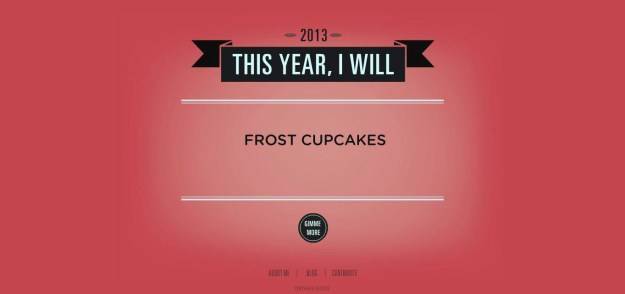
If you are looking for ideas for your own resolutions (or predictions), you might want to check out this generator I came across. One of the first suggestions it gave me was, “I will frost cupcakes”—so I think it might actually know something!

Dear Prudence: Time Waster or Idea Machine?

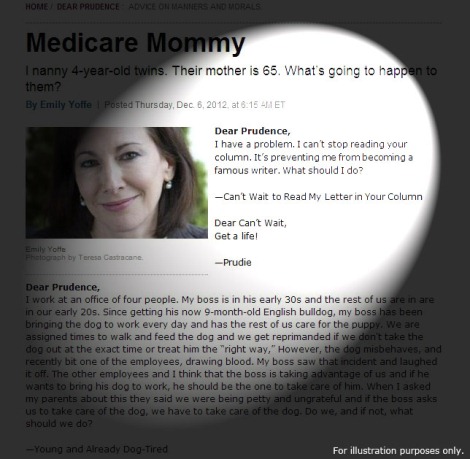
In my first session with my writing coach, she asked me to identify things I was doing that were wasting time; eliminating these productivity killers could free me up to do some writing. Two of my distracting behaviors were being on Facebook and looking out the window. (Damn, I just stared at the trees for half a minute.) I was a bit embarrassed to reveal a third habit: reading the advice column Dear Prudence. In addition to devouring the semiweekly installments, I had been delving into the Dear Prudencearchives all the way back to 2007. At one point, I even considered writing to Prudie herself for guidance on how to overcome my obsession.

Prudence (Emily Yoffe) fields queries regarding social etiquette, relationships, family, and the workplace. So what was it about the column’s questions and answers that merited hours of my time? For one thing, I enjoyed comparing my own reactions against Prudie’s. Often, we were in agreement. Yes, a man who asks his girlfriend to get a nose job and then wants to dump her when she is disfigured by the procedure is kind of a jerk. Yes, it is bad form for a bride to ask the groom’s mother not to wear a dress with spaghetti straps because she finds the look age-inappropriate. In other cases, I was enlightened by Prudie’s point of view.

I also saw a distinct benefit to reading the column, one with a direct application to my writing: The situations people described were fantastic fodder for fiction! For example, here are some story ideas based on actual letters:

  • Relationship drama: A husband and wife are having trouble conceiving when she finds out he is having an affair with her sister. After a traumatic confrontation, the couple moves away to make a fresh start. A few weeks later, the sister announces her pregnancy.
  • Psychological: A school bully becomes a young mother. When her daughter experiences some minor bullying, she is prompted to track down and make amends to the classmates she once tormented. She finds out that one girl, who switched schools because of her, committed suicide.
  • Thriller: A couple moves to the town where the husband’s bachelor brother lives. The husband, who travels frequently, encourages his brother to watch out for his wife. She catches the guy peering in through the bedroom window. Then he lets himself into the house while she is showering.
  • Romantic comedy: A woman discovers that she and her daughter are dating a father and son. Both couples have been talking about marriage.
  • Legal: A man who works at a small company finds out there is a plot to oust the controversial CEO with a false claim of sexual harassment. The human resources department is in on it. Should the employee warn his boss? Or just hope that truth will prevail?

If you are a writer, feel free to use these scenarios as prompts! After the exercise with my coach, I decided to limit my reading of Dear Prudence to just the new ones. I have successfully stayed out of the archives, except to research this post.

Now if you’ll excuse me, I have to check Facebook.

Ten Random Things about My Novel

Well, I met my goal to write 5,000 words of my novel in the month of November. It feels pretty good to open up the file and see a word count of 5,078. My husband asked if the words were good ones, which is a fair question. I believe a sampling—portal, secrets, it, gold, sauerkraut, grammar, taxi, her, the, marveled, apricot, stretch, chimney—shows a range from banal to mildly intriguing.

In the spirit of randomness, here are some additional observations about the experience of starting my novel:

  1. I wrote the second chapter first.
  2. There is a sex scene in the very first chapter. Who saw that coming?
  3. I kept misspelling the heroine’s name (not a good sign). Then I stumbled upon the perfect name, the meaning of which is virtually the working title of the novel. (Home˃Replace)
  4. Dark and StormyI had a general outline in mind, but I didn’t know what I was going to write from one paragraph to the next or even from one sentence to the next. I often thought, “Okay, now what?”
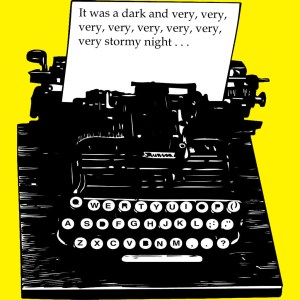
  5. Because I was writing for volume, there was the temptation to be wordy. I admit to using the word very eight times (though not in a row).
  6. On a related note, I avoided editing, because editing almost always shortens.
  7. I discovered that you can research the small things as you go.
  8. Okay, now what?
  9. I am very, very, very pleased with my novel so far.
  10. Publicly stating my goal motivated me to achieve it. (Humiliation is one of the five basic fears.)

The big question is, “Okay, now what?” I should probably call my writing coach. She’s the last person who would think I’d ever write something.

Confessions of a First-Time Novelist

Confession

Having written the first 4,000 words of a novel, I will boldly (if grossly prematurely) call myself a first-time novelist. Making such an assertion, however, brings up insecurities about certain embarrassing qualities I possess—ones that would seriously seem to undermine the success of a budding author. If I contritely confess these shadowy aspects of my nature, perhaps I will be released from their consequences . . .

Confession #1: I don’t like to read fiction.

I usually can’t even make it past the first few words of the back cover copy. “On a warm summer morning in North Carthage, Missouri . . .” “Joe Rickman, head of CIA clandestine . . .” “It’s Christmas Eve . . .” Maybe my aversion to reading for pleasure stems from the fact that I read for a living. (I would venture to guess there are plenty of baristas who don’t drink coffee at home.) This is not to say I haven’t amassed a library of books I suspect would be entertaining (judging from their covers). I am not well-read past the Renaissance.

Confession #2: I don’t want to be a beginner.

That’s right, I vainly want to skip novice, apprentice, and journeyman, and go straight to master. I have been writing educational, nonfiction, and marketing materials for over 20 years, so undertaking a novel is like starting over. This idea extends to other areas of my life. For example, I started playing the guitar and rollerblading at the beach, but I didn’t get very far because being a beginner felt so yucky. (And the guitar was dangerously wide for the bike path.)

Confession #3: I am a procrastinator.

My procrastinating is directly related to my perfectionism. If I delay starting something that requires my immediate attention, I can’t do it imperfectly. Problem solved! To put the perfectionism in perspective, I fact-check my Facebook posts—against three sources. As a professional editor and proofreader, I get paid for rejecting anything less than perfect—so this tendency is constantly being reinforced. One thing I don’t procrastinate about is my perfectionism.

Any of these shameful character traits should rightly disqualify or prevent me from being a first-time novelist. On the other hand, Camus said, “A work of art is a confession,” so perhaps a little guilt is a good thing for a writer.