William Shakespeare (1564–1616) was barely literate, but he could not have died more poetically: on the same day and month he was born, April 23. Today would have been his 461st birthday (if people lived for centuries), as we commemorate the 409th anniversary of his death.
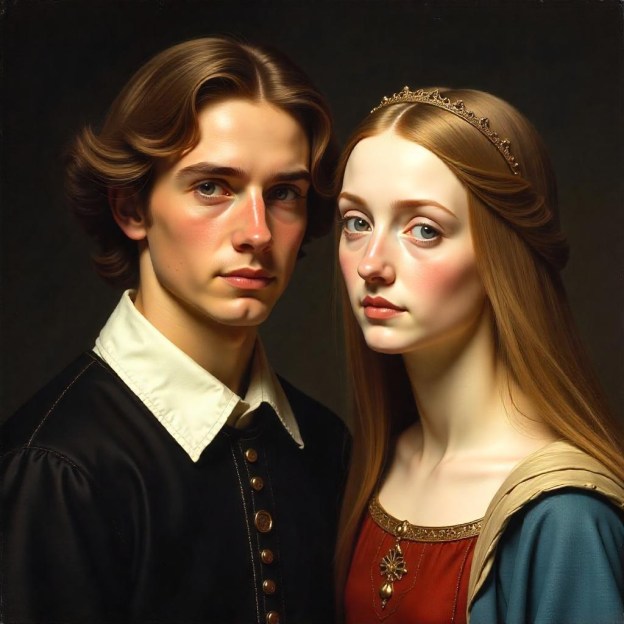
I’m not ready to lay out a case for who wrote the works attributed to William Shakespeare, because I don’t think the world is ready to entertain the idea that the individual widely regarded as the greatest writer in the English language (according to Wikipedia, anyway) was a woman—let alone one who grew up on a farm, in a rigidly patriarchal society that didn’t educate girls.
This is a woman whom scholars claim to know very little about, outside public records. They dismiss her as a footnote in the life of a literary genius—not realizing it was she who wrote the plays and poems they study, teach, and publish criticism on.
No, the time just doesn’t feel right—though perhaps it is ripe. We probably need this information now, if only to expand our thinking a bit—to encompass the fact that the configuration of sex organs within the human body has no bearing on the soul’s depth to feel or on the mind’s capacity to learn, imagine, or create. Ultimately, the sex of the person who wrote Hamlet, Romeo and Juliet, and A Midsummer Night’s Dream shouldn’t matter—which, perhaps, is all the meaning in answering the authorship question once and for all.
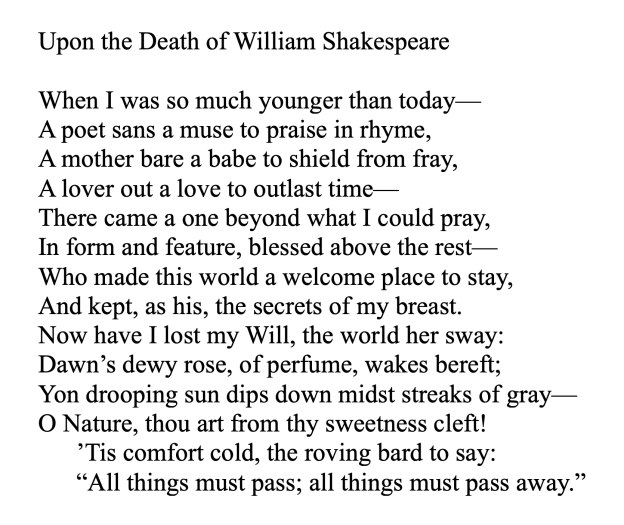
Today, I am sharing a sonnet that might have been penned by Anne Hathaway, William Shakespeare’s wife of thirty-three years, upon the death of her husband. It follows the sonnet form that was popularized, though not invented, by the writer of Shakespeare’s works—but I have leveled up the difficulty a bit. (I’m a bookish kind of daredevil.) Here’s the rhyme scheme of the traditional Shakespearean sonnet:
ABAB CDCD EFEF GG
The different letters represent pairs of lines that rhyme with each other: so, the first and third (A an A), the second and fourth (B and B), the fifth and seventh (C and C)—all the way to the closing couplet (G and G). Today’s sonnet, however, uses the following, somewhat more ambitious rhyming pattern:
ABAB ACAC ADAD AA
What this means is that over half the lines in the poem (eight out of fourteen) rhyme with each other: specifically, lines 1, 3, 5, 7, 9, 11, 13, and 14. This more demanding rhyme scheme, which requires additional craft from the poet, pays homage to the profound specialness of the subject.
From Anne Hathaway…
Each sonnet in my series concludes with lyrics written by the original Paul McCartney (who died in 1966). I took the last line of today’s sonnet from the title track of George Harrison’s triple album All Things Must Pass (1970). I suspect Paul was inspired to write “All Things Must Pass” (the song) by his mother’s passing, when he was fourteen; or by the death of the Beatles’ first bassist, Stuart Sutcliffe, when Paul was nineteen. The song offers words of comfort from the deceased, using natural phenomena (sunrise, sunset, a cloudburst) as metaphors.
In previous posts, I have noted Paul McCartney’s systematic use of meter in his lyrics. In fact, Paul employs enough of the metrical “feet” (rhythmic units) required for Shakespearean sonnets that I have gleaned about two hundred possible last lines for sonnets so far. (Fans might also notice that today’s sonnet opens with a nod to the Beatles’ 1965 classic “Help!”)
It should probably come as no surprise that English student Paul McCartney wrote at least one Shakespearean-style sonnet. This poem has survived, mostly intact. Paul’s replacement published it in his memoir, as his own—but modified two lines to refer to his wife Linda, who died in 1998. While I do not wish to diminish the sentiment of those lines by omitting them below, they are not Paul’s. And Paul would have been mortified to take credit for words he did not write (especially when they contained a punctuation error and a questionable rhyming choice). So, here is the greater part of a Shakespearean sonnet written by young Paul McCartney following the death of his mother:
She was the source of all that life could bring. Each day her glory woke the morning rays. Her voice was first of all the birds to sing. It was her calling to ignite the days. … … An advocate for every beating heart, She would defend each child and each mouse. But now her face and song are not as clear. Her image and her voice are in a haze. Though still she whispers guidance in my ear, Don’t see her ’round the house as much these days. The more delight we find in love and song, The more we’re left to miss them when they’re gone.
Regarding the subject matter of the two missing lines, I can only speculate. Perhaps they refer to Mary McCartney’s work as a midwife and as the head nurse of a hospital maternity ward—hence the words “advocate,” “beating heart,” “defend,” and “child” in the two remaining lines of the quatrain.
In closing, I can attest that a sonnet, like a song, makes a pretty little container to put one’s grief in.
I want to start by saying that I’m not publishing this series of posts in order to reveal myself as a former Beatle to my friends and loved ones. They are not my audience, necessarily. Rather, I would like to share what I have learned with people who care about, have a curiosity about, and can keep an open mind about what happened to James Paul McCartney.
The original Paul McCartney of the Beatles was buried fifty-eight years ago today, on Tuesday, October 18, 1966—or thereabouts.
As I mentioned in my last post, Paul might have been assassinated on multiple occasions as the Beatles toured America in August 1966. But he got lucky; he lived to return to the U.K. at the end of that month. Sadly, he passed away just thirty-nine days later. There’s a sense of relief that Paul didn’t die in the United States—that his remains weren’t weighted down to the bottom of the East River or dumped in the Mojave Desert, where every passing mile looks the same. He made it back to England, Shakespeare’s “precious stone set in the silver sea.” I think Paul loved the feeling of being at home. In this regard, his burial place was perversely apt.
As I reported last week, when I realized six years ago that Paul McCartney had been replaced, my first thought was, “Where is he?” A person can’t just disappear, right? At the time, I wasn’t sure if Paul had removed himself from society, perished, or met some other fate. Gradually, I came to accept that Paul had died, toward the end of 1966. And if he died, there had to be a body—which had to be somewhere.
Before continuing, I will reiterate a clarification I made in my last post: I am a writer. I am able to distill both flights of fancy and truths into words. Therefore, what is written here might be fiction. Or it might represent reality. Either way, it’s my story.
How I Figured Out Where Paul Is (Probably) Buried
For me, three elements came together to suggest the location of Paul’s corpse: my own reasoning, Paul’s replacement’s memoir, and a photograph from 1969.
At the time of Paul McCartney’s death, in 1966, the members of the Beatles were pursuing separate interests: John was acting in a movie in Spain; Ringo was visiting him there. George was in India, learning how to play the sitar. Paul had attended an awards luncheon in London in mid-September; wherever he was a few weeks later, on October 9 (his final day), he likely would have been focused on preparing songs for the Beatles’ return to the studio.
John’s famous “I buried Paul” message, at the end of “Strawberry Fields Forever,” told me two things: First, there had been a burial service for Paul. Second, John must have traveled from Spain (presumably with Ringo) to witness the interment—and possibly to toss, respectfully, a handful of dirt on the lowered coffin (hence, “I buried Paul”). George, returning from India four days later, would have missed the solemnities. The news was surely a terrible blow: his Beatle brother had died and been buried while he was away.
As I pondered where Paul might have been laid to rest, I asked myself a few questions:
Where could Paul’s intimate but star-studded burial service have taken place privately, and unobserved?
Where could Paul have been buried anonymously, and without the risk of being unearthed accidentally?
Paul’s replacement was hiding in plain sight, as a member of arguably the most well-known band in the world at that time. Had Paul’s corpse been stashed somewhere similarly obvious? I had a location in mind. Ultimately, my suspicion would be confirmed—with help from the man who took Paul’s place.
In 2009, Paul’s replacement published an account of his life, centering on his experiences with the Beatles, called The Memoirs of Billy Shears. This title borrows from the song “Sgt. Pepper’s Lonely Hearts Club Band,” in which “Billy Shears” is, I assume, the original Paul’s nickname for William Shakespeare. This assumption is supported by the fact that, on the Sgt. Pepper album, after the title track introduces Billy Shears, it goes straight into “With a Little Help from My Friends”—the first verse of which quotes from Shakespeare’s Julius Caesar (“Lend me your ears.”)
In The Memoirs of Billy Shears, Paul’s replacement hints at where Paul is buried. He states:
If it is Paul you are looking for, he is buried in a field of grass pushing up rhododendrons. I am not him.
Paul’s replacement mentions these specific flowers again, in the same context, when he asserts that Paul’s “rotting corpse pushes up daisies, or, in his case, rhododendrons.” (In the first quote, “field of grass” is a reference to Paul’s unfinished song “Mother Nature’s Son,” which the Beatles recorded after his death; the specific line is, “Find me in my field of grass.”)
I must explain that, according to Paul’s replacement, The Memoirs of Billy Shears is a mixture of fact and fiction; indeed, it contains a number of reprehensible lies. The presence of rhododendrons at Paul’s grave, however, appears to be true.
In pinpointing Paul’s burial site by way of rhododendrons, my first promising discovery was of a photo taken in 1980 of Paul’s replacement settled amidst lovely pink flowers that resembled rhododendrons. Eventually, however, I would stumble upon a truly incriminating image, from eleven years earlier, that chilled me to the bone.
A photo snapped in 1969, in a shoot for a non-album Beatles single, shows what I take to be the site of Paul’s grave. In the photo, John, George, Ringo, Yoko Ono, and Paul’s replacement are posing in a garden. Behind the camera is the replacement’s new bride, Linda. Objects collected from the nearby area—stones, overturned flowerpots, a periwinkle blue umbrella, a statue of the Cheshire Cat from Alice’s Adventures in Wonderland—are arranged in an oval to suggest the location of Paul’s corpse, six feet down. Because the earth there had been dug up two-and-a-half years earlier, to receive Paul’s coffin, the ground cover within the oval looks less mature than that around it. Most importantly, what appears to be a pink rhododendron bush is visible to the left of the grave. The same flowers seem to peek over John’s left shoulder, as well. As Paul’s replacement implied in his memoir: where you find Paul’s body, you will find rhododendrons.
A Few More Clues for You All
I will stop short of providing an address you can Google, but here are some additional indicators as to where Paul is (likely) buried:
John, George, Ringo, and Paul’s replacement recorded Abbey Road and other albums just a stone’s throw (if you have a good arm) from Paul’s grave.
If you had a small pet who died, you might bury it in a similar place.
Paul’s body might be found someday, if someone decides to put in a swimming pool.
Paul’s replacement knew where his predecessor was buried, even though he wouldn’t have attended the burial service.
My hope is that, eventually, enough people will figure out where Paul is (probably) buried that it becomes common knowledge. Then there might be a general call for him to be disinterred—and reburied along with his name.
How Would We Recognize Paul’s Remains?
If we were to find Paul McCartney’s body in an unmarked grave, how would we positively identify it? Presumably, skeletonization has occurred by now. Long gone are the mop of dark brown hair, thick eyelashes, and Cupid’s bow lips. Luckily for us, Paul’s corpse might have a name tag on it—in the form of Paul’s ID bracelet. This trinket, engraved with “Paul,” can be seen on Paul’s left wrist in photos from 1964, including on the sets of The Ed Sullivan Show and A Hard Day’s Night. Paul’s ID bracelet probably wouldn’t have fit his larger-boned replacement, at least not in the same way (pretty loose), so burying it with him might have seemed like a sensible idea at the time; or it could have been a sentimental choice made by Paul’s family. (My song “Silver Bracelet” addresses the possibility that Paul is still wearing his ID bracelet.)
Another distinguishing feature of Paul’s corpse would be a left front tooth that appears to have been broken and repaired. Paul chipped this tooth in an incident in December 1965 (which was not a moped accident, as officially reported). He was said to have feared the dentist, which might be why he didn’t fix the tooth. Five months later, the break is still visible, for example, in the Beatles’ videos for “Rain” (at 0:34, 2:02, and 2:41) and “Paperback Writer” (throughout, but for a lingering closeup that Paul probably didn’t appreciate, see 1:35–1:44). When Paul’s death and replacement were imminent, the tooth was hastily repaired—as his lookalike didn’t also have a chipped left front tooth. Indeed, Paul’s smile appeared intact again on September 13, 1966, at the Melody Maker Awards, in London.
Finally, the location of Paul’s corpse would be a “dead giveaway” (pardon the pun) as to his identity.
What Happened When I Visited Paul’s Grave
At the beginning of 2019, I got as close as I could to Paul’s suspected resting place. The next year, on the fifty-fourth anniversary of Paul’s burial (so, exactly four years ago), I recorded my memories of that day:
On January 18, 2019, I found myself in the part of the world where the original Paul McCartney of the Beatles is buried. (I know the date because of an Instagram post I made that day.) At the time, I was in denial that I had been Paul, though I felt emotionally connected to his story and believed in reincarnation.
While studying Paul’s death and replacement, I had deduced where he was buried. I set out from my hotel on the two-and-a-half-mile walk to the location. The navigation feature on my phone drained the battery, and I became lost. I almost turned around. But then I saw “PAUL” on the awning of a restaurant and decided to keep going in that direction.
After several more missteps, I found the street. I passed the location of the grave twice, on my way to and from a pair of nearby tourist attractions that were my “official” destination, should anyone ask. The first time I walked by, I did so on the opposite side of the street. The second time, about half an hour later, I stopped right outside the gate. Both times, I wept bitterly.
As I returned in the direction I had originally come, I kept repeating, in my mind, “It’s only a place.” Even with my current level of awareness, I’m not sure exactly what I meant by that. Perhaps I was consoling myself that although my physical expression as Paul was gone (buried in that “place”), the eternal part of me had continued.
Only later did I ponder the possibility that a surveillance camera might have caught me gently weeping. But Beatles fans have surely stood in that spot before and displayed strong emotions.
Amazed and Afraid
Spiritual teacher Wayne Dyer often counseled, “Don’t die with your music still in you.” In this maxim, I interpret “music” to be whatever’s inside that wants to be expressed. Of course, it might be actual music.
When Paul died, he had part of “Maybe I’m Amazed” still in him. Based on what he left behind, his replacement released a version of the song on his debut solo album McCartney (1970). Fifty-one years later, in March 2021, I finished writing the lyrics—hopefully capturing what Paul was trying to convey back in the 1960s. The words are approximately 80 percent new (as compared with the replacement’s familiar rendition), including an added third verse.
Below is a video of me performing the new “Maybe I’m Amazed.” This was not necessarily my best take, and there’s an errant sequin on my left shoulder, but it was definitely the dogs’ finest performance. Thanks to Sophie and Grace for distracting from my musical insufficiencies with their adorableness. As they say, “Never work with children or animals,” those unpredictable little scene-stealers. The lyrics appear below the video, and below the lyrics you’ll find some important credits.
I’ll be back here on Halloween, a fitting day to discuss a macabre subject like how the original Paul McCartney died.
Lyrics:
Maybe I’m amazed at the way you love me all the time Maybe I’m afraid of the way I love you Maybe I’m amazed at the way you fill my head with rhyme Turn me on a dime Maybe I’m afraid of the way I’m turning to you
Maybe I’m amazed at the way you need me after all Maybe I’m afraid of the way I need you Maybe I’m amazed at the way you raise me when I fall Run before I crawl Maybe I’m afraid of the way I’m running to you
Maybe I’m a man—maybe I’m a lonely man— Who’s just a little boy asking, “Won’t you let me hold your hand?” Maybe I’m a man, and maybe you’re the only woman I could ever dream of asking, “Baby, won’t you help me understand?”
Maybe I’m amazed at the way you want me all the same Maybe I’m afraid of the way I want you Maybe I’m amazed at the way you seem so glad I came Draw me like a flame Maybe I’m afraid of the way I’m drawing to you
Maybe I’m a man—maybe I’m a lonely man— Who’s just a little boy asking, “Won’t you let me hold your hand?” Maybe I’m a man, and maybe you’re the only woman I could ever dream of asking, “Baby, won’t you help me understand?”
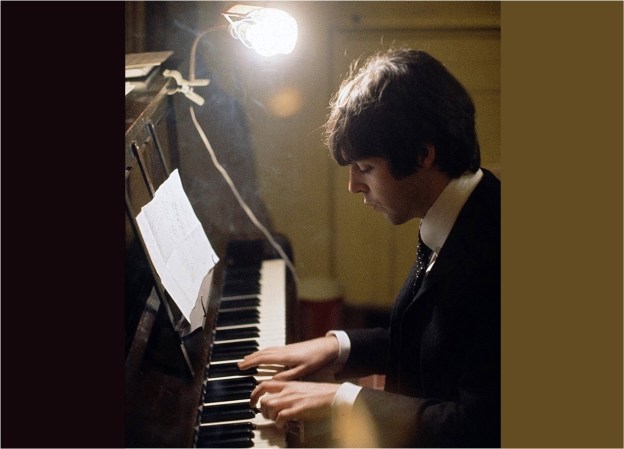
CREDIT: The photo at the top of this post was taken in London, in 1966, by Jean-Marie Périer. I have borrowed this image without permission but with tremendous gratitude and sincere appreciation. In the photographer’s own words (translated from the French): “I really like this photo of Paul, so English, playing the piano in a suit and tie. I called him from Paris and said: ‘I have to do eight pages about you. What day can I come to London?’ He suggests a Thursday… What I like is that he arrives in a suit and tie; it proves that he said to himself: ‘Eight pages on my head [literally, “my apple”]? Okay, let’s play it classic.’” M. Périer: Si vous lisez ceci, merci beaucoup. J’aurais aimé pouvoir me souvenir de nos trois heures ensemble, mais c’était il y a toute une éternité, pour moi.
SPOILER ALERT: There are new sonnets, below, in honor of William Shakespeare’s birthday!
The actor and producer William Shakespeare was born four hundred and sixty years ago today, on April 23, 1564, in Stratford-upon-Avon, England. William’s father, John Shakespeare, was a glove-maker and wool dealer who also had a number of other occupations. William’s mother, Mary Arden, was the daughter of a gentleman farmer.
Less than three months after John and Mary welcomed baby William, Stratford-upon-Avon received a most unwelcome visitor: the bubonic plague. That year, over two hundred townspeople, representing one seventh of the population, would succumb to the devastating bacterial infection.
In November 1582, eighteen-year-old William Shakespeare married Anne Hathaway, a woman who lived in a village about a mile outside of town. Anne, born Agnes, came from a family of successful sheep farmers. William and Anne were best friends who wanted to create a family together. Theirs was the “marriage of true minds” the poet wrote about in Sonnet 116. Indeed, the two would remain wed for almost thirty-four years, until William’s passing, in 1616.
A daughter, Susanna, was born six months into their union. Hamnet and Judith arrived twenty months later. The twins were named after Hamnet and Judith Sadler, a couple with whom William and Anne were friends. The Sadlers would go on to name a son after William.
Undoubtedly, the greatest tragedy faced by the young Shakespeare family was the crushing loss of their Hamnet, in 1596, due to plague. He was just eleven years old.
In Elizabethan England, 30 to 40 percent of children died before their first birthday, and only three in five survived past the age of ten. Given these statistics, you might think the sudden death of a child would have been almost expected—and, therefore, met with a certain degree of detachment or resignation. You would be wrong.
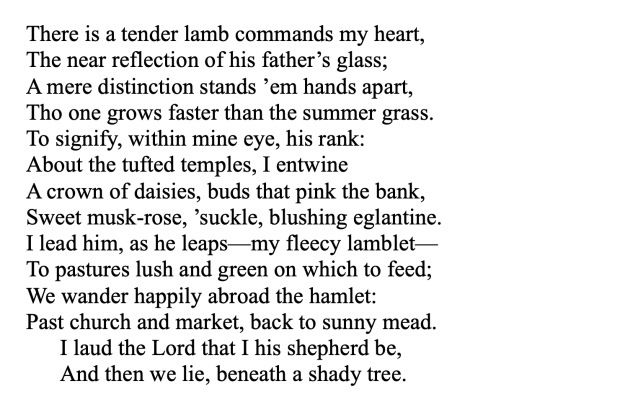
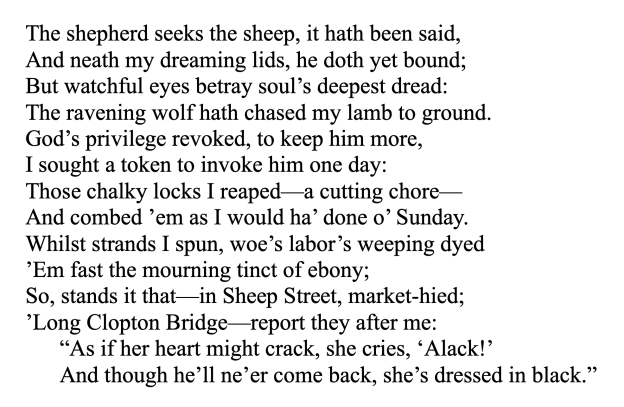
Today I am sharing two sonnets that might have been written about Hamnet Shakespeare: the first while the poet’s son was still alive; and the second after young Hamnet had been buried in the yard at Holy Trinity Church, in Stratford-upon-Avon.
While Hamnet, the poet’s son, lived:
And after Hamnet died:
You might notice something unusual about these two sonnets as well as the last three I posted: They conclude with lyrics from the Beatles. The poems in this post, for example, borrow from “Good Day Sunshine” and “Baby’s in Black.” If you’d like, take a moment to observe how neatly the song lyrics fit into the rhythm of the poetry.
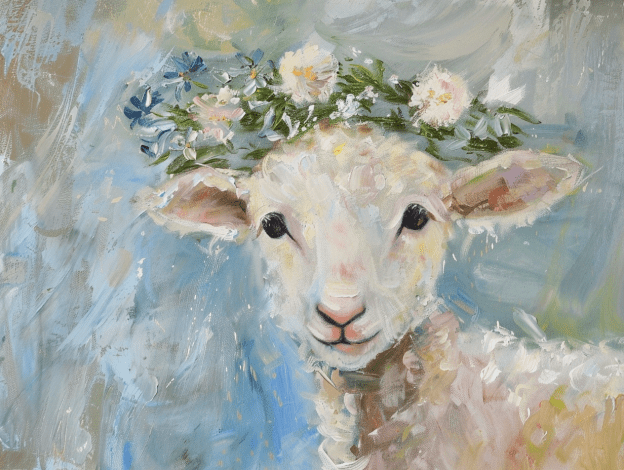
CREDITS: The image of a lamb was generated by Jay Schwartz. Information about John Shakespeare and Mary Arden came from Wikipedia. Statistics regarding the bubonic plague came from the Shakespeare Birthplace Trust and this site. Information about Hamnet and Judith Sadler came from this site. Statistics regarding child mortality in Elizabethan England came from this site.
This time last week (as I write), I was enjoying afternoon tea at The Berkeley, a lovely hotel in the Knightsbridge area of London. To be more precise, given the time difference between England’s capital and where I am now, afternoon tea was a recent pleasant memory.
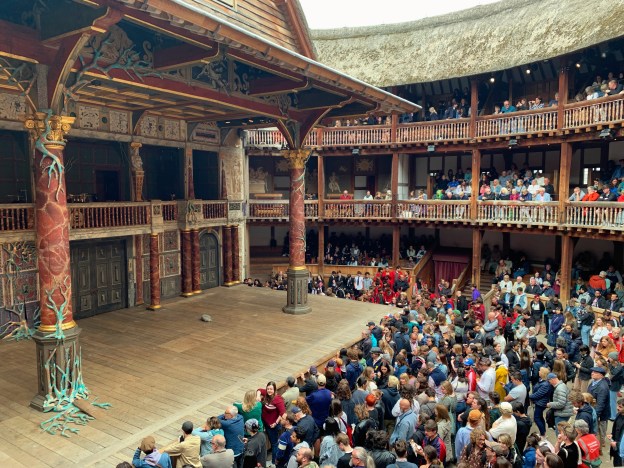
Earlier in the week, I had attended two performances at Shakespeare’s Globe, located on the south bank of the River Thames—so perhaps it’s not a surprise that I have a new sonnet to share with you! I jotted down some ideas for the sonnet during the interval (British for “intermission”) in A Midsummer Night’s Dream, on Tuesday. By The Comedy of Errors, on Thursday, the poem was starting to take shape.
This sonnet, like my previous two, is written from the perspective of the person who wrote the works attributed to William Shakespeare—someone very close to him, whose identity I hinted at in an earlier post. Happy guessing!
The poem I am sharing today strongly suggests the identity of the person who wrote the works attributed to William Shakespeare. That’s right: the pesky “authorship question” has finally been solved!
If you’ve never heard of the authorship question, it’s the controversial theory that William Shakespeare, due to his humble upbringing, was not capable of writing the poems and plays credited to him. Therefore, someone else must have written them—but who?
If you’re wondering whether William Shakespeare was even a real person:
William Shakespeare’s baptism was recorded at Holy Trinity Church in Stratford-upon-Avon, England, on April 26, 1564.
According to surviving documents, William Shakespeare married Anne Hathaway in November 1582. William was eighteen; Anne was twenty-six, and pregnant with their first child.
William Shakespeare’s legally validated will was signed on March 25, 1616, four weeks before his death.
If you’re curious how long the authorship question has been around, it originated during William Shakespeare’s lifetime.
As a Shakespeare fan since I was thirteen, an English Literature major in college, and a devoted theatergoer, I never had much time for the authorship question. To me, the works were the thing. Did it really matter who wrote them?
But when I realized who wrote the works of Shakespeare, I changed my mind. The realization arose more from common sense than from research. If you’d like the same joy of discovery, I have provided five clues, below!
Clue #1: The person who wrote Shakespeare’s works was very close to William Shakespeare, as this person’s plays were performed by William’s acting company. William Shakespeare belonged to the King’s Men acting company, known earlier as the Lord Chamberlain’s Men, for most of his career.
Clue #2: This person was able to write fully realized female characters in an era when women were regarded as weak and subservient to men. Think about Shakespeare’s rich and memorable portrayals of Juliet, Lady Macbeth, Desdemona, Cleopatra, Rosalind, Portia, Viola, Beatrice, Katherine (Kate), Titania, Cordelia, and Ophelia, among other female characters.
Clue #3: This person hotly encouraged a young man to marry and to have a child. Of Shakespeare’s 154 sonnets, the first 126 are addressed to a young man known as the “Fair Youth.” The first 17 of these sonnets are referred to as the “procreation sonnets.” In the procreation sonnets, Shakespeare urges the Fair Youth to wed and to become a father, so that this handsome young man might perpetuate his beauty and live forever through his offspring.
Clue #4: This person is someone whom scholars have overlooked for many years. If the “authorship question” holds merit, why hasn’t a definitive candidate for the author of Shakespeare’s works been recognized yet? What type of person would have been dismissed out of hand—or never considered in the first place?
Clue #5: A final nod to the identity of the individual who wrote the works of Shakespeare can be found in the following poem. This is the sonnet Shakespeare never wrote (until now!) about meeting the Dark Lady, the poet’s famous mistress. Of Shakespeare’s 154 sonnets, the final 28 are devoted to the Dark Lady. Remember, I wrote this poem from the perspective of the person who penned the works of Shakespeare.
I’ll be back in a future post to let you know if your guess is the same as mine!
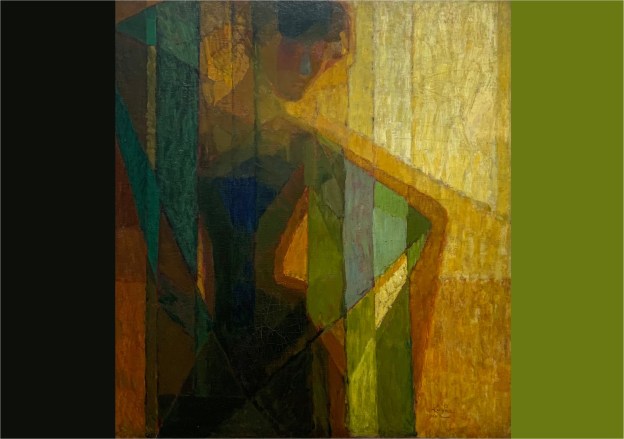
CREDIT: The featured image for this post is Woman in Triangles (1909), by the Czech painter František Kupka (1871–1957), photo taken by me at the Centre Pompidou, in Paris.
Don’t be alarmed, but I’ve written a poem. Some people are frightened of poetry. This fear even has a name: metrophobia. I understand. I’m afraid of spiders. And brown spots on avocados. But there’s no right or wrong way to read a poem. What does it mean to you? How does it make you feel? That’s what matters. Forget what a teacher might say about it, or even what the poet might have intended.
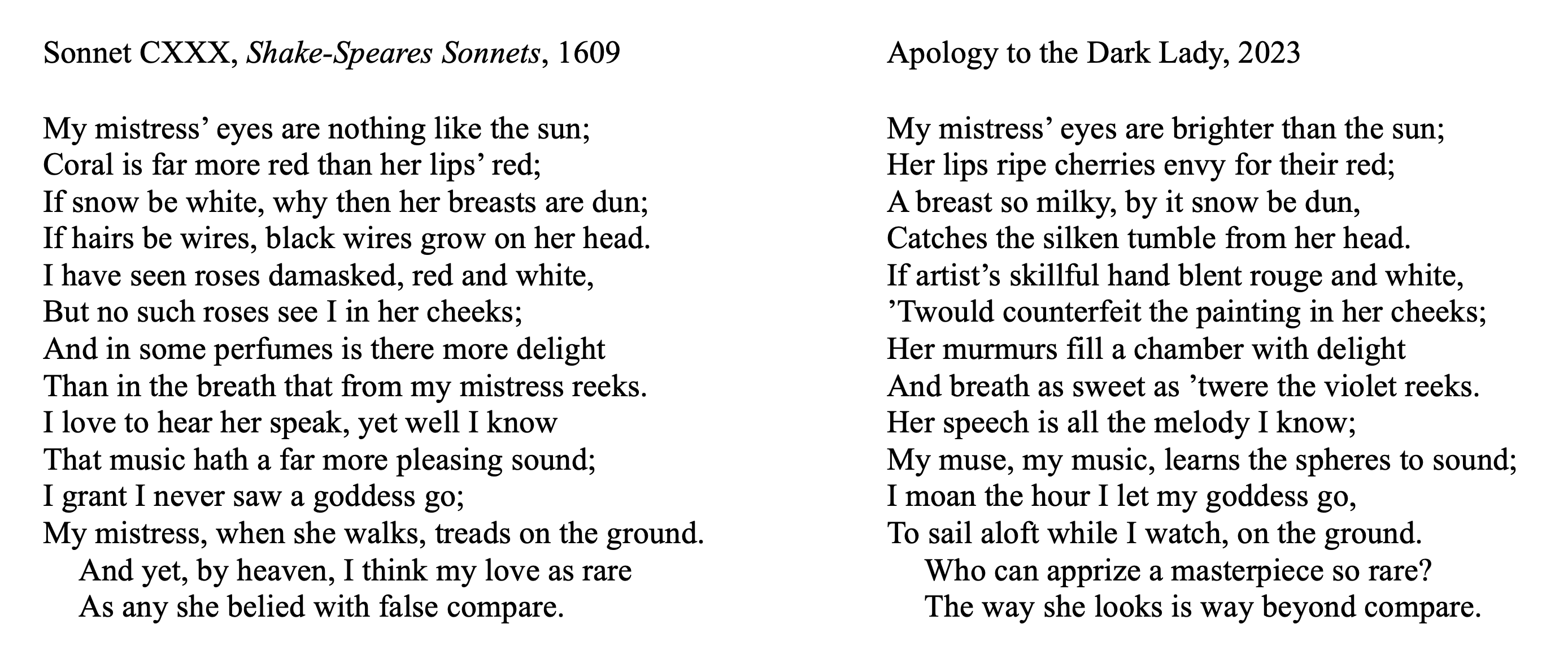
The poem I am sharing today is a redo of a famous Shakespearean sonnet, the one that starts, “My mistress’ eyes are nothing like the sun.” Why reimagine a classic? To redeem Shakespeare’s maligned mistress, known as the “Dark Lady.” What began as a joke between lovers circa 1590 has prompted generations of merciless schoolchildren to mock the Dark Lady’s fictitious flaws, which include bristly hair, foul breath, and a lumbering gait.
In “Apology to the Dark Lady” (below right), I have retained all the original rhymes from Shakespeare’s sonnet (below left), but every insult has been replaced—by a compliment of the very highest order! Let’s give the Bard’s enthralling paramour her due, at long last. And let’s give the actor William Shakespeare a standing ovation as his honorary birthday approaches, on April 23.
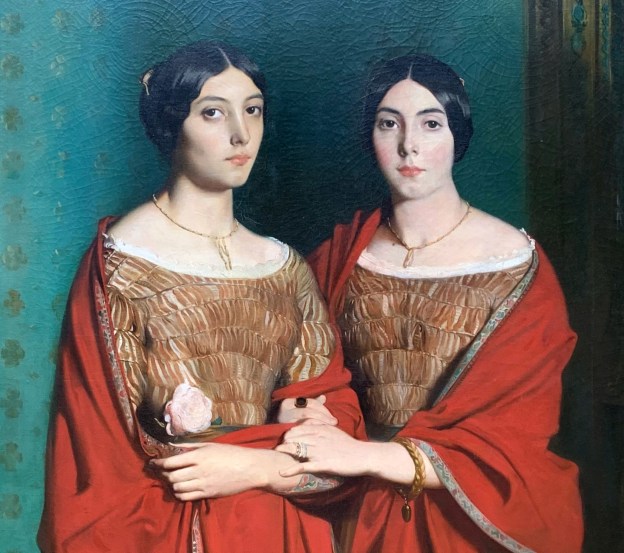
CREDIT: The featured image for this post is The Two Sisters (1843), by the French Romantic painter Théodore Chassériau (1819–1856), photo taken by me. Chassériau painted this portrait of his sisters Adèle and Aline when he was twenty-three. When I saw The Two Sisters at the Louvre last year, I was utterly transfixed.

 This time last week (as I write), I was enjoying afternoon tea at The Berkeley, a lovely hotel in the Knightsbridge area of London. To be more precise, given the time difference between England’s capital and where I am now, afternoon tea was a recent pleasant memory.
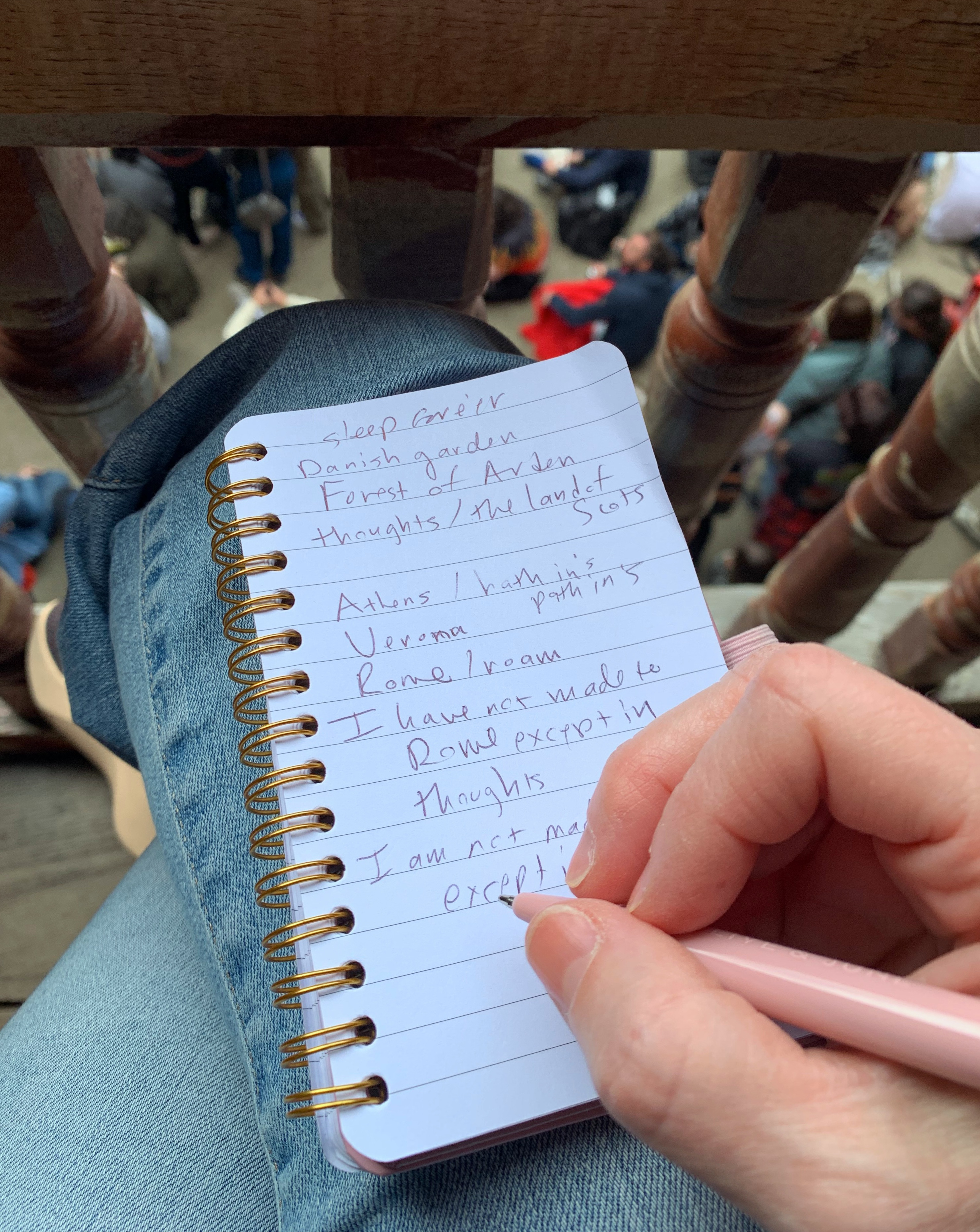 Earlier in the week, I had attended two performances at Shakespeare’s Globe, located on the south bank of the River Thames—so perhaps it’s not a surprise that I have a new sonnet to share with you! I jotted down some ideas for the sonnet during the interval (British for “intermission”) in A Midsummer Night’s Dream, on Tuesday. By The Comedy of Errors, on Thursday, the poem was starting to take shape.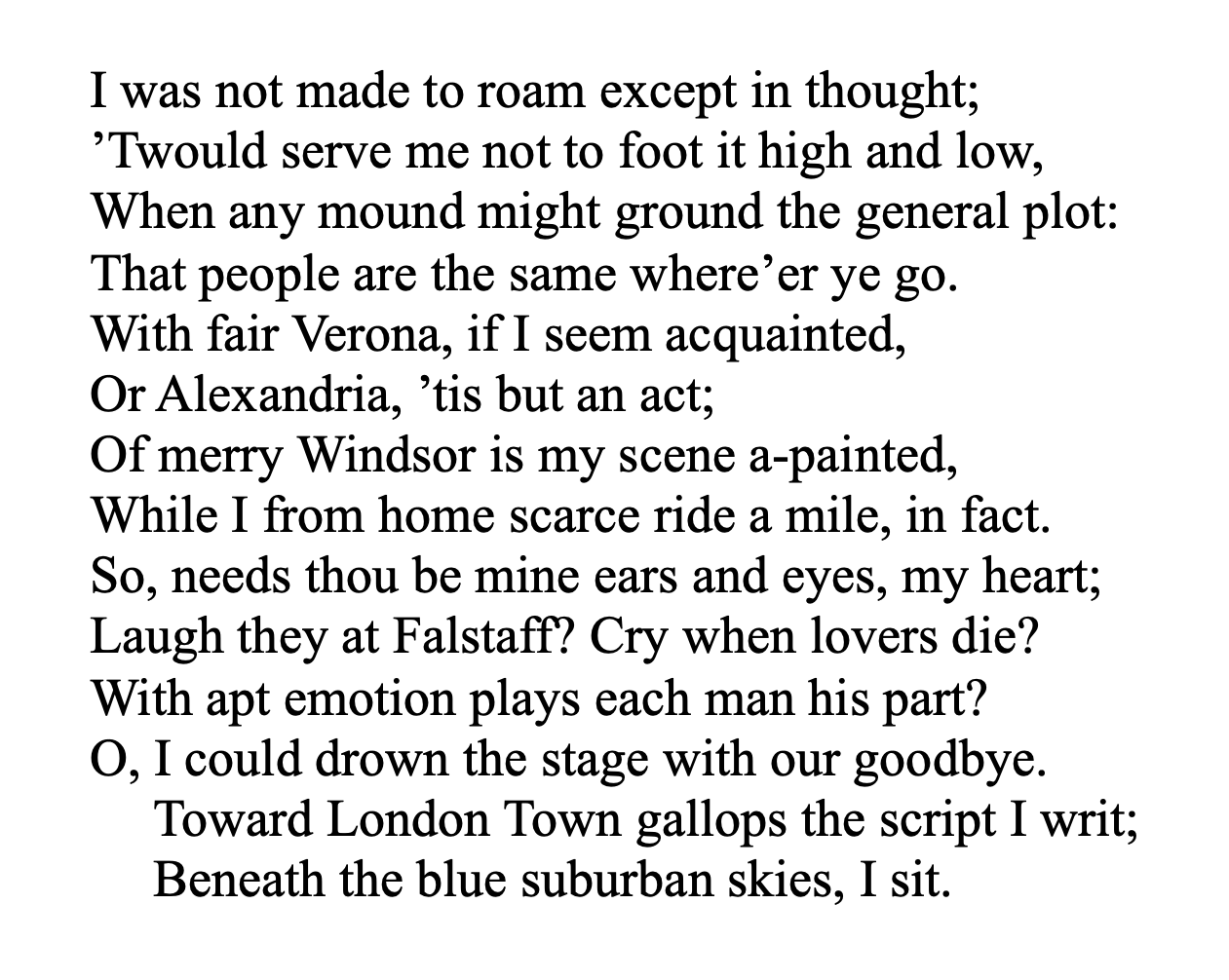
 The poem I am sharing today strongly suggests the identity of the person who wrote the works attributed to William Shakespeare. That’s right: the pesky “authorship question” has finally been solved!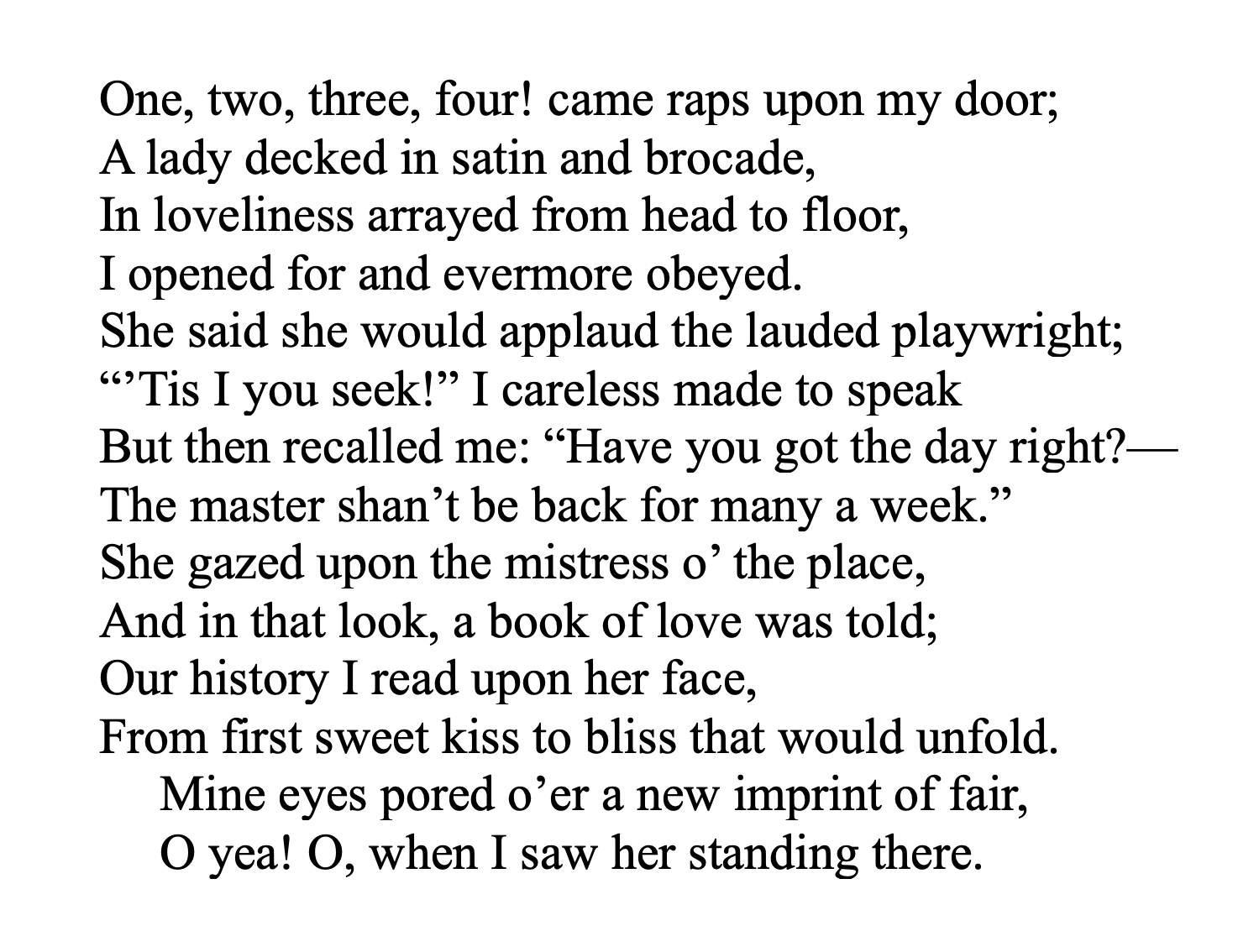
 Novel-Gazing