Category Archives: Shakespeare

Confessions of a Ghost Editor

ghost editorFor four weeks, I had to pretend to be someone else. I messed up once, signing my own name to an e-mail. I concocted an excuse for the mistake, and didn’t sign an e-mail after that.

The person who sends me most of my work was out of the country, without her computer. She didn’t want our projects to lag during her absence, so she asked me to deliver work via her account. I didn’t really mind.

I am a ghost editor. I am not anonymous, because I don’t exist—even namelessly. Rather, my work is presented as someone else’s. As I temporarily assumed this person’s identity, I couldn’t help but wonder: How important is it to get credit for what we do?

This question strikes me as one the ego would ask, as well as rush to answer. Naturally, the part of us concerned with accomplishing something demonstrable in the world desires to be openly acknowledged. Or at least not to have its being negated.

It’s not my business why someone would allow a client to think she did work she didn’t. What is my business is why I have remained contentedly in the shadows for so many years, not developing my own reputation—a name for myself, based on merit and achievement.

In Shakespeare’s Othello, Cassio laments the loss of his good name: “Reputation, reputation, reputation! O, I have lost my reputation! I have lost the immortal part of myself, and what remains is bestial.” I think I disagree.

Reputation is the estimation of others. But the “immortal part of us” is beyond estimation. So reputation must be associated with the “bestial” aspect of our nature—our body, acting upon the earth.

The immortal part of me doesn’t care about seeing its name in the acknowledgments.

Not that it has a name.

Random Acts of Capitalization

Did you know that the phrase “less is more” may have originated from an 1855 poem by Robert Browning? In the 1960s, “less is more” was adopted as an axiom of minimalist architecture. It has since served as a guiding principle in various contexts, including interior design, advertising, and corporate communications. The “less is more” philosophy also applies to an oft-misused element of written English, capitalization.
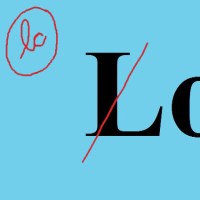
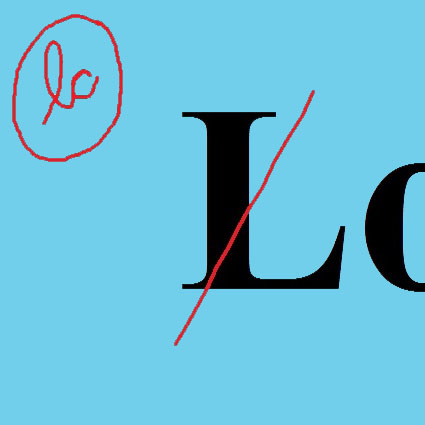
lowercaseCopyeditors haven’t always tracked changes in word processing documents. As recently as the 1990s, we marked up hard copies of manuscripts with red pencils (by the dim glow of kerosene lamps). The protocol for indicating an improperly capitalized word was to strike through it with a forward slash. For me, this dramatic gesture was often accompanied by the thought, “Why? Nooo!” So, why do people seem to think that capitalizing with abandon is such a capital idea?

We are taught in school that certain words are meant to be capitalized, such as the first word in a sentence or quotation, the pronoun “I,” proper nouns, days of the week, months of the year, and holidays. I believe that writers, both casual and serious, are worried they will fail to capitalize when they should. So they overcompensate, introducing capitalization where it isn’t appropriate.

Following are some of the more common capitalization mistakes I encounter in my editing, with the corresponding rules from The Chicago Manual of Style. In the examples, the incorrectly capitalized letters are bold.

Error: Capitalizing important words.

  • Example: “The book is about Jazz Musicians.”

Rule: Initial capitals, once used to lend importance to certain words, are now used only ironically.

An example of the ironic use of initial caps might be, “Last night, she and her boyfriend had The Talk.” Interestingly, Shakespeare is said to have capitalized words, in the original text of his plays, that he wanted his actors to emphasize. Another tidbit: in German, all nouns are capitalized.

Error: Capitalizing titles and offices when they appear after or replace a personal name.

  • Example: “George Washington was the first President of the United States.”
  • Example: “Chester W. Nimitz, Commander in Chief of the Pacific Fleet, played a major role in the naval history of World War II.”
  • Example: “I spoke to the Rabbi.”
  • Example: “She served as the Chief Financial Officer of Vandelay Industries.”

Rule: Civil, military, religious, and professional titles are normally lowercased when following a name or used in place of a name.

Titles appearing before a personal name are capitalized, such as “President Lincoln.” There is an exception, however, for titles used “in apposition”—such as “American president Abraham Lincoln.”

Error: Capitalizing words like army and navy when used on their own.

  • Example: “Elvis joined the Army in March 1958.”

Rule: Words such as army and navy are lowercased when standing alone, when used collectively in the plural, or when not part of an official title.

So, “the army,” “the armies,” and “the United States Army” would be correct.

Error: Capitalizing academic subjects.

  • Example: “He is majoring in Comparative Literature.”

Rule: Academic subjects are not capitalized unless they form part of a department name or an official course name or are themselves proper nouns.

So, “Gender Studies Department,” “Cake Decorating 101,” and “Spanish” would be correct.

Error: Capitalizing seasons.

  • Example: “Santa Barbara holds an annual parade celebrating the Summer solstice.”

Rule: The four seasons are lowercased.

The four seasons are capitalized, however, when used to denote an issue of a journal, such as “Journal of Cupcake Science 2 (Summer 2015).”

So remember, when it comes to capitalization, less is often more. Your overworked Shift key will thank you.

Have All the Stories Been Written?

Romeo and JulietSeveral months ago, I felt inspired to collect ideas for short stories. (This step, which precedes the actual writing, is wonderful, because it isn’t the actual writing.) I tried to find scenarios that would convey concepts I found interesting. For example, I wanted to write about oneness—specifically, how the notion of oneness is difficult to comprehend because we appear to be in individual bodies.

I thought maybe I could illustrate this idea via conjoined twins. Identical twins who are physically joined seem less separate than the rest of us; there is no space between them to suggest disconnection. Indeed, to get along in life, conjoined twins must cooperate; discord would lead to suffering. Mark Twain’s 1869 comic sketch of Chang and Eng Bunker, the famous Thai-American conjoined brothers, humorously illustrates the nature of inseparability:

By an understanding between themselves, Chang does all the in-door work and Eng runs all the errands. This is because Eng likes to go out; Chang’s habits are sedentary. However, Chang always goes along. . . . Upon one occasion the brothers fell out about something, and Chang knocked Eng down, and then tripped and fell on him, whereupon both clinched and began to beat and gouge each other without mercy. The bystanders interfered and tried to separate them, but they could not do it, and so allowed them to fight it out. In the end both were disabled, and were carried to the hospital on one and the same shutter.

Twain may have used the Bunker brothers as a metaphor for national unity.

Around the time I was researching conjoined twins, I became aware of a writing competition calling for short stories in the categories of romance, thriller, crime, horror, science fiction, and young adult. I reasoned that the goal of entering this contest might inspire me to do the (dreaded) actual writing. I chose horror to convey my tale about conjoined twins, although any of the genres might have provided a compelling framework. I fleshed out the plot and characters.

AHSThen the fourth season of the popular TV series American Horror Story premiered, depicting a freak show in Jupiter, Florida, in 1952. Among the characters was a pair of conjoined twins, Bette and Dot Tattler. I found numerous similarities to my prospective horror story about conjoined twins! I surmised that the show’s writers had referred to at least some of the same online sources that I did. Another parallel emerged in the second episode. The freak show’s bearded lady and strong man were portrayed as exes who had a child together. A number of years ago, I wrote a short story (in response to a Writer’s Digest prompt) about a bearded lady and a strong man who get married, and she becomes pregnant!

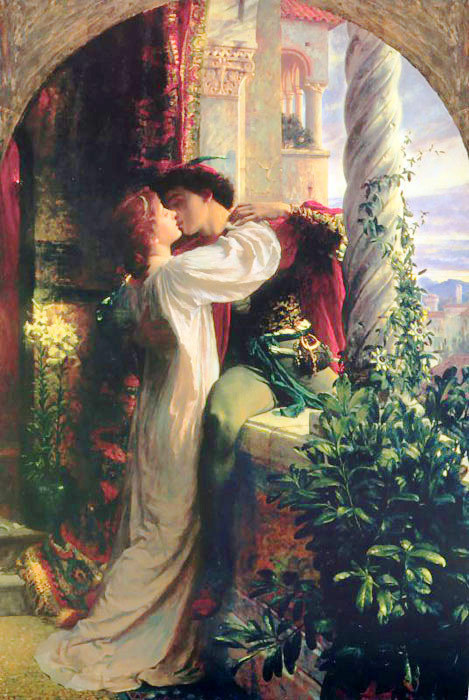
These coincidences got me wondering if it was possible to write a truly original story. I remembered how shocked I was to read in The Riverside Shakespeare, as a college student, that the Bard had based Romeo and Juliet very directly on earlier material—namely, a novel published by an Italian writer circa 1530 (approximately 65 years before Will wrote R&J) that included the story of “two noble lovers”:

Luigi da Porto lays the scene in Verona and names the feuding families the Montecchi and the Cappellati. . . . His Romeo goes to a Cappellati ball to see a girl whom he loves but who scorns him, and falls in love with Giulietta, as she with him. After a longer courtship than Shakespeare allows, conducted mostly on the girl’s balcony, they marry, with the aid of the Franciscan Lorenzo, who hopes that the families will thus be brought together; but Fortune, “enemy of every earthly joy,” prevents this outcome by starting up the feud again. The rest of the story is substantially as in Shakespeare.

Da Porto had been inspired by a 1476 writing by Italian poet Masuccio of Salerno.

So, what is the point of writing stories with the same subject matter, over and over? Perhaps the meaning of a story is more important than the details—and we are willing to accept the same content in slightly different forms. The essential content of most stories is the resolution of a problem. This resolution is not necessarily a happy one, but a natural outcome of how the problem is approached. For instance, I have thought of Shakespeare’s Othello and A Midsummer Night’s Dream as having the same central issue but different outcomes. In the former, Desdemona must defy her father to be with Othello; in the latter, Hermia must defy her father to be with Lysander. The first couple dies; the second couple marries without objection. Both death and marriage are resolutions.

And because our lives are a series of problems, the resolutions found in stories provide catharsis.