Category Archives: Quotes

You Could Be a Shakespeare Expert and Not Know It

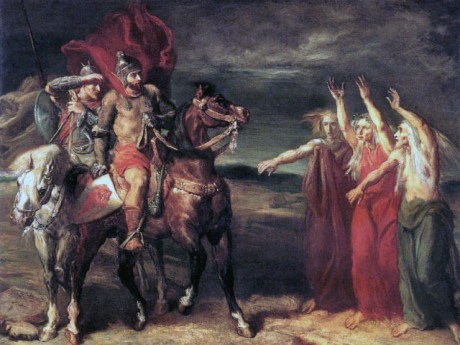
witches

Earlier this month, I saw a production of Macbeth. While 2016 marks the 400th anniversary of the playwright’s death, Shakespeare felt very current that night. The tragedy, about the destructive consequences of political greed, seemed well-timed in the midst of what may go down as one of the most contentious presidential elections in U.S. history. In addition, the play’s witches—the three “weird sisters”—served as a fitting prelude to Halloween.

Ultimately, however, the vitality of “The Scottish Play” came from its language—the beauty of it, but also its lasting impact. Sitting in row E, seat 1, I was awash in nonstop famous lines, along with everyday expressions we may not be aware were popularized by the Bard. I have seen multiple performances of Macbeth, however, and studied all the female characters’ lines for an audition—so I can’t be completely objective about how well-known the words are.

Still, I am prepared to pose a bold thesis: Macbeth has had such a great impact on society and language that an English speaker who hasn’t read it since high school (or ever!) will be able to recognize many quotations from it. To test this theory, I have created a fill-in quiz that should make even sufferers of metrophobia (the fear of poetry) feel pretty smart. (The answers appear at the end of this post.) The numbers after each quote refer to the corresponding act and scene from the play.

  1. lady-m“Double, double toil and _____.” (4.1)
  2. “Out, damned _____!” (5.1)
  3. “By the pricking of my thumbs, / Something _____ this way comes.” (4.1)
  4. “Things without all remedy / Should be without regard; what’s done is _____.” (3.2)
  5. “What, all my pretty chickens and their dam / At one fell _____?” (4.3)
  6. “Eye of _____ and toe of frog.” (4.1)
  7. “That but this blow / Might be the be-all and the _____ here.” (1.7)
  8. “It is a tale / Told by an idiot, full of sound and _____, / Signifying nothing.” (5.5)
  9. “Yet do I fear thy nature; / It is too full o’ the _____ of human kindness.” (1.5)
  10. “Is this a _____ which I see before me, / The handle toward my hand?” (2.1)

Who but an expert in Shakespeare’s works could know 10 (not-so-random) quotes from Macbeth? Based on your number of correct responses, here is your ranking:

10 Shakespeare scholar
9 English teacher
8 Lit major
7 Theater aficionado
6 Honors student
5 CliffsNotes browser
4 Non-nerd
3 Not a fan
2 Hermit
1 Clodpole
0 Extraterrestrial

How didst thou fare? Please shareth thy results!

Answers: 1. trouble, 2. spot, 3. wicked, 4. done, 5. swoop, 6. newt, 7. end-all, 8. fury, 9. milk, 10. dagger.

Highly Quotable Films

Monty Pythin

Several weeks ago, my husband and I had an at-home date night. Dinner was gluten-free pesto pizza, and the movie was Night Shift, a 1982 comedy directed by Ron Howard and starring Henry Winkler and Michael Keaton as city morgue attendants who decide to become pimps. I was thrilled to see that the film was available on cable, because I had been regularly quoting from a particular scene and wanted to show my hubby the original (which I couldn’t find on YouTube). I first saw Night Shift in the theater when I was 14, because my mother, sister, and I were tired from shopping at the Sherman Oaks Galleria. (Shopping continues to exhaust me.) Though I saw the film again numerous times in my youth, I was amazed at how many of the lines I still remembered. I was also surprised at my restraint: I said only about half of them out loud.

Princess BrideTo me, Night Shift represents an HQF (highly quotable film). It offers not just the occasional piece of marvelous dialogue but a continuous succession of amusing utterances. I conducted an informal survey of online lists Airplaneof “most quotable movies.” The film cited most often was . . . Monty Python and the Holy Grail. (Interject your favorite line here; try to stop at one.) The following movies were also regularly identified: The Princess Bride, The Godfather, The AnchormanBig Lebowski, Napoleon Dynamite, and Anchorman: The Legend of Ron Burgundy. Other popular quotable films included The Wizard of Oz, Airplane!, Pulp Fiction, Mean Girls, Ghostbusters, Forrest Gump, Casablanca, Star Wars, Office Space, Caddyshack, and Young Frankenstein.

I was at a dinner party on New Year’s Eve, and one of the guests suggested playing the game of identifying movies by their quotes. I figured I would be pretty good at this pastime but found myself stumped by the first one: “And we’re walking, and we’re walking.” The line sounded familiar, but I couldn’t place it in the 1993 film Dave, in which Kevin Kline portrays a presidential look-alike. That was pretty much the end of the game. However, I ask you to play it with me now! The following quotes are from my personal HQFs. (The answers appear at the end of this post.) If you guess five or more of the corresponding movies correctly, well-done! If you get eight to ten right, you are probably my sister.

  1. “Watch out for that first step—it’s a doozy!”
  2. “Where’s the rest of this moose?”
  3. “Eight o’clock? I don’t know. That’s when I rearrange my sock drawer.”
  4. “You make someone a bridesmaid, and they shit all over you.”
  5. “LOVE BROKERS!”
  6. “I think that the problem may have been that there was a Stonehenge monument on the stage that was in danger of being crushed by a dwarf.”
  7. “Yes, Mrs. Mandelbaum, this one I’ll meet.”
  8. “Oh, that Dorothy. The hair, the teeth, and the smell. That Dorothy.”
  9. “Do you know what he was planning for next Friday night’s poker game, as a change of pace? Do you have any idea? A luau. A Hawaiian luau. Roast pork, fried rice, spare ribs—they don’t play poker like that in Honolulu!”
  10. “This land is not for sale. Someday I hope to build on it!”

The American Film Institute undertook the challenge of identifying the 100 greatest movie quotes of all time. Of the most quotable films mentioned earlier, seven have entries on AFI’s list. (Casablanca has six!) Jean Picker Firstenberg, president emerita of AFI, asserts, “Great movie quotes become part of our cultural vocabulary.” Indeed, we use them in our own lives and circumstances, for various purposes: To make a point. To sound clever. To entertain. To start a conversation. To bond with others. To recall the satisfaction evoked by watching the movie.

Ultimately, a memorable quote, from a movie, play, book, television show, or even commercial, is one that resonates with us. It might express an idea to which we would never be able to put words ourselves, witness a fundamental aspect of our character, or educate us about something meaningful. I am reminded of the double-blind-date scene from one of my own HQFs, When Harry Met Sally . . ., in which Marie (Carrie Fisher) quotes Jess (Bruno Kirby) to himself:

JESS: I think restaurants have become too important.

MARIE: I agree. “Restaurants are to people in the 80s what theater was to people in the 60s.” I read that in a magazine.

JESS: I wrote that.

Marie goes on to say, “That piece had a real impact on me.” Jess replies, “It spoke to you, and that pleases me.” Being spoken to can be a profound experience.

In fact, Jess and Marie leap into a cab together at the first opportunity.

Answers: 1. Groundhog Day, 2. Arthur, 3. The Sure Thing, 4. Sixteen Candles, 5. Night Shift, 6. This Is Spinal Tap, 7. Crossing Delancey, 8. Gregory’s Girl, 9. The Odd Couple, 10. Love and Death.

Famous Last Words

Death Bed

The average person speaks millions of words in a lifetime, most of them mundane, but some, hopefully, profound. I don’t know about anyone else, but I think I’d like to go out on a high note. If I were on my deathbed and happened to say something pithy, wise, or clever, I might just shut up after that. Through the years, the last words uttered by famous people have been recorded and collected. Maybe we hope that those on the verge of death acquire an expanded vision of life, and we can learn from their final observations. Here is a sampling:

  • John Quincy Adams: “This is the last of earth! I am content.”
  • Bing Crosby: “That was a great game of golf, fellas.”
  • Louis XIV: “Why are you weeping? Did you imagine that I was immortal?”
  • Karl Marx: “Go on, get out. Last words are for fools who haven’t said enough.”
  • Sir Walter Raleigh: “I have a long journey to take, and must bid the company farewell.”
  • Salvador Dalí: “I do not believe in my death.”
  • Michael Jackson: “I love you more.”
  • Nostradamus: “Tomorrow, I shall no longer be here.”
  • P. T. Barnum: “How were the receipts today at Madison Square Garden?”
  • Emily Dickinson: “I must go in; the fog is rising.”
  • Dominique Bouhours (French grammarian): “I am about to—or I am going to—die: either expression is correct.”
  • Steve Jobs: “Oh wow. Oh wow. Oh wow.”

About two weeks before my father died, it was arranged that a hospice worker would be with him 24 hours a day. When Walter arrived, he checked the paperwork, which indicated that Dad was unconscious. Still, Walter approached him in the manner he would any patient: “Hello, Mr. Greenfield. My name is Walter. How are you today?” “I feel fine!” came the startling reply. Those were the last words anyone reported hearing my father speak. I may be biased, but I think they hold up to the ones attributed to famous people.

In fact, Mom is considering putting them on his gravestone.