
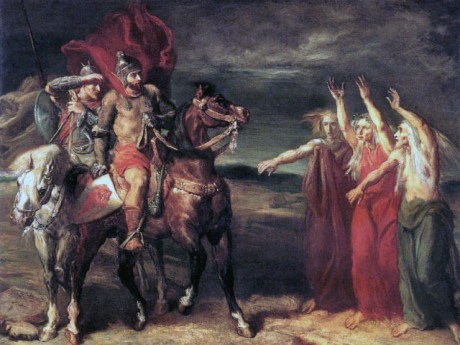
Earlier this month, I saw a production of Macbeth. While 2016 marks the 400th anniversary of the playwright’s death, Shakespeare felt very current that night. The tragedy, about the destructive consequences of political greed, seemed well-timed in the midst of what may go down as one of the most contentious presidential elections in U.S. history. In addition, the play’s witches—the three “weird sisters”—served as a fitting prelude to Halloween.
Ultimately, however, the vitality of “The Scottish Play” came from its language—the beauty of it, but also its lasting impact. Sitting in row E, seat 1, I was awash in nonstop famous lines, along with everyday expressions we may not be aware were popularized by the Bard. I have seen multiple performances of Macbeth, however, and studied all the female characters’ lines for an audition—so I can’t be completely objective about how well-known the words are.
Still, I am prepared to pose a bold thesis: Macbeth has had such a great impact on society and language that an English speaker who hasn’t read it since high school (or ever!) will be able to recognize many quotations from it. To test this theory, I have created a fill-in quiz that should make even sufferers of metrophobia (the fear of poetry) feel pretty smart. (The answers appear at the end of this post.) The numbers after each quote refer to the corresponding act and scene from the play.
 “Double, double toil and _____.” (4.1)
- “Out, damned _____!” (5.1)
- “By the pricking of my thumbs, / Something _____ this way comes.” (4.1)
- “Things without all remedy / Should be without regard; what’s done is _____.” (3.2)
- “What, all my pretty chickens and their dam / At one fell _____?” (4.3)
- “Eye of _____ and toe of frog.” (4.1)
- “That but this blow / Might be the be-all and the _____ here.” (1.7)
- “It is a tale / Told by an idiot, full of sound and _____, / Signifying nothing.” (5.5)
- “Yet do I fear thy nature; / It is too full o’ the _____ of human kindness.” (1.5)
- “Is this a _____ which I see before me, / The handle toward my hand?” (2.1)
Who but an expert in Shakespeare’s works could know 10 (not-so-random) quotes from Macbeth? Based on your number of correct responses, here is your ranking:
10 Shakespeare scholar
9 English teacher
8 Lit major
7 Theater aficionado
6 Honors student
5 CliffsNotes browser
4 Non-nerd
3 Not a fan
2 Hermit
1 Clodpole
0 Extraterrestrial
How didst thou fare? Please shareth thy results!
Answers: 1. trouble, 2. spot, 3. wicked, 4. done, 5. swoop, 6. newt, 7. end-all, 8. fury, 9. milk, 10. dagger.


 Novel-Gazing