William Shakespeare (1564–1616) was barely literate, but he could not have died more poetically: on the same day and month he was born, April 23. Today would have been his 461st birthday (if people lived for centuries), as we commemorate the 409th anniversary of his death.
I’m not ready to lay out a case for who wrote the works attributed to William Shakespeare, because I don’t think the world is ready to entertain the idea that the individual widely regarded as the greatest writer in the English language (according to Wikipedia, anyway) was a woman—let alone one who grew up on a farm, in a rigidly patriarchal society that didn’t educate girls.
This is a woman whom scholars claim to know very little about, outside public records. They dismiss her as a footnote in the life of a literary genius—not realizing it was she who wrote the plays and poems they study, teach, and publish criticism on.
No, the time just doesn’t feel right—though perhaps it is ripe. We probably need this information now, if only to expand our thinking a bit—to encompass the fact that the configuration of sex organs within the human body has no bearing on the soul’s depth to feel or on the mind’s capacity to learn, imagine, or create. Ultimately, the sex of the person who wrote Hamlet, Romeo and Juliet, and A Midsummer Night’s Dream shouldn’t matter—which, perhaps, is all the meaning in answering the authorship question once and for all.
Today, I am sharing a sonnet that might have been penned by Anne Hathaway, William Shakespeare’s wife of thirty-three years, upon the death of her husband. It follows the sonnet form that was popularized, though not invented, by the writer of Shakespeare’s works—but I have leveled up the difficulty a bit. (I’m a bookish kind of daredevil.) Here’s the rhyme scheme of the traditional Shakespearean sonnet:
ABAB CDCD EFEF GG
The different letters represent pairs of lines that rhyme with each other: so, the first and third (A an A), the second and fourth (B and B), the fifth and seventh (C and C)—all the way to the closing couplet (G and G). Today’s sonnet, however, uses the following, somewhat more ambitious rhyming pattern:
ABAB ACAC ADAD AA
What this means is that over half the lines in the poem (eight out of fourteen) rhyme with each other: specifically, lines 1, 3, 5, 7, 9, 11, 13, and 14. This more demanding rhyme scheme, which requires additional craft from the poet, pays homage to the profound specialness of the subject.
From Anne Hathaway…
Each sonnet in my series concludes with lyrics written by the original Paul McCartney (who died in 1966). I took the last line of today’s sonnet from the title track of George Harrison’s triple album All Things Must Pass (1970). I suspect Paul was inspired to write “All Things Must Pass” (the song) by his mother’s passing, when he was fourteen; or by the death of the Beatles’ first bassist, Stuart Sutcliffe, when Paul was nineteen. The song offers words of comfort from the deceased, using natural phenomena (sunrise, sunset, a cloudburst) as metaphors.
In previous posts, I have noted Paul McCartney’s systematic use of meter in his lyrics. In fact, Paul employs enough of the metrical “feet” (rhythmic units) required for Shakespearean sonnets that I have gleaned about two hundred possible last lines for sonnets so far. (Fans might also notice that today’s sonnet opens with a nod to the Beatles’ 1965 classic “Help!”)
It should probably come as no surprise that English student Paul McCartney wrote at least one Shakespearean-style sonnet. This poem has survived, mostly intact. Paul’s replacement published it in his memoir, as his own—but modified two lines to refer to his wife Linda, who died in 1998. While I do not wish to diminish the sentiment of those lines by omitting them below, they are not Paul’s. And Paul would have been mortified to take credit for words he did not write (especially when they contained a punctuation error and a questionable rhyming choice). So, here is the greater part of a Shakespearean sonnet written by young Paul McCartney following the death of his mother:
She was the source of all that life could bring. Each day her glory woke the morning rays. Her voice was first of all the birds to sing. It was her calling to ignite the days. … … An advocate for every beating heart, She would defend each child and each mouse. But now her face and song are not as clear. Her image and her voice are in a haze. Though still she whispers guidance in my ear, Don’t see her ’round the house as much these days. The more delight we find in love and song, The more we’re left to miss them when they’re gone.
Regarding the subject matter of the two missing lines, I can only speculate. Perhaps they refer to Mary McCartney’s work as a midwife and as the head nurse of a hospital maternity ward—hence the words “advocate,” “beating heart,” “defend,” and “child” in the two remaining lines of the quatrain.
In closing, I can attest that a sonnet, like a song, makes a pretty little container to put one’s grief in.
This post contains accounts of physical and emotional abuse between partners in a personal relationship. If descriptions of domestic violence leave you feeling vulnerable to anxiety or depression, you might want to skip this one. If you choose to continue, please take care.
As I mentioned in a previous post, the original Paul McCartney chipped his left front tooth in December 1965. For the next three months, the Beatles kept a low profile. When they reemerged into the public eye, in the spring of 1966, fans took notice of Paul’s broken smile. They wanted to know what had happened to him—and when he was going to fix that cracked gnasher.
Word circulated that Paul’s tooth had been damaged in a moped accident in the Wirral, the peninsula in North West England where his father lived. But I don’t buy it. Based on photos, song lyrics, research, and deductive reasoning, I have arrived at a far more disturbing scenario behind Paul’s dental injury.
The Official Story
In the late spring or early summer of 1966, Brian Epstein, the Beatles’ manager, issued a formal explanation for Paul McCartney’s goofier-than-normal grin. Brian’s words appeared in the American teen magazine 16:
Last mid-December, Paul injured his lip and chipped his tooth in the mo-ped accident. He honestly thought no one would notice the chip, for it is so small. I told him three times he should do something about it. It is in a place where there are no nerve ends, so there is no pain. Paul assured me that he would have the tooth capped, but—unfortunately—he has not done so. It is my opinion that he will just let it be.
I couldn’t confirm the publication date of this statement, but it appears in an article that refers to June 5, 1966, as having occurred in the recent past. Around the same time, on June 24, 1966, New Musical Express, a pop periodical in the UK, published Paul’s version of events:
It was quite a serious accident at the time. It probably sounds daft, having a serious accident on a motorised bicycle, but I came off hard and I got knocked about a bit. My head and lip were cut and I broke the tooth. I was only doing about 30 at the time, but it was dark and I hit a stone and went flyin’ through the air. It was my fault all right. It was a nice night and I was looking at the moon!
Later, Paul’s replacement embellished the story—which was expanded to include Tara Browne, a British socialite and an heir to the Guinness fortune, who died in December 1966 (two months after Paul):
We were riding along on the mopeds. I was showing Tara the scenery. He was behind me, and it was an incredible full moon; it really was huge. I said something about the moon and he said ‘yeah,’ and I suddenly had a freeze-frame image of myself at that angle to the ground when it’s too late to pull back up again: I was still looking at the moon and then I looked at the ground, and it seemed to take a few minutes to think, ‘Ah, too bad—I’m going to smack that pavement with my face!’ Bang!
Paul’s replacement would have been wise to check which phase the moon was in that night. On December 26, 1965, the accepted date of the “accident,” Earth’s satellite was a “waxing crescent.” It would have looked like a small, illuminated sliver—not the kind of perfectly glowing orb that might upend a man’s motorbike. The full moon had occurred over two weeks earlier, on December 8, when the Beatles were performing two shows at Gaumont Cinema, in Sheffield, England.
We can guess why Paul’s replacement might have added details to the original story: he was surely questioned, with some regularity, about the incident in which “he” broke “his” tooth. But why would Brian Epstein and Paul McCartney have lied about what happened? What terrible truth might they have been hiding?
A Photo That Told a Different Story
A few years ago, I came across a photograph of Paul McCartney taken right after his alleged wipeout on a moped. I have seen this image credited to Paul’s brother, Mike. It makes sense that Paul and Mike would have been together the day after Christmas, at their father’s house, which was in the vicinity of the supposed motorbike accident. As a photographer, Mike certainly would have had his camera on hand.
But as I studied Paul’s face in the photo, a thought entered my mind, unbidden: “This looks like a man who has been beaten up.” Paul appeared to have been punched on the left side of the mouth and in the left eye. More recently, I encountered a photo from the same occasion but with less contrast, offering a clearer view of Paul’s injuries—which also included a laceration on the left side of the bridge of his nose.
In both photos, Paul’s expression is one of desolation and despair, rather than: “I can’t believe I came off that bike! What an arse!” And why take a picture at such a moment—to capture, for all time, the result of Paul’s lack of coordination? I believe Paul, or someone else, had the idea to document his wounds, in case charges were to be filed against his attacker.
Assuming Paul was assaulted, who would have—and could have—done it? Who would have had the motive and the access? I mentally explored scenarios in which a stranger might have ambushed Paul McCartney. Ultimately, however, I settled on the likelier possibility that the assailant was someone “on the inside.” Then a really awful thought began to nag at me—an unthinkable thought! One that would shock Beatles fans.
Over time, the pieces of the story fell together.
Paul Meets Jane
On April 18, 1963, Paul McCartney met Jane Asher. He was twenty; she had just turned seventeen. The Beatles were big enough to be part of a lineup at London’s Royal Albert Hall (billed second) but were not household names yet. While Paul was onstage with the band, Jane was in the audience providing commentary for the Radio Times, a weekly magazine that listed radio and television programs. Prompted by the publication’s photographer, Jane was snapped screaming for the Beatles—like the girls around her. After the event, she went backstage and was invited to keep company with the group that night.
I might have had a dream memory related to this initial meeting between Paul and Jane—viewed from her perspective. I wonder if Jane might recognize the following scene, as recorded in my journal on September 14, 2023:
I had several Beatles-related dreams [this morning]. In the first dream, I was in a room. I might have been standing, but I feel more like I was sitting on a couch. I was aware that standing behind me, about ten feet away, were members of the Beatles—definitely including the original Paul McCartney. I wasn’t looking at them; my back was to them. I am trying to put my finger on my feeling in the moment. I think I was slightly awed by their presence—but “awe” is too strong a word. I was aware of them, and I knew they were members of the Beatles. There was the sense that they were waiting for something; maybe they were waiting for some kind of an engagement to start.
I have read that during Paul’s first encounter with Jane, he impressed her by quoting Chaucer. Specifically, he said, “Ful semely hir wimpel pinched was.” This line appears in the General Prologue of The Canterbury Tales, in Chaucer’s description of the Prioress (a nun). While the words sound a bit salacious, all they mean is that the Prioress, a sharp dresser, wore a well-pressed cloth around her neck. I believe I am the only one to proffer a theory as to why Paul quoted this particular line, from among the 17,000 lines in the medieval masterpiece. I imagine that after an evening spent talking, Paul and Jane had an exchange like the following:
Jane: I’d like to go home now. Paul: Of course! I’ll see you to your door. Where do you live? Jane: In Wimpole Street. Paul: Oh! “Ful semely hir wimpel pinched was.” Jane: Paul! You’re so clever and well-read! [writer’s embellishment]
If you missed it, Jane lived on Wimpole Street; the Prioress wore a wimpel.
In my last post, I mentioned that John, Paul, George, and Ringo had known—or known of—each other during the Romantic Period (in past lives). Jane was there, too; she and Paul were siblings, though not related by blood. Two hundred years before that, Jane and Paul were both English dramatists, whose plays are still studied and performed today. It makes sense, then, that when they met (again) in 1963, they connected quickly and bonded over literature. As a footnote, Jane Asher is a fine writer in this lifetime. I read one of her novels, The Question (1998), five or six years ago; I can still remember the ending and how it chilled me to the bone.
A Springtime Engagement
At the end of March 1965, Paul McCartney had a photo session with Jane Asher on the set of the Beatles’ movie Help! In the photos, Jane appears to be wearing an engagement ring, on the fourth finger of her right hand. Based on my survey of the images available online, Jane would not be seen wearing this ring again—except in a photo taken two months later, which I will say more about in a bit.
Why was that ring (almost) never spotted on Jane’s finger again? Maybe Paul and Jane wanted to keep their engagement private. Or maybe Brian Epstein asked Jane not to wear the ring in public, so Paul would still appear “available.” Ringo had tied the knot with Maureen Cox just a month earlier, and perhaps Brian wasn’t ready to lose one of the group’s two remaining bachelors quite yet. I’m not sure it really mattered, though: John’s status as a married man, wed to Cynthia since 1962, hadn’t seemed to dampen enthusiasm for the band.
We get a glimpse of Paul’s feelings for Jane through Beatles songs recorded both before and after their engagement:
A love like ours could never die. (“And I Love Her,” 1964)
Through thick and thin, she will always be my friend. (“Another Girl,” 1965)
If she’s beside me, I know I need never care. (“Here, There and Everywhere,” 1966)
I’m so proud to know that she is mine. (“Good Day Sunshine,” 1966)
The sincerity of Paul’s affection for Jane is evident in the following stanza from “Center of Love,” a poem he wrote for her:
And I touched you, As I caressed your glowing hair. And the peace I felt in you, It was as tender as a dove. And I knew that it would last, So I whispered in your ear, That we were lying there, You and I, in the center of love.
Paul’s replacement published this poem, as his own, in his 2009 memoir.
Within three weeks of his engagement shoot with Jane, Paul purchased a home in the St. John’s Wood neighborhood of London. The three-story Regency townhouse was situated about a mile and a half from where Jane currently lived with her parents and siblings, and where Paul resided in an attic bedroom. It was also an eight-minute walk from EMI Studios, where the Beatles did most of their recording.
The Day Before “Yesterday”
I hope I have successfully conveyed the forward momentum of Paul McCartney’s relationship with Jane Asher in the spring of 1965. To recap, Jane’s engagement ring made its first appearance sometime between March 24 and March 30; on April 13, Paul bought a house. On May 27, Paul and Jane left for a two-week holiday in Portugal—during which, I think, they planned to marry.
On May 26, the day before the couple’s departure, the Beatles recorded their fifty-second and final musical appearance for BBC radio. Between 2:30 and 6:00 p.m., the group rehearsed and recorded seven songs at the BBC’s Piccadilly Studios, in London. When the session was over, I believe Paul informed John of his impending nuptials—probably so John wouldn’t hear it somewhere else, if word got out.
At this point, I speculate, John issued Paul an ultimatum: If he married Jane, he would lose John and the Beatles. Their relationship would be through. And the band would be through.
A Failed Elopement
Paul McCartney’s elopement with Jane Asher started as inauspiciously as it possibly could have. During the five-hour car ride from the airport in Lisbon to the Algarve (Portugal’s southernmost region), John’s warning from the previous day must have been ringing in Paul’s ears: He could marry Jane or be a Beatle, but not both. And if John broke up the Beatles because of Paul, then George and Ringo would suffer, too! By the time Paul and Jane arrived in the coastal city of Albufeira, Paul had penned the lyrics to “Yesterday,” on the back of a brown envelope. (The song’s melody had come to him months earlier.)
“Yesterday” gives the impression of being a song about lost love. And it is that, to a certain degree. But more significantly, the verses express how Paul was feeling in the midst of an extremely challenging situation. He felt troubled, a fragment of the man who had seemed to have his life all figured out just the day before, wishing he could hide, with the shadow of a terrible choice hanging over him. The bridge to “Yesterday” includes the line, “I said something wrong.” That something was: “I’m marrying Jane Asher.”
A photo of Paul and Jane in a restaurant in Portugal tells an interesting story. Both have their heads turned to face the camera. Jane appears happy and relaxed, with a knowing look in her eye. Paul, wine glass in hand, looks anxious, barely able to muster a tense smile. If you click the image and zoom in, you will see that Jane appears to be wearing a ring on the fourth finger of her right hand. I believe this is her engagement ring—which she feels free to wear here, in this remote location, in the days or hours leading up to her wedding.
Judging from Jane’s expression in the photo, I doubt Paul had shared his conundrum with her yet. But at some point, he must have told her about John’s conditions for the continuance of the Beatles. I can feel Paul’s deep desire to be married and have a family, and to take responsibility for the three children he had already fathered. I imagine he told Jane that he wanted to stick to their plan to get married in Portugal. Perhaps Jane responded, with compassion and humor, that the mood was sort of ruined, and there would be a better time to exchange vows.
Back to Reality
Brian Epstein asked Paul and Jane to return from Portugal a day early so that all four Beatles would be in Britain on June 11, when it was to be announced they were being awarded an honor called Member of the Order of the British Empire (MBE). I have the sense that Paul and Jane were relieved to shave a day off the saddest non-honeymoon in history. The following morning, on June 12, the Beatles gathered at Twickenham Film Studios to watch a rough edit of Help! Well, all of them but one: John didn’t show.
News outlets were clamoring for the Beatles’ reactions to the MBE announcement, so a press conference was hastily arranged at the studios. John arrived over an hour late, and only after Brian had retrieved him personally from his home. John explained his tardiness to the 150 assembled reporters:
I set the alarm for eight o’clock and then I just laid there. I thought, “Well, if anyone wants me, they’ll phone me.” The phone went lots of times, but that’s the one I never answer. My own phone didn’t go at all, so I just laid there.
You might hear John’s excuse and think, “That John Lennon—what a quirky fellow.” But I believe his absence was entirely deliberate. He didn’t want to see Paul. He thought, “Paul is married, and the Beatles don’t exist anymore.”
Two days later, on the evening of June 14, Paul recorded the song for which he finally had lyrics: “Yesterday.” That afternoon, the group had recorded two other songs featuring Paul: “I’ve Just Seen a Face” and “I’m Down.” This latter track contains the line, “Man buys ring, woman throws it away”—clearly a reference to Paul’s ill-fated elopement with Jane. But Paul and Jane weren’t broken up. After the “Yesterday” session ended, at 10 p.m., they went to a nightclub in South Kensington together. Nevertheless, the fact that John was essentially holding the Beatles hostage must have imposed a serious strain on their relationship.
Paul’s Three “Women”
Toward the end of 1965, Paul McCartney wanted to write a song for Jane Asher called “Woman.” He made several attempts, resulting in at least three songs with that title. One “Woman” would be recorded by the British pop duo Peter and Gordon, while Paul was still alive, with his full permission and—hopefully—apologies. It’s not very good. Perhaps the most redeemable lines are as follows:
Woman, don’t forsake me Woman, if you take me Then believe me, I’ll take you To be my woman
Peter Asher and Gordon Waller did a lovely job with the song, taking it to the top twenty in the United States. These two souls, during the English Renaissance, had been instrumental in preserving the plays of Shakespeare for posterity; so, the least Paul could do was pass along a few tunes. (The earlier “A World Without Love” was a much better gift.)
Two other songs of Paul’s called “Woman” were stolen, after his death, by different artists. John Lennon recorded one of them for his album Double Fantasy (1980). As a single, it reached the top spot in the UK and peaked at number two in the United States. I believe this “Woman” was the one Paul wanted to write for Jane. I think he was satisfied that it expressed what was in his heart.
And what of the third “Woman”? Paul’s brother, Mike, put his name on it, recorded it, and released it as the haunting title track of his 1972 album Woman. Here’s the weird, gross, funny part: The song is intensely intimate, intended to be shared only between lovers—yet Mike’s mother is on the album cover, representing “Woman.” (Of course, Mary McCartney was Paul’s mum, too.) This is not a song about one’s mother. I can’t imagine that the sexual imagery could have been misinterpreted. Here’s the first line: “Woman, I want to go down and drown in you.” The absurdity takes a bit of the sting out of the fraternal betrayal.
A Christmas Promise
I have no proof of the scenario presented in this section, but working back from the larger story, it makes sense to me.
On Christmas morning, 1965, Paul McCartney serenaded Jane Asher with the song “Woman,” as a renewal of his proposal and of their plan to marry. But which “Woman” do you think it was?
The so-so one that Peter and Gordon turned into a respectable song
The expressive one that John Lennon made famous
The erotic one that Paul’s brother recorded
If you guessed number 2, you’re right. If you guessed number 3, you’re making me laugh right now. Indeed, lyrics from the “Woman” Paul sang to Jane on Christmas Day sound very much at home in a marriage proposal:
“I’m forever in your debt”
“Hold me close to your heart”
“My life is in your hands”
“It is written in the stars”
“I love you…now and forever”
Paul had essentially said, “Sod the Beatles. Let’s just do it.” Jane accepted. By the way, that’s the risk of dating a musician: at the holidays, you’re likely to get a song instead of a real gift.
I read somewhere that Jane Asher’s favorite song is “Woman”—the one recorded by Peter and Gordon. Peter Asher, of Peter and Gordon, is Jane’s brother. And the song was written by her fiancé. So, the choice makes sense. But I like to think that when Jane mentions her favorite song, she is secretly nodding to the “Woman” Paul crooned to her to persuade her to marry him.
Later that day, Jane and Paul traveled from her family’s home in London to be with his relatives in and around Liverpool.
How Paul McCartney Broke His Tooth
Fifty-nine years ago today, on December 26, 1965, John Lennon savagely attacked his bandmate Paul McCartney in a fit of jealousy—breaking Paul’s left front tooth and causing multiple lacerations. I know, I could have told you that right at the top. But I think you’ll appreciate having the foregoing information as you read my speculative dramatization of what happened:
On the day after Christmas, 1965, Paul McCartney and his fiancée, Jane Asher, were at Paul’s father’s house, in Heswall, on the Wirral Peninsula. The festive mood was made even jollier by talk of the future nuptials of two so dear to all who were present.
There was a knock on the door. It was John Lennon. He hadn’t been expected. He wanted to talk to Paul alone, upstairs. He didn’t say why.
The bedroom door closed behind them.
“Is it true?” John asked, quietly. “Is the rumor I heard true?”
“Yes,” Paul said. “It’s true.” He wanted to sound confident, to look John in the eye. But there was a tremor in his voice; his look was askance.
Instantly, a rage rose inside John. He started pummeling Paul, who was too busy defending himself to get off any shots of his own.
“Stop!” Paul cried. “John, stop!” He was scared. He thought his bandmate might kill him.
John hurled insults as he punched Paul in the mouth, the nose, the eye.
Those gathered downstairs became aware of raised voices and a commotion coming from the floor above. They burst in. John ceased his attack.
“Get out of here, Lennon!” snarled Jim, Paul’s father. “I never liked your sort.”
John left. It was obvious that Paul was going to live. Mike McCartney fetched his camera, to document his brother’s injuries—in case charges were to be filed.
Paul went to Accident and Emergency. The doctor on duty, as he put several stitches inside Paul’s mouth, inquired delicately of his famous patient: “You’re not the ‘cute one,’ are you?”
As they say, comedy is tragedy plus time. I should note that Paul sustained injuries to the left side of his face, consistent with the fact that John was right-handed. In a future post, I will describe John’s history of violent acts, including an earlier incident motivated by jealousy over Paul—with even more dire consequences.
A number of years ago, I noted something Ruth McCartney said in an essay that appears in her mother’s memoir Your Mother Should Know (by Angie McCartney). Ruth, Paul’s much younger sister, relates a memory of “John and Paul arguing out a song together in the attic at Cavendish Avenue,” referring to Paul’s home in London. Ruth would have been five years old when John Lennon attacked her brother. Is it possible she has misremembered Jim McCartney’s house as Paul’s house? And the “argument” she heard was John Lennon beating up Paul McCartney? Maybe, as a little girl, she was told that Paul and her uncle John had been fighting about a song.
Mike McCartney took a picture of his father and titled it “Dad doing his Crossword.” I can’t link to it, but I will describe it to you: Jim McCartney sits in an armchair, in a wood-paneled room, his newspaper in front of him. Behind him is a shelf-like projection, possibly the mantel of a fireplace. On this mantel rests a photo of the Beatles, propped up next to what appears to be a framed music award. When I first saw this image, I noticed something strange: There were only three Beatles in the photo on the mantel. I could make out George and Paul, with Ringo in front of Paul. But where was John? His visage must have been hidden (deliberately?) behind the framed music award.
Just a Jealous Guy
Any musician who has covered the song “Jealous Guy” (such as Joe Cocker, Roxy Music, or the Weeknd) has paid tribute to the time John Lennon beat the crap out of Paul McCartney. If you want to know what happened that day, “Jealous Guy” offers some clues:
“My heart was beating fast”
“I was tryin’ to catch your eyes / Thought that you was tryin’ to hide”
“I began to lose control”
“I was feeling insecure / You might not love me anymore”
“I was swallowing my pain”
Here’s the twisty part: Paul wrote “Jealous Guy” from John’s perspective, for him to sing. Which John did, on his Imagine album (1971).
When I made the connection between “Jealous Guy” and the photo of Paul’s battered face, I felt gratified. At least John had apologized, even if Paul was no longer alive to hear him:
I didn’t mean to hurt you I’m sorry that I made you cry I didn’t want to hurt you I’m just a jealous guy
But then I studied the lyrics. Metrically, the verses were perfectly regular, making it unlikely John had written them. In a previous post, I made the case that the original Paul McCartney was the sole composer of virtually the entire Beatles’ catalog—and many of the members’ best-known solo hits. “Jealous Guy” appears to be one of them. It fits Paul’s “songwriting fingerprint” exactly.
I was confused: Why would Paul have taken his abuser’s point of view? I came up with several possible reasons:
He was accustomed to writing songs for his bandmates.
Writers take inspiration where they can find it.
To control the narrative of a situation in which he had felt helpless.
To help him find compassion for John.
To craft the thoughtful apology he wished to hear from John.
In the third verse of “Getting Better,” on the Beatles’ Sgt. Pepper album (1967), John admits exactly what he did: “I used to be cruel to my woman / I beat her and kept her apart from the things that she loved.” Paul had left “Getting Better” unfinished, but it was clearly about John—that “angry young man.” John filled in the third verse after Paul died.
O My Prophetic Song!
John Lennon’s physical violence against Paul McCartney was foreshadowed—even predicted—by a song on the Beatles’ Rubber Soul album (1965). “Run for Your Life,” with lead vocals by John, is a truly horrifying anthem to domestic abuse. Paul lifted the first two lines, “I’d rather see you dead, little girl / Than to be with another man,” directly from a 1957 Elvis Presley song. Paul must have thought these words encapsulated John’s feelings toward him.
Below are the three unique verses of “Run for Your Life,” followed by its chorus, so you can see how chillingly prescient they were:
I’d rather see you dead, little girl Than to be with another man You better keep your head, little girl Or you won’t know where I am
Well, you know that I’m a wicked guy And I was born with a jealous mind And I can’t spend my whole life trying Just to make you toe the line
Let this be a sermon I mean everything I’ve said Baby, I’m determined And I’d rather see you dead
You better run for your life if you can, little girl Hide your head in the sand, little girl Catch you with another man That’s the end, little girl
Clearly, Paul understood the danger of John’s jealousy. Was “Run for Your Life” a cry for help? Was Paul saying to John, “Look what you’re doing!”? Was he saying to others, “Can’t you imagine what he is capable of?”
Twenty-three days after “Run for Your Life” was released on Rubber Soul, John delivered on the song’s promise.
Broken Tooth, Broken Up
Five days after their altercation, John Lennon and Paul McCartney attended separate New Year’s Eve parties. Five days after that, on January 5, the Beatles were in the studio overdubbing a concert they had performed in New York City the previous summer; footage of the show was to be released as a television movie. The high in London that day was 3.9 degrees Celsius, or 39 degrees Fahrenheit. I have to imagine the atmosphere inside the studio was just as chilly.
A few weeks later, on January 21, George Harrison married Pattie Boyd, whom he had met two years earlier, on the set of A Hard Day’s Night. Paul McCartney and Brian Epstein were George’s best men. At the wedding, Paul’s outward wounds appeared to have healed; but he seemed to be nursing the inward ones with a bit too much alcohol. John and Ringo did not attend, as they were on holiday together with their wives. I think Ringo might have been keeping John busy, and away from Paul. And I like to think that George had threatened John with grievous bodily injury if he ever harmed Paul again.
For the first quarter of 1966, the Beatles were essentially broken up—or at least experimenting with a separation. Additional highlights of this period include the U.S. and UK releases of Peter and Gordon’s “Woman” (January 10 and February 11, respectively); the Beatles’ ten Grammy nominations (February 13); John’s famous “We’re more popular than Jesus” comment (March 4); and a holiday for Paul and Jane in Switzerland (March 6 to March 20).
Spring brought a thawing of relations. On March 24, all four Beatles, with their partners, attended the première of the movie Alfie, in which Jane Asher had a role. The following day, John, Paul, George, and Ringo participated in a photo shoot for the controversial cover of their compilation album Yesterday and Today (1966)—an odd and unsettling collection of songs, if you ask me (but you didn’t).
Paul and John resumed socializing; on April 1, they visited the newly opened Indica Books & Gallery, in which Paul was an investor. Five days later, on April 6, the Beatles were back in the studio, to begin recording the album that would become Revolver (1966).
Little Darling
I believe that Paul McCartney wrote “Here Comes the Sun” during this period (the early spring of 1966). The Beatles would record it after his death, with George singing lead, for the Abbey Road album (1969). In “Here Comes the Sun,” the cold of winter gives way to the warmth of spring—a metaphor Paul uses to represent the thawing of the frostiness between him and John, and within the group as a whole.
The first verse of “Here Comes the Sun” establishes that “it’s been a long, cold, lonely winter.” John had assaulted Paul at the beginning of winter, and the intervening three months were clearly long, cold, and lonely. But Paul is noting a transition out of this frigid season in their relationship: “I feel that ice is slowly melting.” Indeed, a sense of ease is coming back: “The smile’s returning to the faces.” The chorus concludes with Paul’s view of where things stand now: “I say, ‘It’s all right.’”
I’d like to share a relatively recent story about “Here Comes the Sun.” On November 12, 2020, I was driving my dog Grace to puppy camp, for socialization during the coronavirus pandemic. The radio was tuned to NPR, National Public Radio. A story came on about how hospitals in largely rural North Dakota were at capacity due to COVID-19. The show’s host, David Greene, was interviewing the chief medical officer at the state’s largest hospital, who described the heartbreak of losing patients to the virus. The medical officer concluded:
On the upside, we play the song “Here Comes the Sun” any time we have a patient leave the unit or get discharged. And that brings a bit of a smile to people’s faces, and the patients like hearing that.
As the story ended, “Here Comes the Sun” came up. Of course, I wept. It was gratifying to hear that after all these years, my words still meant something to someone. “Yet part of me was frustrated,” I noted in my journal, “that the world believes—and probably always will—that George Harrison wrote that song.”
Same Time, Next Year
When Paul McCartney and Jane Asher got engaged for the second time, on Christmas Day, 1965, they planned to marry exactly one year later. How could I possibly know such a thing? I think I’m about to impress you with my sleuthing—with the caveat that I don’t know for sure that I’m right. Here we go.
In 1980, in Bermuda, John Lennon recorded a demo of “Grow Old with Me.” You guessed it: Paul wrote this one, too. I can’t tell if Paul intended the composition as a poem or a song; John might have provided the melody heard in the recording. Paul borrowed the first two lines of “Grow Old with Me” from a Robert Browning poem. Paul’s first verse reads as follows:
Grow old along with me The best is yet to be When our time has come We will be as one
The remaining verses are equally romantic. But it’s the bridge that provides an important clue:
Spending our lives together Man and wife together World without end World without end
Please try to overlook the outdated expression “man and wife.” It’s the repeated phrase “world without end” that’s important to our investigation. When I read it, I connected it instantly with a favorite Shakespearean monologue of mine, from Love’s Labour’s Lost. In that speech, marriage is characterized as a “world-without-end bargain”—an agreement that lasts forever, so it shouldn’t be entered into hastily (“in heat of blood”). The characters decide to wait a year (“until the twelve celestial signs / Have brought about the annual reckoning”), and if they still feel the same, they will wed:
Then, at the expiration of the year, Come challenge me, challenge me by these deserts, And, by this virgin palm now kissing thine I will be thine…
Were Paul and Jane inspired by Love’s Labour’s Lost to wait a year before exchanging vows? Or did they plan their wedding for one year hence and then recall Shakespeare’s “world-without-end bargain”? Either way, the phrase was top of mind when Paul wrote “Grow Old with Me,” about his lifelong commitment with Jane.
Two years ago, I posted my song about the engagement of Paul and Jane. I didn’t think anyone would understand “The Christmas After This” (video below), especially without knowing the inspiration behind it—which you now do! But then my mom left me the following voicemail, which also references a poem I wrote for my uncle’s birthday:
Hi, Karen. This is your mother speaking. I just had to call you and tell you how much I appreciated the song for Christmas. And, um, I’m just amazed at your talent. And, um, and also, the poem for Stanley was absolutely beautiful. And I’m so proud of what you do, and, um, it’s just amazing to me. You are so talented. And I just wanted to tell you that and to tell you how much I love you. Okay, sweetheart, bye-bye.
I’m glad I wasn’t able to get to the phone at that moment, because now I have a recording of my mother’s sweet words.
Mom’s Voicemail re: the Song for Christmas
Paul McCartney and Jane Asher would not grow old together. Paul died eleven weeks before their wedding day. But that didn’t stop him from writing a song, in his next lifetime, to honor their relationship.
The Christmas After This
Lyrics:
All hark ye, park thee round the tree To mark this merry comedy
Since we met I’m in your debt Now lend me your ear
Take my word Let it be heard How I need you here
Next Christmas We’ll reminisce this As both Our troth Do swear
The Christmas after this one The Christmas after this, hon The Christmas after this
A halo round a moonless stone A glistering to gild your own
Take this ring We’ll do our thing For just one more year
Take a chance On our romance Forge a new frontier
Next Christmas We’ll reminisce this As both Our troth Do swear
The Christmas after this one The Christmas after this, hon The Christmas after this
An old guitar, romantic jargon To seal a world-without-end bargain
[Hummed verse]
Take this song And dream along With your balladeer
[Instrumental pre-chorus and chorus]
A dress of wool, a suit of lace (“That’s backwards!”) An oath beside the fireplace (“Egad, that’s hot!”) Some nog for toasting, “Cheerio!” A snog beneath the mistletoe
Take my hand And it is planned Yea, our day is near
Take my heart We’ll never part Nay, nor never fear
Next Christmas We’ll reminisce this As both (as both) Our troth (our troth) Do swear
I will be thine Take all that’s mine
The Christmas after this one The Christmas after this, hon The Christmas after this
The Christmas after this kiss The Christmas after this bliss The Christmas after this
CREDITS: The photo at the top of this post is a screenshot I took of the Beatles’ promotional video for “Paperback Writer.” Many thanks to the photographers who took the pictures that appear in my video for “The Christmas After This.” Henry Grossman took the pictures of Paul McCartney and Jane Asher on the set of Help!
The original Paul McCartney of the Beatles died fifty-eight years ago today, on Sunday, October 9, 1966. He was twenty-four.
I do not have confirmation that Paul McCartney died on this particular day. But October 9, 1966, falls squarely between Paul’s last well-documented appearance (when he was filmed with Ringo at the Melody Maker Awards, in London, on September 13, 1966) and his replacement’s first official appearance as a Beatle (when he was filmed with John, George, and Ringo arriving for a recording session at EMI Studios, also in London, on November 24, 1966).
In recognition of this anniversary of Paul’s passing, I am sharing a new recording—and some information I can’t keep to myself any longer. In I Know Why The Caged Bird Sings (1969), the first volume of Maya Angelou’s autobiography, the poet observes: “There is no greater agony than bearing an untold story inside you.” When this quote found me, a few weeks ago, it resonated deeply. It seemed to grant me permission to tell my tale—if only for my own relief.
Ultimately, however, I want the truth to be out there—for Paul.
I am certain of very few things in this world, but I am 100 percent certain that the original Paul McCartney of the Beatles died and was replaced. If you’re thinking, “This is rubbish,” I don’t blame you. It’s an astonishing claim. But I ask you to keep reading, if only for a good story.
The following account represents a combination of research, observation, interpretation, analysis, reasoning, and intuition. I welcome corrections, from people who were there, to any erroneous conclusions I might have reached. I am hoping to set the record straight—not add to the mountain of false information already out there about the Beatles.
Going Through a Dead Man’s Pockets
I am almost 100 percent certain that many of the songs left behind by the original Paul McCartney (as lyric sheets and home demos) were stolen by the Beatles—resulting in some of their best-known hits. A “songwriting fingerprint” distinguishes Paul’s lyrics. As it turns out, he was very prolific. Paul’s backlog sustained the Beatles for nearly four years after his death and then formed the backbone of the members’ solo careers.
For example, the original Paul McCartney wrote eleven of the twelve complete tracks on the Beatles’ iconic Sgt. Pepper album, released in May 1967—seven months after Paul’s death. These songs include “Sgt. Pepper’s Lonely Hearts Club Band,” “With a Little Help from My Friends,” “Lucy in the Sky with Diamonds,” and “A Day in the Life.” In other words, Paul wrote the soundtrack to the Summer of Love but then spent it in the ground.
On George Harrison’s acclaimed triple album All Things Must Pass (1970), the singles “What Is Life” and “My Sweet Lord” originated with Paul.
In his early twenties, Paul wrote what would become John Lennon’s most famous solo single, “Imagine” (1971); Paul penned the lyrics on stationery from The New York Hilton, where the Beatles are known to have been hosted while touring in the mid-1960s. John recorded Paul’s love ballad “Woman” for his album Double Fantasy (1980), released fourteen years after Paul’s death and just three weeks before John’s shocking murder.
Ringo took Paul’s “Octopus’s Garden” as his own; it appears on the Beatles’ Abbey Road album (1969). Paul had probably written the ditty to amuse his little sister. It was a children’s song, like “Yellow Submarine” and “All Together Now.”
Wings, the band formed by Paul’s replacement after the Beatles broke up, released the wildly successful “Mull of Kintyre” in 1977. The song hit number one at Christmastime in the U.K. and was the first single to sell over two million copies nationwide. It had been written eleven years earlier by the original Paul, inspired by his purchase, in 1966, of a farm on the Kintyre Peninsula (on Scotland’s west coast).
“My Love” (1973), “Band on the Run” (1974), “With a Little Luck” (1978), “Coming Up” (1980), and “Ebony and Ivory” (1982) are among numerous chart toppers written by Paul but recorded by his replacement.
“Sir Paul” peddled his predecessor’s songs as recently as 2020, on the album McCartney III. Music videos for Paul’s songs incorporate his original handwritten lyrics.
The foregoing is a very small sampling of the songs stolen from the original Paul McCartney. I want to note here that Paul’s replacement did contribute several songs to the Beatles’ catalog, including one track on the Sgt. Pepper album and at least one track on the White Album (1968).
I have found evidence suggesting that Paul’s songs were, indeed, recorded by others after his death. Raw footage exists of John and George in the studio, working on a song (“Oh My Love”) for what would become John’s Imagine album (1971). The two former Beatles (John on piano, George on guitar), along with John’s coproducers, Phil Spector and Yoko Ono, are trying to figure out which instruments to include on the track. Eight minutes and forty-five seconds into the video, George says, rather shakily: “It sounds to me like one of the ones where he would have had those guitarists playing the rhythm.” In this statement, “he” is Paul, and “those guitarists” are John and George. In other words, Paul would have had John and George provide the song’s rhythm on guitar, rather than have Ringo do it on drums. Presumably, George is speaking in code because multiple cameras are capturing the scene.
[Edit, February 5, 2025: I recently came across some notes I jotted down in 2022 about a video of the recording session for “Oh My Love.” It wasn’t the same video as the one linked above but contained a lot of the same footage. My notes at the time referenced a clue highly suggestive that Paul had written “Oh My Love.” The clue can be found at 5:21 in the video linked above. While John is familiarizing George with the song’s chords, he says, “That’s a Paul song there.” Presumably, John means that a particular chord, chord progression, or sequence of notes was characteristic of Paul’s style.]
Paul’s “Songwriting Fingerprint”
Over time, a convention developed of attributing full or main authorship of a Lennon–McCartney track to the musician who provided lead vocals on it. On Wikipedia, you will find statements like the following (bold and parentheses mine):
“Here, There and Everywhere” is a song by the English rock band the Beatles from their 1966 album Revolver. A love ballad, it was written by Paul McCartney and credited to Lennon–McCartney. (Because Paul sang lead on “Here, There and Everywhere,” he is presumed to have written it.)
“Nowhere Man” is a song by the English rock band the Beatles… The song was written by John Lennon and credited to the Lennon–McCartney partnership. (John sang lead on “Nowhere Man,” so it’s assumed that he wrote it.)
“A Hard Day’s Night” is a song by the English rock band the Beatles. Credited to Lennon–McCartney, it was primarily written by John Lennon, with some minor collaboration from Paul McCartney. (It’s reckoned that John wrote more of “A Hard Day’s Night” than Paul did, because John sang lead on the verses, whereas Paul sang lead on the relatively shorter middle eight.)
Regardless of this “system,” if you examine the Beatles’ songs, whether credited to Lennon–McCartney, Harrison, or Starr, you will find a striking similarity of lyrical form and technique highly suggestive of a single author—whom I contend was the original Paul McCartney.
As a side note, I find it kind of humorous when John Lennon and Paul’s replacement clash over ownership of a song that neither of them wrote (Wikipedia, bold mine):
“In My Life” is a song by the English rock band the Beatles, released on their 1965 studio album, Rubber Soul. Credited to the Lennon–McCartney songwriting partnership, the song is one of only a few in which there is dispute over the primary author; John Lennon wrote the lyrics, but he and Paul McCartney later disagreed over who wrote the melody.
I doubt this was a tug-of-war over the song but rather two lies, told on separate occasions, that happened to contradict each other.
A hallmark of Paul’s lyrics (exemplified by “Yesterday,” recorded in 1965) is a strong consistency among like parts of a song. For instance, Paul establishes a structure, meter (rhythm), and rhyme scheme for one verse and then applies the same to all the other verses—with a nearly pathological rigor. What this means is that in one of Paul’s songs, you will generally find that each verse has the same number of lines, the same line in each verse contains the same number of syllables, and those syllables are stressed or unstressed according to the same pattern. Paul also adheres to an ordered plan for rhyming from verse to verse.
Paul seems to exert an almost obsessive control over his words, as if he finds comfort in developing “rules” for a song and then writing within those constraints. One might describe Paul’s style as poetic—in an old-fashioned way. (I write sonnets for fun, so I understand this mindset.) Indeed, Paul cited English Literature as one of his favorite subjects in school. Perhaps, as a budding lyricist, Paul took his cue from Shakespeare and other poets he encountered in his studies. Alan Durband, Paul’s English teacher at the Liverpool Institute, gave a filmed interview in 1965 about Paul as an English student and as an aspiring English teacher:
Paul McCartney—a young man who came to me, I suppose, some eight or nine years ago, then quite undistinguished in the musical world but not so undistinguished as a student of English. And it was as an English master that I knew him best… In English, he had a very definite interest, and it wasn’t hard to keep him to his texts…
Playing the guitar was, from probably the age of fifteen, an obsession with him. Indeed, at the age of eighteen, about a week before he left school, he came to me and asked me my advice. He wanted to know whether he should carry on playing the guitar professionally, because he’d been offered a job in Hamburg, playing the guitar at twenty pounds a week, or whether he should carry on and become a teacher, as he’d always intended to be.
Paul’s schoolmaster gave him some sound advice, which the pupil promptly ignored. During the interview, Mr. Durband refers to having been visited by Paul and his father and receiving tickets to Beatles concerts in Liverpool; but his words are intercut with photos of Paul’s replacement. It almost goes without saying that it was the original Paul who maintained a relationship with his trusted instructor from the Inny.
The takeaway here is that Paul’s measured approach to songwriting, especially his heightened awareness of meter, is reflected across the Beatles’ catalog. While appreciating the consistency of Paul’s style, we must leave room for aberration, variation, oversight, experimentation, improvisation in the studio, etc. I will elaborate, with examples and further considerations, at another time, including a discussion of additional traits that characterize Paul’s lyrics (such as the use of internal rhyme, literary allusions, and a strong narrative progression).
I fear I am already losing readers who suffer from metrophobia, “an irrational or disproportionate fear of poetry.” But I promise: this story is about to get really interesting, with hidden messages and even a murder plot.
Couldn’t John Have Written the Beatles’ Songs?
If the vast majority of the Beatles’ original songs were written by one person, as my theory goes, why couldn’t that person have been John Lennon? I can think of a few reasons. First, the “songwriting fingerprint” just described extends to numerous songs recorded after the Beatles broke up. So, if John was the Beatles’ sole songwriter, he would have continued to write songs for his former bandmates, letting them take the credit, as they all pursued solo careers. That scenario seems very unlikely.
Second, John did not display a knowledge of poetic meter. Regarding “Across the Universe,” the third track on the Beatles’ album Let It Be (1970), John stated:
I don’t know where it came from, what meter it’s in, and I’ve sat down and looked at it and said, “Can I write another one with this meter?” It’s so interesting: “Words are flying out like endless rain into a paper cup, they slither while they pass they slip away across the universe.” Such an extraordinary meter and I can never repeat it! It’s not a matter of craftsmanship, it wrote itself.
John sounds mystified by the meter of a song he claims to have written. Yet the meter of “Across the Universe” is not a mystery to someone who has studied poetry a little. The lines of the verses alternate between trochaic (with an extra half foot) and iambic. (In poetry, a trochee is a stressed syllable followed by an unstressed one, as in “flying”; an iamb is an unstressed syllable followed by a stressed one, as in “away.”) In “Across the Universe,” running the lines of the verses together produces a driving, hypnotic quality. I suppose you could write a song as metrically regular as “Across the Universe” without intending to, but it would be awfully lucky; John admits as much in his remarks. I think it’s obvious that John knew “where it came from” (Paul), and that it “wrote itself” because Paul wrote it.
But here’s the most startling part: In the recording of “Across the Universe,” John seems to acknowledge Paul’s passing and perhaps his authorship, by saying Paul’s name, clearly, three times. Specifically, John says “Paul” following each of the first three utterances of “Jai guru deva,” at approximately 0:40, 1:41, and 2:38. John’s third vocalization of “Paul” is so clear and sustained that when I heard it again recently, I got chills. John intones this song so exquisitely I have to wonder if Paul wrote it with him in mind.
But let’s return to when Paul was still bopping around as the Beatles’ bassist.
Why Did Others Get Credit for Paul’s Songs While He Was Alive?
If Paul wrote the Beatles’ songs by himself, why was John’s name in the credits? There are a few possibilities. First, it was John’s band from the start. In 1956, John founded a skiffle group, called the Quarrymen, in Liverpool, England. Paul joined the Quarrymen in 1957; George joined in 1958. By 1960, the Quarrymen had evolved into the Beatles. Four years later, John still saw himself as the one in charge, as evidenced in a filmed interview in Adelaide, Australia, on June 12, 1964. The boys are asked, “Do you have an acknowledged leader of the group?” John says, “No, not really,” as he stands to claim the title. It plays like a joke but reflects the truth of the matter. (In the video, you will see Jimmie Nicol, who sat in on drums for eight concerts while Ringo was ill.)
Because John saw himself as the group’s leader, his ego wouldn’t allow him to be left off the Beatles’ songwriting credits. Paul, at least, got to have his name first on the Beatles’ first album, Please Please Me (1963). On that album’s back cover, the group’s original compositions, including “I Saw Her Standing There” and “Love Me Do,” are credited to “McCartney–Lennon.” On subsequent albums, however, John’s name would be listed first, cementing the sequence that would be commemorated in the myth of the Lennon–McCartney songwriting partnership.
At the time Paul’s name was demoted, George’s name was promoted. Starting with the Beatles’ second album, With the Beatles (1963), George received credit for writing the original tracks on which he sang lead. But he wrote none of them, I’m sorry to say. While Paul was alive, George was assigned authorship of “Don’t Bother Me,” “If I Needed Someone,” “I Want to Tell You,” and “Taxman,” among other songs written by Paul.
Paul clearly acquiesced to the false attribution of his songs; I can almost feel the resentment seething beneath his outward acceptance of this arrangement. But there was a reason beyond the need to satisfy John’s stubborn self-pride that the credits were being spread around: it was theorized that having multiple songwriters within the band would increase the Beatles’ appeal. In fact, moving “McCartney” after “Lennon” might have been part of this campaign—suggesting, subtly, that there was no hierarchy among the Beatles’ equally talented songwriters, who were simply listed in alphabetical order.
So, where did the Beatles’ management get such an idea?
The Think Tank That Probably Had Second Thoughts
The Beatles had started organically; they wanted to make music and entertain people. The members had no idea they were being manipulated by a think tank—which viewed the band as part of a social experiment. This organization intended, presumably, to measure the response of the youth population to the stimulus that was the Beatles. In other words, if the band was packaged in a certain way, what kind of a response would that provoke? Going a step further, could the Beatles be used to control the behavior of the demographic to which they appealed?
You might wonder how this think tank was able to gain access to the Beatles on a level deep enough to mold their style, sound, and presentation to the world. Three men extremely close to the band were also members of the think tank; they very actively exerted influence over John, Paul, George, and Ringo. The intentions of these individuals were relatively benign, I believe, arising from a curiosity about human psychology. But is it ethical to involve people in an experiment without their knowledge?
I don’t think we can know for sure whether the think tank’s interventions contributed to the band’s enormous success. But if you’ve seen early photos of the Beatles, sporting pompadours and clad neck to toe in leather, I think we can at least agree they needed some serious fashion advice. (Pete Best, seen in the linked image, was the Beatles’ drummer from 1960 until August 1962.)
The Beatles’ international popularity had the unfortunate side effect of attracting the attention of truly sinister agents. After that, the three men guiding the band, who were also members of the think tank, had little choice but to comply with a plot to murder and replace Paul McCartney.
Song for an Assassin
The Beatles performed their last concert ever (aside from the famous “rooftop concert,” with Paul’s replacement) at San Francisco’s Candlestick Park, on August 29, 1966. The group returned to England (via Los Angeles), landing at Heathrow Airport on the morning of August 31, 1966. At this point, Paul had less than six weeks to live. During the seventy-two hours prior to the Beatles’ arrival back on British soil, multiple attempts had been made on Paul’s life. Paul was unaware of these attempts, aside from feeling suddenly unwell (due to being poisoned) and noticing bullet holes where he had passed earlier.
Paul was so unaware of the designs on his life that he chatted up one of his would-be assassins and wrote a song for him. Paying homage to the professional killer’s homeland, “Back in the U.S.S.R.” would become the first track on “side one” of the Beatles’ double album known colloquially as the White Album (released two years after Paul’s death). The song refers to getting sick on a plane, which was where the assassin had poisoned him: “On the way, the paper bag was on my knee / Man, I had a dreadful flight.” Indeed, Paul was so ill that when the plane landed, in San Francisco, he parked himself in the lavatory while his future full-time impersonator descended the steps with the rest of the band, mugging for the cameras. (Paul recovered and performed with the band that night.)
I have seen photos, freely available online, that show Paul and the man who replaced him in the same location, at the same time. In these photos, Paul and his double are dressed exactly alike. Clearly, Paul was to be assassinated, and his replacement was to take over on the spot.
I will describe one such photo now but save a full discussion of it for another time. In the photo, Paul and his replacement are pictured on a boat, with some others, in New York City. Paul is the only Beatle visible; he leans against a railing at the left of the photo, conversing with a man who is dressed like a sailor. Meanwhile, Paul’s replacement sits toward the middle of the boat, with a big grin on his face. Perhaps he believes he is moments away from becoming a Beatle; or maybe his smile is a nervous one. Paul and his replacement appear to be wearing the same jacket, shirt, and tie. I don’t know why Paul wasn’t murdered on this occasion—perhaps because someone, unexpectedly, was photographing the scene.
This controversial image, in which people see two (sometimes three) Pauls, has been conflated with photos taken of John Lennon and Paul’s replacement aboard the very same vesseltwo years later. While the confusion is understandable, the images in question depict two entirely separate events—one that occurred before Paul’s death and the other after.
Why He Had to Go
Beatles fans might recognize today’s date, October 9, as John Lennon’s birthday. In one of life’s weird coincidences, Paul died on John’s birthday. Five years later, when John turned thirty-one, he had a party. During the celebration, John led his guests in a positively dirge-like singalong to “Yesterday” (which Paul had written about an impasse in their relationship). In a recording of this singalong, it sounds like John switches the pronoun in “Yesterday” from feminine to masculine (at 0:45): “Why he had to go, I don’t know.” Then he seems to switch back: “She wouldn’t say.” Was John remembering Paul on that day, lamenting how his bandmate had gone away exactly five years earlier?
The Podcast That Changed Everything
Over the years, whenever the “Paul is dead” (PID) urban legend came up (randomly—I didn’t seek it out), I ascertained that the one and only Paul McCartney seemed to be very much alive. I hardly gave it a second thought (and barely a first).
But in 2018, an episode of The Paranormal Podcast hijacked my imagination in such a way that I had to find out more. The guest expert was addressing “probably the greatest rock-era legend of all.” He began by saying, “For the record, I don’t believe that Paul McCartney is dead.” He went on to describe the “trail of clues” left by the Beatles that Paul had died in 1966, in a car crash, and been replaced with a “body double.” I listened with moderate interest. But when the guest said, “People looked at photographs,” and noticed that Paul was now taller, it was a record-scratch moment for me. I had been walking through my kitchen, in the midst of doing some kind of chore, and I just stopped. I felt like I couldn’t stand. I bent forward at the waist and rested my elbows on the counter, and then my chin on my hands. The show’s host, Jim Harold, sounded similarly staggered: “I don’t know that I’m convinced, but that one blew me away: that there were two different McCartneys based on height alone.”
My curiosity piqued, I devoted myself to studying photographs of the two “Pauls” online. After three long, intense days, I arrived at a conclusion: they were not the same person. I felt destroyed. Wailing, I demanded, “Where is he? What happened to that cute boy?” I had to know. For the record, while I liked the Beatles (I had acquired their compilation album 1962–1966, also known as the Red Album, in college), they were essentially “before my time,” having broken up two years after I was born. So, I was baffled by my profound emotional response to discovering that the original Paul McCartney had disappeared somewhere along the way.
I was closer to the story than I ever could have imagined.
Paul Is Dead
I would catalogue for you the seemingly endless array of clues that “Paul is dead,” but I probably shouldn’t. I went down that rabbit hole six years ago and barely made it out again. Many of the proffered pieces of “evidence” hold validity; others, while highly creative, have little or no significance. I will list a few of my favorites, which you can explore, if you’d like:
The Sgt. Pepper album cover depicts a funeral for Paul.
John says Paul’s name three times in “Across the Universe” (discussed earlier in this post).
George cries out for Paul, over and over, toward the end of “While My Guitar Gently Weeps.” George’s calls of “Paul!” seem to start at 3:41 but become very clear at 3:54. Hearing his anguish breaks my heart.
In “All You Need Is Love,” John inserts an homage to the Beatles’ “She Loves You” meant for Paul (at 3:22): “Loved you, yeah, yeah, yeah / We loved you, yeah, yeah, yeah.”
John’s slowed down but very clear pronouncement “I buried Paul,” in “Strawberry Fields Forever” (at 3:56, and then repeated), is an absolute classic in PID lore.
There are some pretty convincing “Paul is dead” clues that utilize backmasking. I find the sound of music played in reverse a bit unsettling, but if it doesn’t bother you, you might check out the following backward messages: “It was a fake mustache” [“Sgt. Pepper’s Lonely Hearts Club Band (Reprise)”], referring to faux whiskers worn by Paul’s replacement; “Turn me on, dead man” (“Revolution 9”); and the particularly disturbing “Paul is bloody” (“Blue Jay Way”).
I have some special words for the PID community: Thank you. Thank you for caring. Thank you for standing up for Paul and his memory. Thank you for having the courage to express your convictions publicly, even if others might question your judgment or even your sanity. Your courage has made mine possible. I feel like I am going very far out on a limb with this post, but I am emboldened by the knowledge that at least a small percentage of the population, as represented by you, has already surmised the truth that Paul was replaced. You were right. You were right.
Proof Positive That Paul Is Dead
We can pore over secret messages in the Beatles’ music and artwork, but the most compelling evidence that Paul McCartney died and was replaced is entirely circumstantial: he didn’t attend his father’s funeral.
Let me try to impress upon you how unlikely this scenario would have been, had Paul been alive when his father passed. By all appearances, Paul was very close with his father. For example, he took an active interest in Jim McCartney’s romantic life after the gutting death of the family’s matriarch, Mary. When Jim became interested in a vivacious young widow, Angela Williams, Paul had known a proposal was imminent; he phoned the evening Jim was planning to pop the question (5:10). When Paul learned the answer was yes, he drove straightaway from London, a trip of about four hours, to see Angie and her four-year-old daughter, Ruth. (In the linked video, Ruth says something interesting, starting at 6:42. Referring to Paul, she remarks, “We were eighteen years apart”; her use of the past tense would seem to suggest her brother is no longer alive.)
Paul had recently purchased a lovely house for his father in Heswall, a coastal town about ten miles from Liverpool. He had also arranged for his father not to have to work as a cotton salesman anymore, or ever again. Paul gave his father quite an unusual gift for his sixty-second birthday: a racehorse! It was reportedly well-received. I’m sure Paul felt grateful to be able to make his father’s life a little more comfortable and enjoyable.
Do these seem like the actions of a man who would skip his father’s funeral for any reason other than having beaten him to the grave?
Paul’s replacement was in Europe, touring with Wings, when Jim was buried. Mike McCartney had to lie to explain his brother’s absence: “It was no coincidence that Paul was on the Continent at the time. Paul would never face that sort of thing.” This comment is incredibly painful, but I don’t blame Mike; I’m not sure what else he could have said.
You Are Getting Sleepy
Why would Jim McCartney abide the replacement of his son, whom he loved, with a stranger? Why would Mike McCartney make his brother’s replacement the best man at his wedding? Why would John, George, and Ringo accept a new band member and move forward as if nothing had changed, aside from their clothes and amount of facial hair? Why would the Beatles’ manager and the Beatles’ producer continue to manage the band and produce their music with an imposter in Paul’s place?
From what I know of the situation, and of the players involved, the answer is a combination of coercion and hypnosis. I don’t know to what degree, if any, these forces are still in effect. Presumably, however, real relationships developed, over time, between Paul’s replacement and the people who had been close to Paul.
How to Tell Paul and His Replacement Apart
I don’t encourage anyone to spend a lot of time trying to distinguish between Paul and the man who replaced him, as this exercise can prove frustrating, but here’s a quick guide to a few of the ways in which the two men differed. If you choose to do some exploring of your own, just keep in mind that photos can be misleading or even doctored.
Stature. At the end of 1966, “Paul McCartney” was suddenly several inches taller than John Lennon and George Harrison. Until then, the three had appeared to be about the same height, as supported by their self-reports:
John: “just under six feet tall”
Paul: “just above 5 feet 11 inches tall”
George: “five feet ten inches tall”
(Knowing John, he was probably exaggerating a bit when he said he was almost six feet tall.)
John and George had shared a mic with Paul onstage countless times, even all three together—as when the Beatles performed “This Boy” at the Washington Coliseum, on February 11, 1964, during their first concert in America. You can really see (starting at the 6:37 mark) how close in height they were—and how cute! They probably couldn’t believe they were in the United States, in the nation’s capital, playing for such a large and receptive audience. Using the same staging, Paul’s replacement would have seemed to tower over John and George. A direct comparison is impossible, as the Beatles didn’t tour again after Paul died.
I hesitate to direct you to images showing the taller, broader man who replaced the original Paul McCartney, as arguments might be made about camera angle, distance of the subject from the camera, posture, heel height, etc. And such arguments might be valid! But I believe this small selection of photos, considered together, is suggestive:
Sgt. Pepper album cover, front and back (scroll down to see both)
Outtake from the photo shoot for the Sgt. Pepper album cover (scroll down)
Hair. Paul’s hair parts naturally on the left, as seen in his purported passport photo; his replacement’s hair parts naturally on the right, as seen in a seeming recreation of the same (hand-dated nineteen days after Paul’s death). Of course, hair can be styled against a natural part or even trained to take a new part.
I believe that Paul, toward the end, was made to wear a hairpiece at times, to conceal the way his hair fell; that way, after he was replaced, his part wouldn’t seem to have suddenly relocated. For example, as Paul boarded a plane from Los Angeles to San Francisco, on August 29, 1966, he appeared to be wearing a lopsided hairpiece toward the front of his head; his part was not visible. We have already seen Paul’s replacement as he exited the same plane, with John, George, and Ringo. (Paul was sick in the lavatory, if you’ll recall.) The replacement’s hair was styled like Paul’s, without an obvious part.
Paul was caught possibly checking the position or stability of his hairpiece two days later, after the band touched down in London. In newsreel footage, we see Paul put his right hand on top of his head (at 0:37); he then scratches his head, possibly to distract from his true intention (to make sure his hairpiece is where it should be). He concludes this shifty maneuver with an awkward pivot. In the closeup interview that follows (at 0:50), Paul’s part seems to be very well-hidden behind a thick fringe.
Eye color. Paul described himself as having “very dark (almost brown) hazel eyes.” Paul’s replacement also appeared to have hazel eyes, but they tended toward green (starting at 0:49). According to the American Academy of Ophthalmology: “Hazel eyes are a mixture of pigment color and color from scattered light, so they can look different in different lighting conditions.” Fortunately, we have Paul’s description of his own eyes, with which he was presumably quite familiar under various lighting conditions.
Face shape. Paul’s face is rounder; his replacement’s face is longer.
Vocals. To my ear, Paul’s singing voice is smokier, raspier, as on “Eleanor Rigby”; his replacement’s singing voice is slipperier, smoother, as on “Penny Lane.” Regarding these two songs: “Eleanor Rigby” (released August 5, 1966) was the last Beatles single on which Paul sang lead; “Penny Lane” (released February 13, 1967, in the U.S.) was the first Beatles single on which his replacement sang lead. Paul had written most of “Penny Lane,” but his replacement finished it. For “Eleanor Rigby,” Paul won a posthumous Grammy for Best Contemporary (R&R) Vocal Performance, Male or Female. At the same ceremony, John and Paul received the Grammy for Song of the Year, for “Michelle,” which Paul had written for his daughter in France.
Don’t Hate
Before you get too mad at the American studio musician who assumed Paul McCartney’s identity so convincingly, he had little choice in the matter—though he certainly capitalized on the gig in some less than honorable ways and failed to meet some very serious responsibilities (beyond missing his doppelgänger’s father’s funeral).
Becoming an instant megastar the likes of Paul McCartney would obviously have its perks. But I want to share just a few of the pitfalls of impersonating the Beatles’ dead bassist: Having to relearn how to play the guitar and write, because you’re right-handed whereas he was a lefty; having to study and emulate your predecessor’s idiosyncratic gestures and speech patterns; having to fake a British accent for the rest of your life; having to pretend strangers are your family members; having to describe the inspirations behind dozens of songs you didn’t write; and having to come up with fake memories of Beatlemania for an exhibition of the other guy’s photos at the National Gallery in London. Plus, when people say you look great for eighty, you can’t tell them you’re actually eighty-five!
When you think about it, Paul and his replacement share a truly unique bond: they both walked the earth as Paul McCartney of the Beatles.
Paul Is Alive (Sort Of)
[Edit, October 15, 2024: Someone I know asked me to consider deleting this section from my post, as it might damage my credibility as a reasonable, rational human being. This person typically speaks their mind and lets the chips fall where they may. I almost never do that. I am quiet and modest. I am not provocative. But out of respect for their concern, I am issuing the following clarification: I am a writer. I am able to distill both flights of fancy and truths into words. Therefore, what is written here might be fiction. Or it might represent reality. Either way, it’s my story. I am reminded that Mary Shelley first published Frankenstein anonymously because she feared her children might be taken away from her—as a woman capable of penning a tale of horror. Her full name appeared in the second edition, five years later. Do we wish Mary Shelley had censored herself, choosing subject matter deemed appropriate for a female writer of her day? Are we not glad she ultimately took credit for a book that went on to inspire generations of women authors and continues to captivate readers more than two hundred years after its release?]
So far, I’ve been talking about Paul in the third person. I don’t expect anyone to believe this, and sometimes I don’t believe it myself, but I was Paul McCartney. It probably took longer for me to accept this than it should have—not because I didn’t believe in reincarnation but because then I would have to own Paul’s pain. I was feeling it anyway, but if I accepted that I used to be Paul, I’d have the added burden of self-pity. The first few years were the roughest. I think I’ve processed much of the grief—not in any organized way, because you can’t see a traditional therapist about a past life, but through tears, lots of tears.
I know I sound like those people who discover, through hypnosis or a psychic reading, that they were once Cleopatra or Napoleon. (My greatest regret is that I wasn’t Chaucer.) But whether or not I used to be Paul McCartney doesn’t affect the fact that he was replaced by a lookalike. If you simply can’t believe in reincarnation, I get it. On the other hand, just because something seems implausible to you, or doesn’t fit into your view of the world, doesn’t mean it isn’t happening.
I get sad speculating that if people find out Paul McCartney died almost sixty years ago, they will look back and think, “Huh. We didn’t really miss him.” Debunkers of the “Paul is dead” urban legend already say things like: “If they did replace Paul McCartney with a double, they managed to find, somehow, a left-handed bass player who was perhaps even more talented than the original Paul.” I hope you can understand how painful it is to hear such a dismissive remark (though I know the speaker had no idea the real Paul was listening).
It’s hard to convey the desolation accompanying the realization that you died, and virtually no one noticed. And those who did notice—those closest to you—carried on with a complete stranger in your place! Having been betrayed so thoroughly by everyone in your life, you can only turn it around on yourself: you must not have been deserving of their loyalty. You can cry, and you do; but you cry into a void. You are perfectly alone in your knowledge. Your story is too extraordinary to share. Who would believe it? Who would entertain even the basic premises—that Paul McCartney died in 1966, was replaced by a lookalike, was plagiarized more egregiously than perhaps any other musician in history, and is now a writer in California (well, first a baby, and later a writer)?
Regarding this last premise, I could tell you that I started piano lessons when I was five, quitting promptly when I was six and leaving my parents with an expensive, useless piece of furniture. I could tell you that, as I child, I made milk-carton guitars strung with rubber bands. I could tell you that, as a preteen, I regularly sang into a hairbrush in the bathroom mirror. I could tell you that, as a young adult, I cried at the end of a documentary about the Beatles—which didn’t make any sense, because the documentary ended with the band’s attainment of success and popularity. I could tell you that I found myself fascinated with Paul McCartney’s profile, when I saw a caricature of it once, probably on the cover of Revolver (1966). I could tell you that in recent years, I returned to the piano, learned how to play a real guitar, and wrote some songs. But these aspects of my personal history, even taken together, don’t prove that I used to be Paul McCartney.
I have, however, encountered one person who seemed to recognize me. (I will speak vaguely, to protect his privacy.) This person didn’t come out and say, “I remember you from when you were Paul McCartney.” But he suggested, via seemingly out-of-the-blue comments, that he was looking through me to the cute, left-handed bass player within. I saw this individual in a professional context, typically several times a year. Following is a summary of his increasingly specific remarks, which included references to the Beatles and to celebrities whose last names begin with “Mc”—culminating in “McCartney.”
September 2018: First visit. No indication of recognition.
October 2018: Second visit. The person brought up having attended a local performance eight years earlier featuring music by the Beatles and a guest appearance by the Beatles’ producer, George Martin. He asked, “You know who George Martin is?” I said, “Yes.” He said, “Really?”
May 2021: As the 1970s hit “I Go Crazy,” by Paul Davis, played over the sound system, the person remarked: “Can you imagine what it would be like to have someone love you so much they go crazy when they look in your eyes?” (I was a bit offended that he assumed I would have no familiarity with such a situation.) Then he said, “Can you imagine what it would be like if everyone who looked at you went crazy?” Then he said, “Like if you were one of the Beatles?”
October 2021: The person shared a “dream” from that morning, in which he’d had to perform a service for a martial arts celebrity with a last name starting with “Mc,” who was due to go onstage. Later, he quoted Ringo Starr (“I’ve got blisters on my fingers!”) and brought up another celebrity whose name begins with “Mc” (Ewan McGregor).
November 2021: The person mentioned the movie Spy, starring Melissa McCarthy, but he said her name wrong, as Melissa McCartney. I repeated her name, but correctly. About a minute later, he recapped the movie’s cast and got the name wrong again, saying “Melissa McCartney.”
Regarding the math, I was born seventeen months and twenty-two days after Paul died. Interestingly, as Paul, I was born within five months of my mother in this life.
Learn to Fly
When Paul died, he left behind the song “Blackbird.” His replacement recorded a very lovely version of it for the Beatles’ White Album. While I was researching the “Paul is dead” urban legend, I came across a video of Paul’s replacement learning how to play “Blackbird” in the studio. The footage is quite grainy, and for a few moments, I let myself hope I was watching the original Paul—possibly working out the melody for a new song, on a break from recording something else (maybe Revolver, his final album with the Beatles). But studying the figure in the video left me with the sad truth: Paul was gone.
I Know Why the Caged Bird Sings, which I quoted at the beginning of this post, takes its title from a poem by Paul Laurence Dunbar (1872–1906), considered “one of the first influential Black poets in American literature.” Dunbar writes of a bird in a cage, whose “wing is bruised” (from beating it against the bars) and who “would be free.” At the end of the poem, we learn why the caged bird sings: as a prayer, as a plea to Heaven. The poem, called “Sympathy,” is so beautiful that I wish everyone the experience of reading it. It’s inspiration, perfectly realized. It’s the reason poetry exists as a form of expression.
I wonder if Paul encountered “Sympathy,” by chance, as I have done; was similarly astounded; and reached for the nearest pen and scrap of paper. Might Paul have written “Blackbird” to explore what happens after Dunbar’s bird is liberated, perhaps through divine intervention? What does a wounded bird, who has known life only in a cage, do with his newfound freedom? What does he have the strength to do? The more I think about it, the more I can envision a dusty volume containing Dunbar’s poem still sitting on a shelf in Paul’s London home, which remains among his replacement’s assets, as far as I know.
Paul didn’t get a chance to share his version of “Blackbird,” so I offered him my hands and vocal cords. He said, “Well, these will just have to do now, won’t they?” After watching the video (below), you might find yourself wondering: “Isn’t it hard for a novice player to sing along while fingerpicking a guitar?” But rest assured: I only make it look difficult.
What Happens Now?
Just a few dozen people follow my blog (thank you!), including bots, so I don’t expect my life to change once I hit “Publish.” Since 2021, I have been writing, recording, and posting very pointed songs about Paul’s experience—with nary a ripple. These include songs for Paul’s brother, sister, hometown, fiancée, three children, bandmates—and even his replacement.
Paul and I will be back here toward the end of next week with another new video, also recorded live on my living room couch. It’s for a song Paul left incomplete when he died but has since finished (with a little help from his friend, me).
CREDITS: The photo at the top of this post was taken by Mike McCartney, in 1962, at 20 Forthlin Road, Liverpool; I borrowed the image without asking, but I’m thinking Mike will give me a pass since I’m his brother (or at least harboring his brother in my subconscious). All links in this post were active at the time of its publishing, on October 9, 2024.
SPOILER ALERT: There are new sonnets, below, in honor of William Shakespeare’s birthday!
The actor and producer William Shakespeare was born four hundred and sixty years ago today, on April 23, 1564, in Stratford-upon-Avon, England. William’s father, John Shakespeare, was a glove-maker and wool dealer who also had a number of other occupations. William’s mother, Mary Arden, was the daughter of a gentleman farmer.
Less than three months after John and Mary welcomed baby William, Stratford-upon-Avon received a most unwelcome visitor: the bubonic plague. That year, over two hundred townspeople, representing one seventh of the population, would succumb to the devastating bacterial infection.
In November 1582, eighteen-year-old William Shakespeare married Anne Hathaway, a woman who lived in a village about a mile outside of town. Anne, born Agnes, came from a family of successful sheep farmers. William and Anne were best friends who wanted to create a family together. Theirs was the “marriage of true minds” the poet wrote about in Sonnet 116. Indeed, the two would remain wed for almost thirty-four years, until William’s passing, in 1616.
A daughter, Susanna, was born six months into their union. Hamnet and Judith arrived twenty months later. The twins were named after Hamnet and Judith Sadler, a couple with whom William and Anne were friends. The Sadlers would go on to name a son after William.
Undoubtedly, the greatest tragedy faced by the young Shakespeare family was the crushing loss of their Hamnet, in 1596, due to plague. He was just eleven years old.
In Elizabethan England, 30 to 40 percent of children died before their first birthday, and only three in five survived past the age of ten. Given these statistics, you might think the sudden death of a child would have been almost expected—and, therefore, met with a certain degree of detachment or resignation. You would be wrong.
Today I am sharing two sonnets that might have been written about Hamnet Shakespeare: the first while the poet’s son was still alive; and the second after young Hamnet had been buried in the yard at Holy Trinity Church, in Stratford-upon-Avon.
While Hamnet, the poet’s son, lived:
And after Hamnet died:
You might notice something unusual about these two sonnets as well as the last three I posted: They conclude with lyrics from the Beatles. The poems in this post, for example, borrow from “Good Day Sunshine” and “Baby’s in Black.” If you’d like, take a moment to observe how neatly the song lyrics fit into the rhythm of the poetry.
CREDITS: The image of a lamb was generated by Jay Schwartz. Information about John Shakespeare and Mary Arden came from Wikipedia. Statistics regarding the bubonic plague came from the Shakespeare Birthplace Trust and this site. Information about Hamnet and Judith Sadler came from this site. Statistics regarding child mortality in Elizabethan England came from this site.
This time last week (as I write), I was enjoying afternoon tea at The Berkeley, a lovely hotel in the Knightsbridge area of London. To be more precise, given the time difference between England’s capital and where I am now, afternoon tea was a recent pleasant memory.
Earlier in the week, I had attended two performances at Shakespeare’s Globe, located on the south bank of the River Thames—so perhaps it’s not a surprise that I have a new sonnet to share with you! I jotted down some ideas for the sonnet during the interval (British for “intermission”) in A Midsummer Night’s Dream, on Tuesday. By The Comedy of Errors, on Thursday, the poem was starting to take shape.
This sonnet, like my previous two, is written from the perspective of the person who wrote the works attributed to William Shakespeare—someone very close to him, whose identity I hinted at in an earlier post. Happy guessing!
The poem I am sharing today strongly suggests the identity of the person who wrote the works attributed to William Shakespeare. That’s right: the pesky “authorship question” has finally been solved!
If you’ve never heard of the authorship question, it’s the controversial theory that William Shakespeare, due to his humble upbringing, was not capable of writing the poems and plays credited to him. Therefore, someone else must have written them—but who?
If you’re wondering whether William Shakespeare was even a real person:
William Shakespeare’s baptism was recorded at Holy Trinity Church in Stratford-upon-Avon, England, on April 26, 1564.
According to surviving documents, William Shakespeare married Anne Hathaway in November 1582. William was eighteen; Anne was twenty-six, and pregnant with their first child.
William Shakespeare’s legally validated will was signed on March 25, 1616, four weeks before his death.
If you’re curious how long the authorship question has been around, it originated during William Shakespeare’s lifetime.
As a Shakespeare fan since I was thirteen, an English Literature major in college, and a devoted theatergoer, I never had much time for the authorship question. To me, the works were the thing. Did it really matter who wrote them?
But when I realized who wrote the works of Shakespeare, I changed my mind. The realization arose more from common sense than from research. If you’d like the same joy of discovery, I have provided five clues, below!
Clue #1: The person who wrote Shakespeare’s works was very close to William Shakespeare, as this person’s plays were performed by William’s acting company. William Shakespeare belonged to the King’s Men acting company, known earlier as the Lord Chamberlain’s Men, for most of his career.
Clue #2: This person was able to write fully realized female characters in an era when women were regarded as weak and subservient to men. Think about Shakespeare’s rich and memorable portrayals of Juliet, Lady Macbeth, Desdemona, Cleopatra, Rosalind, Portia, Viola, Beatrice, Katherine (Kate), Titania, Cordelia, and Ophelia, among other female characters.
Clue #3: This person hotly encouraged a young man to marry and to have a child. Of Shakespeare’s 154 sonnets, the first 126 are addressed to a young man known as the “Fair Youth.” The first 17 of these sonnets are referred to as the “procreation sonnets.” In the procreation sonnets, Shakespeare urges the Fair Youth to wed and to become a father, so that this handsome young man might perpetuate his beauty and live forever through his offspring.
Clue #4: This person is someone whom scholars have overlooked for many years. If the “authorship question” holds merit, why hasn’t a definitive candidate for the author of Shakespeare’s works been recognized yet? What type of person would have been dismissed out of hand—or never considered in the first place?
Clue #5: A final nod to the identity of the individual who wrote the works of Shakespeare can be found in the following poem. This is the sonnet Shakespeare never wrote (until now!) about meeting the Dark Lady, the poet’s famous mistress. Of Shakespeare’s 154 sonnets, the final 28 are devoted to the Dark Lady. Remember, I wrote this poem from the perspective of the person who penned the works of Shakespeare.
I’ll be back in a future post to let you know if your guess is the same as mine!
CREDIT: The featured image for this post is Woman in Triangles (1909), by the Czech painter František Kupka (1871–1957), photo taken by me at the Centre Pompidou, in Paris.
Don’t be alarmed, but I’ve written a poem. Some people are frightened of poetry. This fear even has a name: metrophobia. I understand. I’m afraid of spiders. And brown spots on avocados. But there’s no right or wrong way to read a poem. What does it mean to you? How does it make you feel? That’s what matters. Forget what a teacher might say about it, or even what the poet might have intended.
The poem I am sharing today is a redo of a famous Shakespearean sonnet, the one that starts, “My mistress’ eyes are nothing like the sun.” Why reimagine a classic? To redeem Shakespeare’s maligned mistress, known as the “Dark Lady.” What began as a joke between lovers circa 1590 has prompted generations of merciless schoolchildren to mock the Dark Lady’s fictitious flaws, which include bristly hair, foul breath, and a lumbering gait.
In “Apology to the Dark Lady” (below right), I have retained all the original rhymes from Shakespeare’s sonnet (below left), but every insult has been replaced—by a compliment of the very highest order! Let’s give the Bard’s enthralling paramour her due, at long last. And let’s give the actor William Shakespeare a standing ovation as his honorary birthday approaches, on April 23.
CREDIT: The featured image for this post is The Two Sisters (1843), by the French Romantic painter Théodore Chassériau (1819–1856), photo taken by me. Chassériau painted this portrait of his sisters Adèle and Aline when he was twenty-three. When I saw The Two Sisters at the Louvre last year, I was utterly transfixed.
My uncle Stanley turns eighty-six tomorrow. He’d be the first to admit that. Stan is one of those people whose birthday often falls on or very close to a major holiday. In his case, he must compete for attention with a basted, golden-brown bird. (Indeed, I found numerous greeting cards, like the one shown in this post, celebrating the coincidence of a person’s birthday with Turkey Day—not to be confused with Turkish Republic Day, which involves more fireworks and presumably less pumpkin pie.)
Today, at a small family get-together for Thanksgiving, I read a poem I wrote in my uncle’s honor. Stanley is fully capable of reading on his own, but my sister suggested that an oral presentation of the verses might be festive. I tend to shy away from having all eyes on me, but among friends and fam, I can be a bit of a ham—or turkey, as the case may be. When my sis and I were kids, we would put on “little shows,” with singing, dancing, and skits—about which I feign embarrassment to this day.
Below you will find an audio recording of my truly underwhelming recitation of the poem at today’s gathering and, below that, the text of the same.
Stan the Man
Stan the Man
I’d like to write a poem About my mother’s brother; To love him is to know him— There really is no other.
But few words rhyme with “uncle”; “Carbuncle” is the cutest. Does Stan like Art Garfunkel? He might prefer a flutist.
No, no, that just won’t do; I have a better plan. Yes, I will take my cue From words that rhyme with “Stan”!
For one thing, Stan’s a man; This cannot be disputed. In Valley San Fernan— Has he been firmly rooted.
Stan looks at life quite gaily, This son of Chuck and Ann; His boy plays ukulele, His girl Duran Duran.
What’s Stan without his Linda? She’s Jane to his Tarzan. Their bond no one can hinder; She bakes him bars pecan.
Stan likes to tell a joke; He tells it very deadpan. He’s such a witty bloke— And drier than a bedpan.
On weekly family Zooms, Stan educates the clan— All in our separate rooms, More smart than we began.
To list Stan’s qualities, A year’s too short a span; He aims always to please, And I’m his biggest fan.
Well, this was unexpected. I was trying to write a song, and a poem came out. “The Raven and the Nightingale (Took Tea with Mary Shelley)” happened quickly, over the last two days. Mostly, I listened and wrote down what I heard. (And consulted an online rhyming dictionary a few times; RhymeZone is an amazing resource for not only rhymes but phrases and quotations.)
In the poem, the raven is an allusion to Edgar Allan Poe, and the nightingale is an allusion to John Keats—for the straightforward reason that Poe wrote the famous poem “The Raven” (1845), and Keats wrote the famous poem “Ode to a Nightingale” (1819). Born within fourteen years of each other, Poe, Keats, and Mary Shelley (who published the novel Frankenstein in 1818) were contemporaries—Poe in the United States, and Keats and Shelley in England and Italy (though Poe lived in and around London for five years as a boy).
Maybe I’ll try to turn the poem into a song. But for now…
The Raven and the Nightingale (Took Tea with Mary Shelley)
A bird of ebon crossed the sea And met a songbird in a tree. “’Tis bitter cold upon the heath— Let’s find a roof to be beneath.”
They lit upon a windowsill, Where nightingale began to trill. “I have a better way, old chap,” And raven showed him: tap, tap, tap.
“A raven! And a nightingale! Come in and fill your belly.”
The raven and the nightingale Took tea with Mary Shelley.
“You saved me from a fitful sleep.” She sighed and let Darjeeling steep. “I’ve been alone so long, you see, It’s grand to have some company!”
The raven and the nightingale Ate little cakes with jelly.
The raven and the nightingale Took tea with Mary Shelley.
The raven quoth, “There goes the dark! ’Tis morn, the province of the lark.” Said nightingale, “Since we are free, Let’s go to where they make the tea!”
“Dear raven and dear nightingale, Safe travels to New Delhi.”
The raven and the nightingale Took tea with Mary Shelley.
It was too cold to take out my phone, so I lifted this photo from the Internet.
The sun sank as I walked along the south bank of the River Thames. All I could think of was the cold. The biting wind felt bone-chilling to this California girl. Then the hulking, timber-framed structure came into view: a polygonal building, approaching circular, with whitewashed walls and a thatched roof. My eyes misted over. As I toured Shakespeare’s Globe, reconstructed close to the site of the original, I enjoyed no respite from the frigid conditions—it’s an open-air arena, after all.
The day before (chilly, rainy), I had seen Antony and Cleopatra at the National Theatre. Ralph Fiennes (stirring, mellifluous) played one of the titular roles. (I’ll let you guess which one.) The production spanned three-and-a-half hours, with one “interval,” and featured a live snake. Between this performance and my trip to the Globe, I reasoned I’d had enough Shakespeare for one week. I’m not sure I was right.
Shakespeare’s sonnets, illustrated
The (heated, indoor) exhibition at the Globe included artwork illustrating some of Shakespeare’s sonnets. Even before I knew I would be visiting London, I had decided to write a Shakespearean sonnet. That’s in the realm of things people decide to do, right? In a conversation with my husband, I discovered that maybe people, in general, are not as excited by archaic poetic forms as I am. The conversation ended with one of us calling the other a nerd.
Shakespeare’s sonnets are in the public domain, so I considered including one in this post. But my own effort appears below, so that would be like hanging the Mona Lisa next to a stick figure. (You can determine which is meant to be which.) Did you know the Shakespearean sonnet was developed by the Earl of Surrey in the 1500s, prior to the Bard’s birth? Shakespeare made the form famous, however, in his great sonnet sequence, printed in 1609.
I liked at least five things about writing a Shakespearean sonnet:
Its formal structure. I do well with limits.
Its meter. Sticking to the required iambic pentameter guarantees a nice rhythm.
Its rhyme scheme. ABAB CDCD EFEF GG is more forgiving than the Petrarchan pattern, which requires that two sets of four lines rhyme with each other.
Its length. As poems go, sonnets are relatively short. When you get to line 14, you’re done!
Its closing couplet. This pair of rhyming lines at the end provides an opportunity for great pith.
In an example of much ado about nothing, here is my attempt at a Shakespearean sonnet:
Perception and Vision
My mind was sick, and so my body. Blight
Surrounded me and bound me in a dim
And frightful prison. Blisses flickered bright
But did not stay to mitigate the grim.
Reality had I reversed and flipped,
Projecting war and vain imaginings—
A camera obscura in a crypt.
There is another way to look at things!
Beyond the body, seated in the mind,
Is endless light. It sheds the truth on all,
Unveiling sinlessness ever enshrined—
Shining away my fathomless cell wall.
With no more steps to take, a tick I wait,
Among the lilies thick outside your gate.
By the way, the Globe’s gift shop is the mother lode for anyone looking for a present for me.

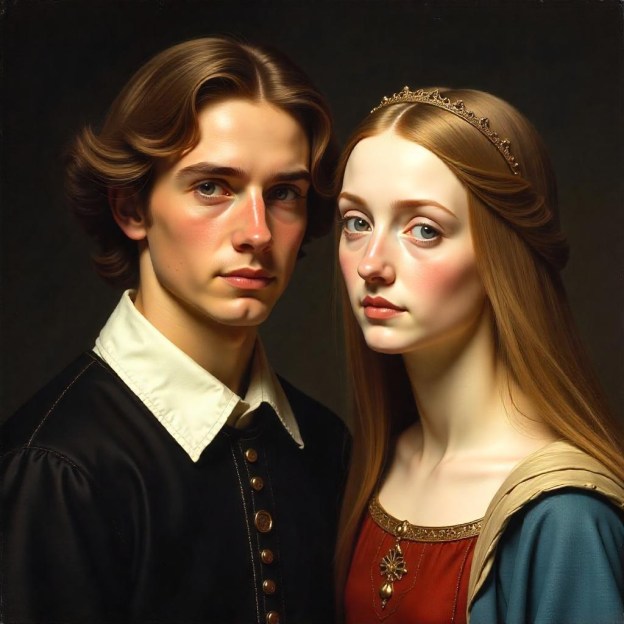
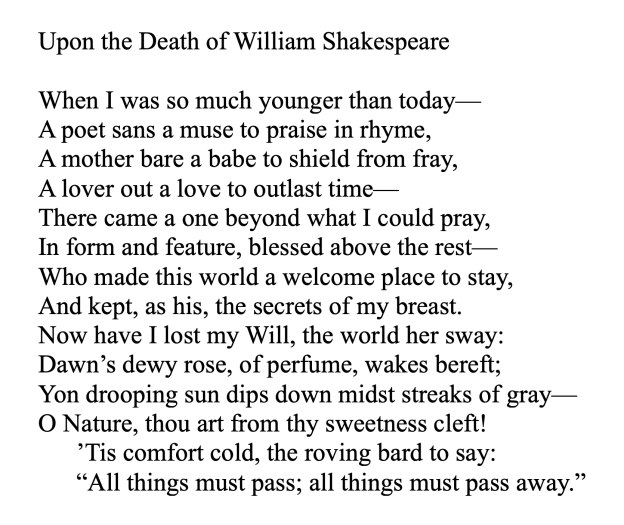
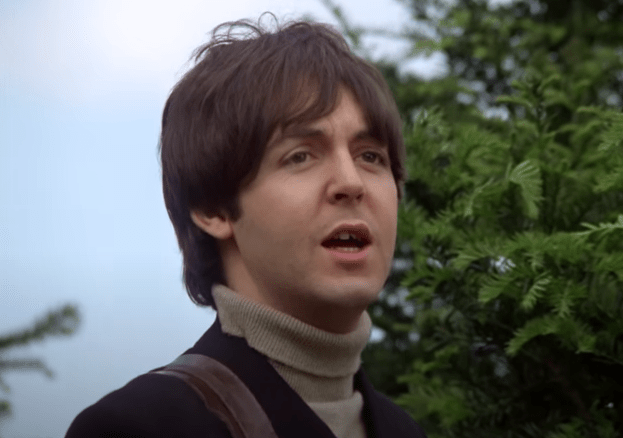
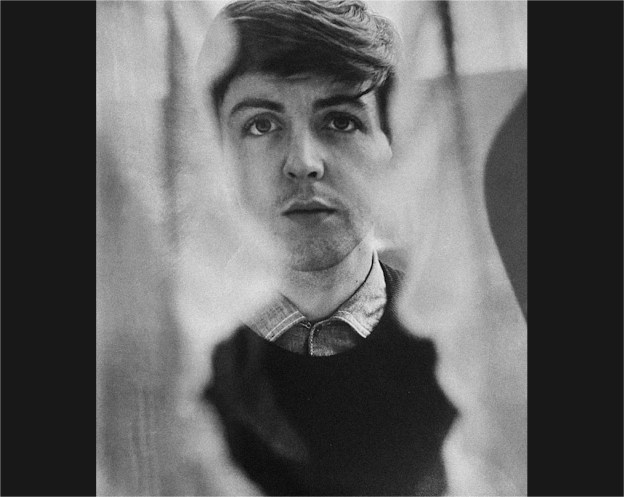
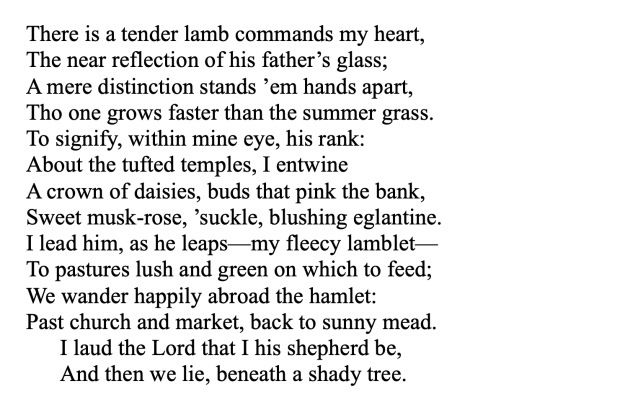
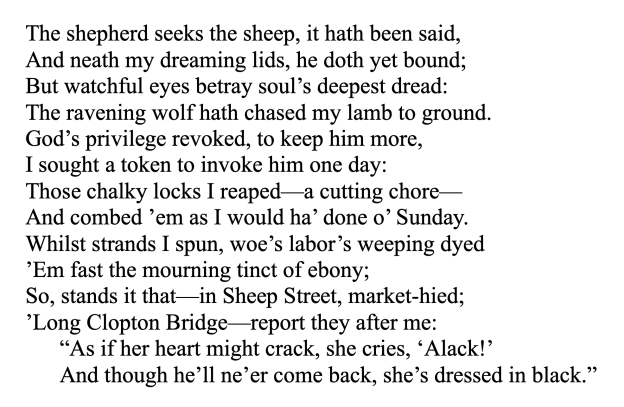
 This time last week (as I write), I was enjoying afternoon tea at The Berkeley, a lovely hotel in the Knightsbridge area of London. To be more precise, given the time difference between England’s capital and where I am now, afternoon tea was a recent pleasant memory.
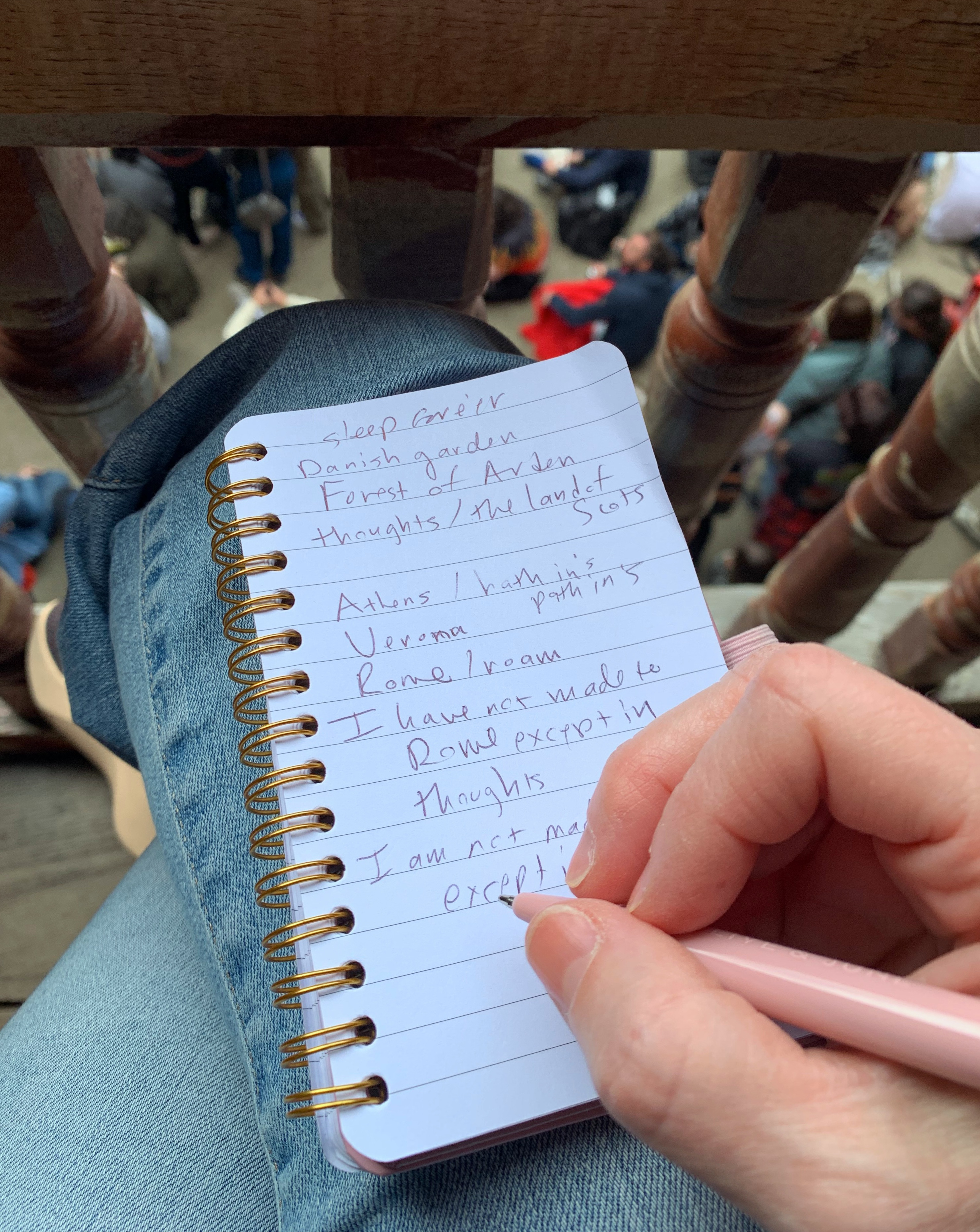 Earlier in the week, I had attended two performances at Shakespeare’s Globe, located on the south bank of the River Thames—so perhaps it’s not a surprise that I have a new sonnet to share with you! I jotted down some ideas for the sonnet during the interval (British for “intermission”) in A Midsummer Night’s Dream, on Tuesday. By The Comedy of Errors, on Thursday, the poem was starting to take shape.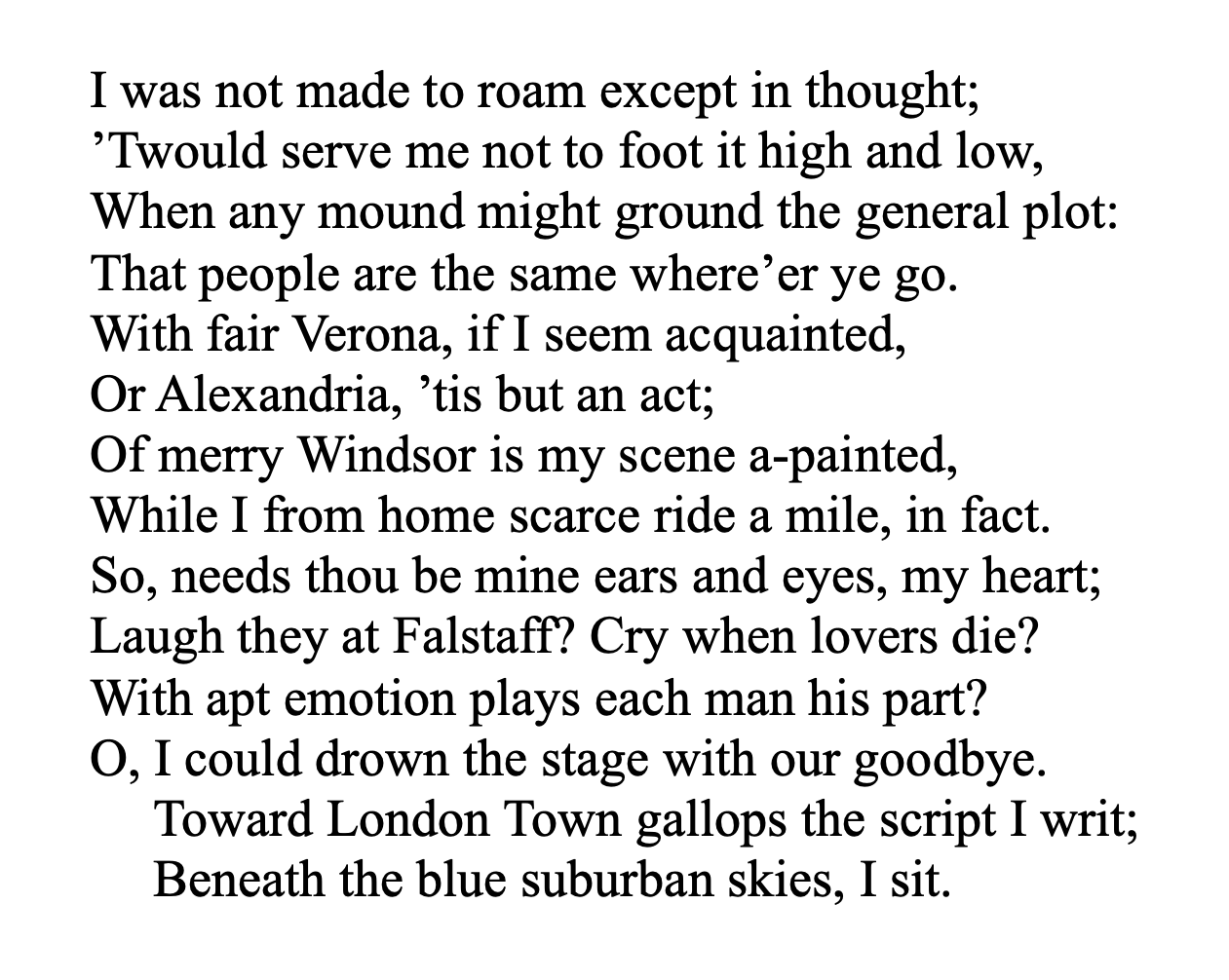
 The poem I am sharing today strongly suggests the identity of the person who wrote the works attributed to William Shakespeare. That’s right: the pesky “authorship question” has finally been solved!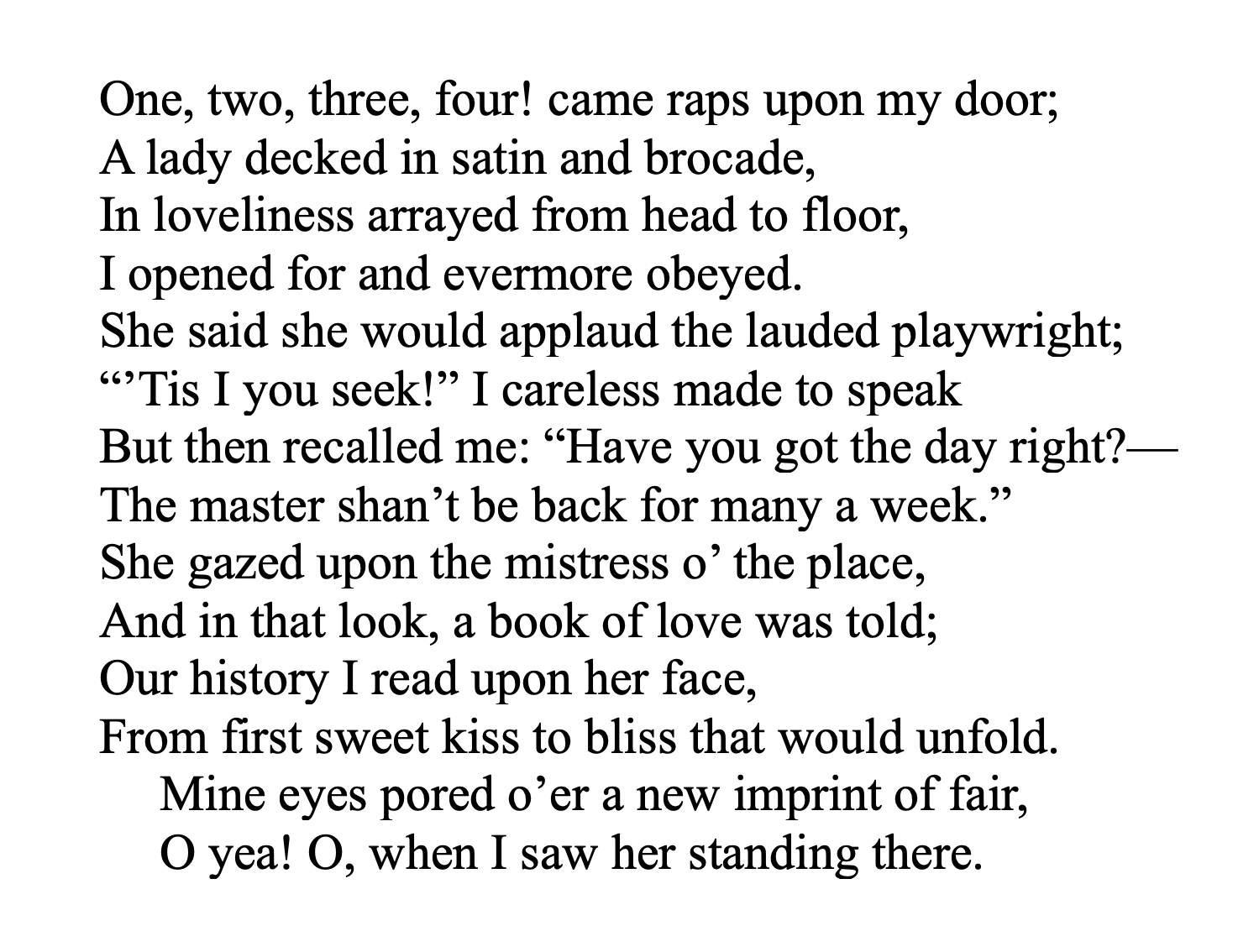
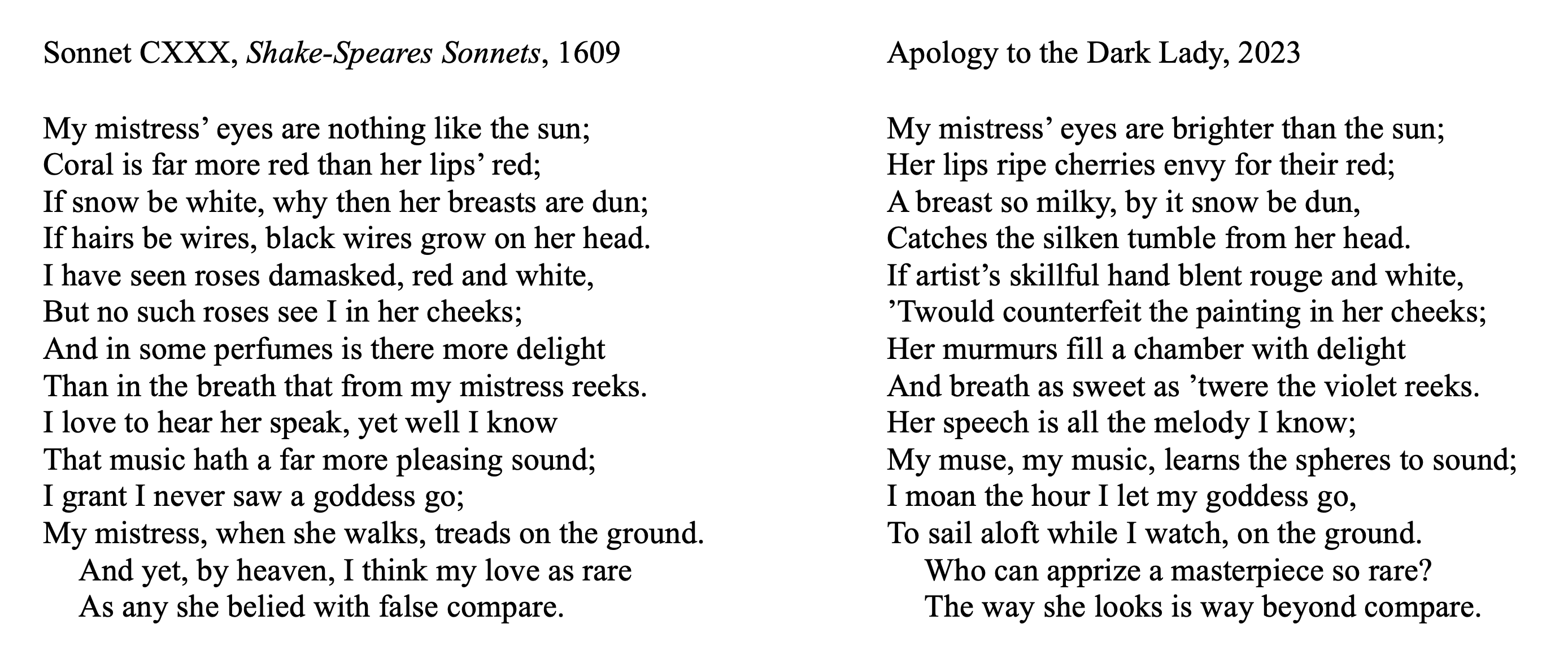

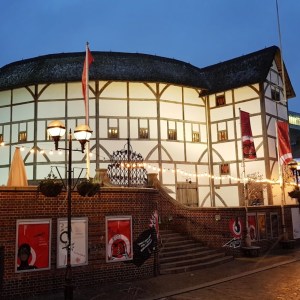
 Novel-Gazing

