
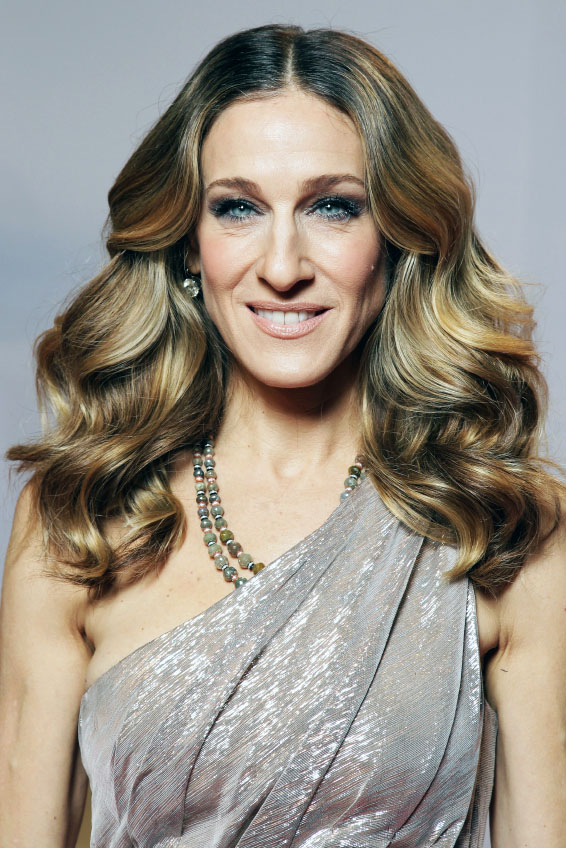
Sarah Jessica Parker, who plays Carrie Bradshaw on Sex and the City
According to numerologist Glynis McCants (and Greek mathematician Pythagoras), numbers possess a vibrational energy that forms the foundation of the universe. In numerology, the numbers associated with a person’s name and birthdate reveal his or her strengths, weaknesses, goals, and gifts. As I mentioned in an earlier post, I have considered using numerology as an aid in character development. So I was curious whether the qualities of successful fictional characters did, in fact, reflect their “numbers.”
I chose to examine Carrie Bradshaw, from HBO’s Sex and the City. Bravo ranked her eleventh on their list of the 100 greatest TV characters, and she came in second among TV Guide’s 25 greatest TV characters of all time. So I think it can safely be argued that she is an effective character. I located her birthdate on an infographic of fictional characters’ birthdays. Based on this date and her name, I calculated her basic numerology blueprint, below. (For an explanation of how the computations are made, please check out Glynis Has Your Number.)
Carrie Bradshaw, born 6/15/1966
Life path: 7
Birth day: 6
Attitude: 3
Soul: 8
Personality: 5
Power name: 4
So what do all these numbers mean?
Your life path number indicates the course your life must take in order for you to be satisfied. The 7 vibration is a truth-seeker, always asking, “Who am I?” In life and in her column, Carrie constantly tries to get to the truth about people. For example:
Later that day, I got to thinking about fairy tales. What if Prince Charming had never shown up? Would Snow White have lain in that glass box forever? I couldn’t help but wonder: inside every confident, driven, single woman, is there a delicate, fragile princess just waiting to be saved? Was Charlotte right? Do women just want to be rescued?
A recent article has compiled everything Carrie ever wondered about, season by season.
Your birth day number signifies how others see you. Someone born on a 6 day, like Carrie, “craves love, friends, and companionship.” Carrie’s character and the entire show are centered around this idea; the four protagonists remain inseparable. As Big observes, “You three know her better than anyone; you’re the loves of her life. And a guy’s just lucky to come in fourth.”
Your attitude number reflects your basic outlook on life. Carrie, as a 3 vibration, “values communication and creative energy”; her job as a writer is a perfect reflection of this aspect. A person with a 3 attitude “tends to be the joker. They have a sense of humor.” Indeed, Carrie uses self-deprecating humor to confront the issues in her life.
Your soul number represents what you feel inside. The 8 soul, like Carrie’s, is happy when it has “financial freedom, job security, and a nice home.” Accordingly, Carrie is very connected to her job and her apartment. She also lives on the dark side of the number 8, as shown in her lack of financial freedom: dismayed that she can’t afford to buy her apartment because of her excessive acquisition of expensive footwear, she laments that she will “literally be the old woman who lived in her shoes.”
Your personality number denotes what you show the world. The 5 personality “has an air of fun and energy” and “wants to know where the party is.” Indeed, Carrie has made appearances at countless parties—the Fleet Week party, the purse party, the party where someone steals her shoes, the all-couples party, and the black and white ball, to name a tiny fraction. The 5 personality is also known for having an addictive streak; Carrie is an on-again, off-again smoker who may have a dangerous shopping habit.
Your power name number represents the strength of your name. Carrie’s 4 vibration signifies “The Teacher.” And she really has made her name in the world by educating and enlightening others through her column and books. The people she meets often refer to her as their relationship guru.
Carrie Bradshaw seems to embody her numerology quite convincingly. Yet I can’t help but wonder: could I have made the numerology of any fictional character work? Am I just that good at twisting information for my own purposes?


 Novel-Gazing