A few weeks ago, I made an observation about a movie I was watching. Then I made the rash decision to turn that little act of noticing into an entire blog post—and I really don’t know if it is going to work. The movie was Perfect Sense, a 2011 apocalyptic romance (pandemic love story?) starring Eva Green and Ewan McGregor. I gave it five cupcakes out of five, although I suspect it’s the kind of film that people will find either pretentious or earnest, empty or meaningful, based on their personal outlook. (IMDB rates it 7.1.)
 I will be giving away the ending of Perfect Sense here, but I recommend seeing it anyway. It’s quite affecting. Plus, it contains “good” nudity, as my husband would say, as well as the occasional expletive to keep things colorful.
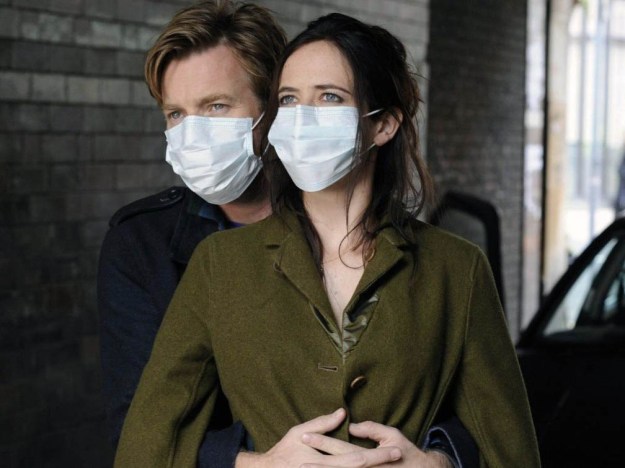
Set in Glasgow, Perfect Sense centers on Susan and Michael. She is an epidemiologist, he a chef. Their occupations are a plot convenience, as the film is about a globe-trotting disease (“Somebody call an epidemiologist!”) that affects the senses (all of which enter into the acts of cooking and eating). Susan lives across the street from the upscale restaurant where Michael works, and they meet just in time to become consorts on the front lines of both infectious disease research and sensory stimulation. I didn’t mind this contrivance because it worked, I probably would have written it the same way, and the actors are ridiculously attractive (even in surgical masks).
The affliction, which is not obviously contagious and has no identifiable source, takes away the senses one by one, starting with smell. The loss of each sense is preceded by an outburst of emotion: smell by grief, taste by terror, hearing by rage, and sight by love. The entire world goes through the stages of the disease roughly simultaneously, causing periods of pandemonium and civil unrest. Between losses, however, society adjusts to the new normal. For example, after the sense of smell is gone, “The food becomes spicier, saltier, more sweet, more sour. You get used to it.”
The last sense to disappear in the movie is sight. “Fade to black” in a screenplay was never meant so literally! We do not witness the loss of touch. The audience is left to imagine what deprivation of that fifth and final sense would be like: People are no longer able to perceive the world or communicate with each other in any way. They cannot feel, see, hear, taste, or smell anything. This disturbing prospect led to my aforementioned observation, spelled out here: “No wonder we find it so hard to believe that we are not a body!”
“Whoa!” you might be thinking. “Who said anything about not being a body?” Some of the manuscripts I edit are in the mind-body-spirit category; I also read books and listen to podcasts in this area. In these materials, I have come across three basic options for the essential nature of who we are:
- We are a body.
- We are a body and we are spirit.
- We are spirit.
One of these theories may sound most plausible to you (and it’s probably one of the first two). Materialists, who maintain that the fundamental substance of nature is matter, would likely say that we are a body only. I have heard many New Age/spirituality authors, on the other hand, posit that we are spiritual beings having physical experiences (or something along those lines). Finally, one text I have encountered goes so far as to say that we are spirit only, and that the body and the rest of the physical world are illusions.
 Our identity is wrapped up in the body, in large part due to the sensory input we receive. Even if we begin to think of ourselves as incorporeal—as momentarily separate from the body—a sensation (stubbed toe, loud noise, the smell of baked goods) will bring us right back into the physical. In other words, on an intellectual level, accepting that we may not be a body is doable. But when something happens that impacts the body in a major or even minor way (we receive a cancer diagnosis, come down with a cold, have a deep-tissue massage), conceiving of the body as illusory seems absurd.
The spiritual text mentioned earlier concurs regarding the body: “It is almost impossible to deny its existence in this world.” It follows up, “Yet if you are spirit, then the body must be meaningless to your reality.” A famous teacher of this work observed, “That is why [this text] is such a threat: it teaches the nonexistence of our very self.”
If we were to lose our bodily senses, as in Perfect Sense, we would no longer be aware of our body, other bodies, and the rest of the physical world—everything that appears to constitute reality. This idea is inherently frightening. In fact, on the movie’s IMDB message board, viewers have used the following words to describe its ending: “Terrifying.” “Maddening.” “Devastating.” “Depressing.” “This movie left me curled up in a fetal position bawling my eyes out.”
Within the context of a curriculum for spiritual transformation, denying the information provided by our senses is similarly distressing. It requires a huge leap of faith—a rejection of all that seems most real. But how many of us would attempt the shift from body-identification to spirit-identification, if doing so resulted in healing and lasting peace?
 Novel-Gazing