
Sixty years ago today, on June 14, 1965, the Beatles were gathered at EMI Studios, in London. Twenty-two-year-old Paul McCartney had three songs to get off his chest—one penned many years earlier, and two inspired by recent events. First up was the country-pop ditty “I’ve Just Seen a Face.” Next, the group laid down the screaming rocker “I’m Down.” Finally, Paul nailed the acoustic ballad “Yesterday” on the second take (with chamber music added later).
The three compositions recorded by the Beatles that late spring day exemplify Paul McCartney’s versatility as a songwriter. As I pondered this six-hour cross-genre musical display, I hit upon an idea—part-challenge, part-experiment, and all-madness. For the sixtieth anniversary of “Paul’s big day in the studio,” I would attempt to replicate the three songs myself—delivering all the vocals and playing all the instruments, using the (comparatively meager) tools and abilities at my disposal.
I could spend the rest of this post cataloguing the failings of my efforts. But surely, they will speak for themselves.
I’ve Just Seen a Face
Recorded first during the Beatles’ afternoon session on June 14, 1965
“I’ve Just Seen a Face” had been in Paul McCartney’s repertoire since the late 1950s. I am 96 percent certain that Paul wrote “I’ve Just Seen a Face” about falling in love, at first sight, with a beautiful young man named Stuart Sutcliffe. (Paul hints at the song’s male subject in the playful line, “Other girls were never quite like this.”) Here is a possible timeline for how Paul became acquainted with Stu:
July 6, 1957: Paul McCartney (famously) meets John Lennon at the annual garden fete (party) of St. Peter’s Church, in Liverpool
Fall 1957: John meets Stuart Sutcliffe, at Liverpool College of Art
Slightly later in fall 1957: John introduces Paul to his new friend Stu
At the time they met, Stu was two years older than Paul, having turned seventeen over the summer. Can you guess where I’m going with this? I am 92 percent sure that Paul wrote at least one other (better known) song about first glimpsing Stu: “I Saw Her Standing There.” Indeed, Stu was “just seventeen,” and the way he looked was “way beyond compare.” Stu would eventually become the Beatles’ first bassist.
When John found out about Paul’s relationship with Stu, he told Paul to knock it off. But he caught Paul “talking to that boy again” and reminded him, “You can’t do that.” Paul turned John’s admonition into a song that played well live, earning a spot in the typical setlist for the Beatles’ 1964 world tour.
When “I’ve Just Seen A Face” was released in August 1965, on the album Help!, Stuart Sutcliffe had been dead for over three years.
I’ve Just Seen a Face
I’m Down
Recorded second during the Beatles’ afternoon session on June 14, 1965
Paul McCartney brought “I’m Down” into the studio three days after returning from a two-week trip with his girlfriend, Jane Asher. I believe the couple had intended to wed while in Portugal—a plan foiled by an ultimatum from John Lennon.
John had threatened Paul that if he married Jane, the Beatles would be over. And Paul’s relationship with John would be over. Paul and Jane chose to keep the Beatles together rather than wed, as “I’m Down” corroborates: “Man buys ring, woman throws it away.” Jane didn’t really throw the ring away. But Paul was truly “down,” despite the song’s upbeat energy. John apparently delighted in his control over Paul, laughing as Paul suffered; the song’s chorus asks, “How can you laugh when you know I’m down?”
“I’m Down” was released in July 1965, as the B-side of the non-album single “Help!” My recording starts with words spoken by Paul, in an exaggerated American accent, prior to the first take.
I’m Down
Yesterday
Recorded during the Beatles’ evening session on June 14, 1965
“Yesterday” is one of the most covered songs in the history of recorded music, and I consider Paul’s replacement’s performances of it to be covers. Years ago, I was equal parts amused and outraged by a video in which Paul’s replacement cited “Yesterday” as the best song he had [n]ever written.
Paul’s lyrics for “Yesterday” had the same origin as those for “I’m Down”: John Lennon’s ultimatum. Again, Paul could marry Jane Asher, or the Beatles could continue to exist—but not both. In an earlier post, I theorized, at length, about this “shadow hanging over” Paul. Undoubtedly, John felt relieved—perhaps even triumphant—when Paul and Jane returned from their elopement unhitched. Three days later, Paul showed up at the studio with the lyrics to “Yesterday.” The melody had come to him some time earlier; in fact, he had played it so incessantly while the Beatles were filming Help! that the director threatened to remove the piano from the set.
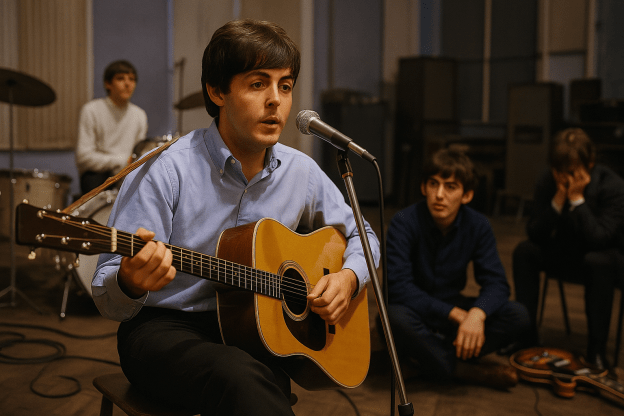
The photo accompanying this post represents my conception of how the studio looked when Paul debuted his full version of “Yesterday.” I think my AI prompt says it all:
I would like to create a color image that brings to life my vision of what it was like in studio 2 at Abbey Road Studios when the Beatles were recording “Yesterday,” on June 14, 1965. The focus is on 22-year-old Paul McCartney; a soft glow highlights his concentration. He is sitting on a stool, with one leg crossed over the other, as he plays a relatively large, light golden brown acoustic guitar and sings into a microphone on a stand. It’s important that Paul, a famous left-handed guitarist, is playing left-handed; that is to say, he is strumming with his left hand and fingering the frets with his right hand. Paul is wearing a pale blue long-sleeved button-down shirt.
In the background, 23-year-old Ringo Starr is sitting behind a drum kit; he is wearing a white pullover sweater and has a youthful, fresh-faced appearance, just as he looked in 1965. Elsewhere in the room, 21-year-old George Harrison is sitting on the floor cross-legged, with a thoughtful look on his face; an electric guitar is lying on the floor nearby. Also in the room, 23-year-old John Lennon is sitting on a chair, his face buried in his hands; he is trying to control his strong emotions, as he recognizes that Paul’s song is about him. Because “Yesterday” is a solo effort by Paul, there is the sense that Ringo, George, and John are essentially audience members, as they listen to Paul and contemplate the meaning of his melancholy song.
(Note that Ringo, George, and John were actually a year older at the time; I cheated their ages down to try to avoid facial hair in the generated image. Also, I provided the name “Abbey Road Studios” because it is more familiar than the venue’s earlier name, “EMI Studios.” I tried to get AI to position the pick guard on Paul’s guitar above the sound hole, as Paul had flipped around and restrung a right-handed guitar; but that was too much to ask.)
If you think it’s wild speculation that Paul McCartney wrote “Yesterday” about John Lennon, I direct you to a video of the Beatles’ performance of the song in Munich, Germany, on June 24, 1966. I am not especially fond of this electric, all-band rendition, which is in the key of G instead of the original F (requiring Paul to strain a bit for some of the notes). John appears quite emotional as Paul croons the second instance of the bridge, starting at 1:33: “Why she had to go / I don’t know, she wouldn’t say…” As the camera zooms in, John looks at Paul and bites his lip, seeming to hold back tears; then he glances away, possibly to defuse his feelings. To me, this is the visage of a man who knows he has screwed up royally. Roughly six months earlier, John had beaten Paul up and broken his tooth; and roughly six months before that, he had issued the ultimatum that prompted Paul to write the lyrics to “Yesterday.”
Yesterday
CREDITS: Each patterned background in the video for “I’m Down” is credited as follows: “Image by freepik.” Mike McCartney took the photo of Paul McCartney that opens the video for “I’m Down.”
 Novel-Gazing