Category Archives: Grammar

Yes! We Have No Banana’s*

*Superfluous apostrophe intentional—please, no angry letters.

A recording of the Broadway revue tune “Yes! We Have No Bananas” spent five weeks at number one in 1923 (which speaks to a simpler time, I think). It tells of a greengrocer who has string beans, onions, cabbages, scallions, tomatoes, potatoes, coconuts, walnuts, and two kinds of red herring but is out of bananas. An agreeable fellow, “he never bananas_cutoutanswers ‘no,’” so when customers request the tropical yellow fruit, he responds with the famous titular line. Believe it or not, there is a tenuous connection between this novelty song and superfluous apostrophes in plural words. Can you possibly imagine what it is?

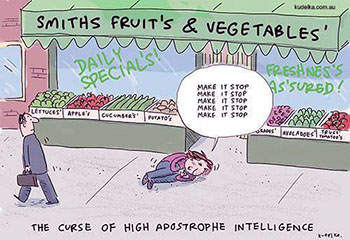
The insertion of an apostrophe before the final s in a plural noun is a common pet peeve among the “apostrophe intelligent.” But did you know this contentious grammatical error has a name—a really cute one? It’s called a “greengrocer’s apostrophe,” after the misuse of apostrophes on the often handwritten signs in greengrocers’ shops: “FRESH ENGLISH PEA’S,” “SEEDLESS GRAPE’S,” “JUICY NECTARINE’S,” “LEMON’S, 25¢ EACH.” By the way, I am not insinuating that Jimmy Costas, the Long Island greengrocer who allegedly inspired the song about out-of-stock bananas made this blunder himself—he was just an interest-creating device.

In case it’s news to you that apostrophes have no place in plurals, or you are a greengrocer, let’s review the rule for creating standard plural forms (from The Chicago Manual of Style):

Most nouns form their plural by adding s or—if they end in chjsshx, or z—by adding esFor example:

  • boy/boys
  • apple/apples
  • watch/watches
  • dish/dishes
  • tax/taxes

But what would a rule be without exceptions? For some words, you just have to learn the correct plural form or (as a last resort) consult a dictionary:

Words ending in y that changes to ies

  • ruby/rubies
  • family/families

Certain words ending in o

  • tomato/tomatoes
  • hero/heroes

Certain words of Latin or Greek origin

  • bacterium/bacteria
  • crisis/crises

All words with irregular plurals

  • child/children
  • ox/oxen

Of course, there are additional nuances—we are talking about the English language. For example, Chicago recommends using the singular form for the plural for names ending in an unpronounced s or x, as in “the seventeen Louis of France.” There is also one instance in which an apostrophe should be used to indicate a plural, to aid in comprehension: for lowercase letters used as words, such as “x’s and y’s.” On a related note, capital letters used as words, numerals used as nouns, and abbreviations form the plural by simply adding s: “two As and three Bs,” “the 1970s,” “PCs.” There are exceptions to this rule, as well, but we won’t get into those here.

Today’s takeaway: don’t be possessive about plurals!
Cherished Annoyances

A pet peeve is a source of irritation that is almost fun to complain about. Maybe grumbling about the little things in life is a way to release frustration over the bigger issues. Following are some common pet peeves, according to the Internet:

  • Loud cell phone conversations in public
  • Open-mouthed chewing
  • Poor driving etiquette
  • Talking during a movie
  • Cutting in line
  • Snapping gum
  • Double-dipping
  • Dishes in the sink
  • Nail biting
  • Tardiness

Do any of these behaviors or circumstances excite you to impatience or anger? (Or are you, perhaps, a perpetrator?) Judging by my friends’ posts on my Facebook Timeline, I am a person with a lot of pet peeves—all surrounding the improper use of English. Here is a sampling of the items others have shared with me:

ancient grammar police_300  jane_300

dog_250  fruits and vegetables_350

I don’t believe I’m as critical of word-related errors as others assume I am. But I admit to bristling at the occasional linguistic blunder. Over the last few weeks, I paid attention to the verbal gaffes that raised my blood pressure. Here are a few:

Pet peeve: Using “phenomena” as a singular noun.
Incorrect: “The phenomena of global warming is a divisive political issue.”
Correct: “The phenomenon of global warming is a divisive political issue.”

Pet peeve: Not using commas to set off nouns of direct address, especially in conjunction with the word hi. (Even editors I know get this one wrong.)
Incorrect: “Hi Rachel.”
Correct: “Hi, Rachel.”

Pet peeve: Using “track” when “tract” is correct.
Incorrect: “The gastrointestinal track consists of the stomach and the intestines.”
Correct: “The gastrointestinal tract consists of the stomach and the intestines.”

Pet peeve: Using the superlative form of an adjective when comparing two things.
Incorrect: “Between Adele and Rihanna, who is the best singer?”
Correct: “Between Adele and Rihanna, who is the better singer?”

Pet peeve: Using “I” instead of “me” because it sounds correct (but isn’t).
Incorrect: “The waiter was very attentive to Caitlin and I.”
Correct: “The waiter was very attentive to Caitlin and me.”

It can be satisfying to lose our s#*t over an issue of minor importance. We briefly get to play the victim, which confirms our personal innocence. I know I enjoy it.

I Am Not Silently Correcting Your Grammar

The word editor has been in my job title for over 20 years. People seem to think I am always editing, even in my spare time. But when the clock is off, I remove my editor’s hat. It looks like this:

Copy Editor Hat

(Not really, but I might order it.) Aside from authors who pay me, the only people whose grammar I might summon the energy to correct are TV newscasters.

It’s another story, however, when I have that proverbial red pen in my hand. It looks like this:

Track Changes

Indeed, when I am asked to make a manuscript as morphologically and syntactically sound as possible, I take no prisoners. Here are some of the errors I eradicate most frequently:

  1. Two spaces between sentences. The number of spaces used between sentences has a fascinating history (if you’re into typography—who isn’t?), but single spacing has been the accepted printing convention since the mid-twentieth century. For instance, the following spacing is incorrect: “I like cupcakes.  They are yummy.” Fortunately, this gaffe is easily fixed with a little “find and replace” action.
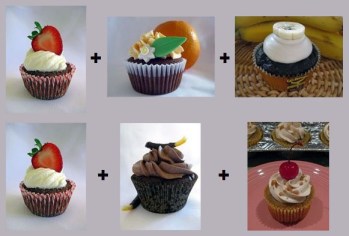
  2. Missing serial comma. It says in the bible (The Chicago Manual of Style), “When a conjunction joins the last two elements in a series of three or more, a comma—known as the serial or series comma or the Oxford comma—should appear before the conjunction.” Here is an example of the profound confusion caused by a missing serial Cupcakescomma: “I am making the following flavors of cupcakes: strawberry, orange and chocolate and banana.” So, in addition to strawberry cupcakes, am I making cupcakes that are (1) orange and (2) chocolate and banana? Or (1) orange and chocolate and (2) banana? Either way, it looks like I’m making cupcakes.
  3. Random capitalization. I wish I could get inside the head of the writer who, without warning, capitalizes words that should be lowercase. If I were editing a book on baked goods (please send me manuscripts on baked goods—or just baked goods), I might find a sentence like this: “A Cupcake is a small cake designed to serve one person, which may be baked in a paper or Aluminum Cup.”
  4. Dangling modifiers. A dangling modifier is a word or phrase that describes a word not clearly stated in the sentence—often to humorous effect. For example, “Standing at the dessert counter, my eyes took in the rows of colorful cupcakes.” In other words, my eyes were standing at the dessert counter—which is absurd, because eyes don’t even have feet! Here is a possible reworking: “Standing at the dessert counter, I ogled the rows of colorful cupcakes.”
  5. Pronouns with unclear antecedents. I often encounter pronouns that could refer to more than one noun in a sentence. For example, “After putting sprinkles on the cupcakes, I sealed them in a container.” We don’t know if “them” refers to “sprinkles” or “cupcakes.” We only know it refers to something good.

The law of irony dictates that if you write about editorial pet peeves, you will make a stupid mistake and have it pointed out to you—which is where a comforting cupcake comes in.