Category Archives: Dream Memory

Is This Town Big Enough for Two Paul McCartneys?

“How dare he come to my Bowl.”

I laughed at my own outrage.

Eleven days ago, Sir Paul performed right here in Santa Barbara, California, where I live. The Santa Barbara Bowl is a stunning outdoor amphitheater with about 4,500 seats. I have seen some of my favorite artists at the Bowl, including Elvis Costello, Crowded House, and Duran Duran. Sir Paul’s engagement was a one-night affair, promoted less than two weeks ahead. I received the same email that lots of locals did: tickets were being distributed by lottery, resale was not allowed, and cell phones were forbidden in the performance area. I didn’t want to know any more.

I had a visceral need not to know.

In a sense, Sir Paul had been “dead to me” for years, due to my self-imposed blackout on Beatles-related news and social media. I established this boundary not in protest but to spare myself the pain of watching the world carry on as if Paul McCartney hadn’t died long ago. I have kept my distance, to protect my heart. Then the man who replaced me arrived in my own backyard.

This is the blog post I didn’t see coming, because I didn’t see Sir Paul coming to my little burg.

The Day of the Concert

While Santa Barbara qualifies, by population, as a medium-sized city, it can sure feel like a small town sometimes. On the afternoon of the concert, I had to go downtown for a routine eye exam. I hoped to get in and out without hearing anything about the show. The optometry office is located in a lively plaza called La Arcada. The late September day was lovely; people were eating outside, tourists were strolling and shopping, rock music was playing. The office door was propped open as I waited to be taken back and asked, “Better, worse, or about the same?” a dozen times.

Wouldn’t you know it: Two men standing outside the open door began talking loudly about the concert. After I heard “Paul McCartney” and “lottery,” I instinctively plugged my ears. The conversation lasted for about a minute. In the room with me was another patient, two chairs away; and two women who worked there. They must have thought I was absolutely mad, sitting there with my fingers in my ears!

From my house, I can often hear concerts being performed at the Santa Barbara Bowl. In such instances, the town’s acoustics, aided by atmospheric conditions, bring sound waves from the Bowl’s speakers to the hills above the coastline, three miles away. “Who’s at the Bowl?” is a fun game to play, but I probably would have died if “Can’t Buy Me Love” had wafted in through the open window. I was saved from this scenario by the fact that I am residing elsewhere at the moment.

For at least part of the time Sir Paul was onstage, I was dining at a restaurant less than a mile from the venue (and almost a direct shot). But all was quiet in the streets; I didn’t hear a single note.

Why I Didn’t Go

I didn’t even consider attending the concert, because I knew it would cause me emotional distress. The first time Sir Paul stood at the mic, fingers poised over his/my Höfner bass, and said something like, “Yah, we were in Paris, and we saw this guy in the corner wearing a black turtleneck and a black beret, and we thought we should write a French number” (i.e., “Michelle”), I would have screamed: “Liar!” And security would have escorted me from the venue.

Okay, not really. I would have managed my anguish as best I could—as I did on a similar occasion almost a year ago. Three days after I published my “coming out” post as the original Paul McCartney, I attended a Micky Dolenz concert with my sister. Growing up, we loved the Monkees. And let me tell you, Micky still has it! He’s a fantastic performer, with way more energy than folks half his age. However, I struggled through part of the show, as I recounted in my journal two days later.

Early on, Micky Dolenz told a story about having met Paul McCartney, in 1967; he went to Paul’s house, where he encountered Paul’s sheepdog. Of course, Micky was referring [unknowingly] to William (my replacement), to MY house, and to MY dog (Knickers).

In other words, a beloved figure from my childhood was telling a charming anecdote that erased me. Not maliciously, but casually. My documentation continued:

The next day, Micky went to EMI Studios, where the Beatles had just recorded my song “Good Morning Good Morning.” Micky and his band launched into it and played two more [post-Paul] Beatles songs. It was too much for me.

I was surrounded by joy, nostalgia, and celebration—people having fun, reliving their youth. But for me, those songs weren’t just cultural artifacts. They were stolen pages from my soul. Like a tuning fork, my body vibrated with the grief, injustice, and shock of being both seen and unseen. More recently, I recalled my inner experience that night:

When I heard where Micky’s story was going, I started to cry. Then I began hyperventilating and crying harder. These reactions continued throughout the segment devoted to the Beatles. It was like being a vampire and having holy water thrown on you. I felt like I had to get out of there. I kept looking behind me to see where the exits were, but they seemed so far away. There seemed to be so many people between where I was and where the exits were. I didn’t think I could make it, for some reason, and I didn’t want to disrupt others when they were having such a good time.

After the Beatles songs were over, I fully recovered and thoroughly enjoyed the rest of the show. In fact, the next morning, I regaled my sister’s husband with (almost) all the highlights while he made us blueberry pancakes.

[Edit, October 10, 2025: Two nights ago, on October 8, 2025 (so, less than twenty-four hours after I published this post), I went to a Colin Hay concert here in Santa Barbara. This is the third time I’ve seen the Men at Work front man perform at the historic Lobero Theatre. Between songs, Colin tells a good story, and he has lots of them. I knew he might mention Ringo, since they tour together. And he did mention Ringo. But I wasn’t prepared for a ten-minute story, early on, about “Paul McCartney”—whom Colin referred to mostly as “McCartney.” For everyone in the theater except me, it was an amusing tale about how, many decades ago, Sir Paul attended several of Colin Hay’s performances, invited himself over to Colin’s house for dinner, and washed the dishes after.

Colin’s story about “McCartney” seemed to go on and on (for me), and each word stung. I overcame the temptation to escape to the lobby; I didn’t want to distract my companions. After the anecdote was over, and Colin started playing a song (a favorite of “McCartney’s”), I pretty much shut down inside, trying to process the venom that seemed to be coursing through my veins. I attempted to make a comeback; but mostly, I just prayed for the (two-hour) concert to be over, so I could go home and be by myself for a few minutes.]

I didn’t attend Sir Paul’s recent concert, for reasons that by now should be obvious. I feel a pang of regret, even though I was present at every Beatles performance in history, from Hamburg to the Cavern Club to Candlestick Park (with the exception of the “rooftop concert,” in 1969). I feel as if I’ve somehow missed an opportunity—for what, I don’t know. But I haven’t missed Sir Paul—not really. In the last few years, he has appeared in my dreams with startling regularity. While fans have gathered at stadiums to hear him sing, I have been meeting him in the quiet hours, in scenes ranging from tumultuous to serene.

In the context of his show at the Bowl—so close, so charged—the moment seems perfect to revisit and reflect upon my dreams with Sir Paul and some of his family members.

Dreams with Sir Paul

From my journal, I have culled twenty-one entries involving dreams with Sir Paul, or William. (William Shepherd is the name he claims in his memoirs.) When considered chronologically, these dreams trace an arc that mirrors my own emotional journey—from confrontational to more reflective. There have been moments of animosity, recognition, reconciliation—even joy. Through it all, William has remained a central figure—sometimes elusive, sometimes accessible. My dreams with him have formed a kind of mythic diary, written in the language of the subconscious.

2021: The Reckoning Begins

In 2021, I started recording my dreams regularly. The ones involving William were raw and direct. My subconscious didn’t tiptoe around the facts. It confronted William head-on—naming what was taken, what was lost, and what still burned. These early dreams weren’t gentle; they carried the energy of anger and disbelief.

January 30, 2021: The Rebuking

I described this dream in my journal almost five years ago. When I reread it in preparing this post, I was astonished by how coherently I spoke my truth. While dreams can be surreal and symbolic, this one was quite literal—and confrontational in a way I very rarely (if ever) am in waking life.

Weirdly (or not), this morning, William was in my dream. I entered a room, and he was sitting, alone, behind a round table. (There were a few others in the room, to my right.) When I noticed him, I said, “Oh, look! It’s Paul McCartney. Or should I say, William Shepherd?” I spat out the name like a curse word. Then he was standing across from me, and I told him, “I’ve been writing songs again—and they’re good!” I began to list all the things he took from me, as Paul—my girlfriend, my house, my money. “I don’t care about the money,” I added.

He came closer, as if he were about to pass me on his way out of the room. I looked up at him, and he was quite a bit taller (which makes sense, since I’m five-foot-four, and he’s something like six-foot-three). He was young, about the age when he started with the Beatles. He seemed, I don’t know, defenseless. That’s the word that comes to mind when I picture his face again. I dreamt about William last week, as well. He warned of the danger I would be in if I tried to reveal the truth, similar to the peril he faced in publishing his fiction-mixed-with-fact memoir.

As my dream shows, on a subconscious level, I continue to bear a certain amount of hostility toward William. (I can verify this hostility sometimes shows itself in my conscious life, as well.) In the late 1700s, William and I became half-sisters.

That last sentence is a bit of a non sequitur. I suppose I was reminding myself that although I said goodbye when he said hello in the Beatles lifetime, William and I had known each other before—and cared about each other as family.

March 14, 2021: The Classroom Confession

I reconstructed this dream from notes jotted down at the time. The emotional tone was one of angst and frustration, arising from an attempt to be seen, believed, and remembered.

In this dream, I found myself in a classroom where Linda McCartney was the teacher. Sir Paul entered; there was a buzz of excitement. I turned to the girl sitting in front of me, who resembled a friend of mine from junior high, and said, “I was the original Paul McCartney. This guy replaced me, because I died in 1966.” She seemed a bit incredulous, but I told her I would prove it to her. I said I wanted a picture of William, and others seemed to have the same idea; I saw a male holding up his phone. The girl encouraged me to take the photo, but when I tried, I couldn’t quite find him in the room again, with people now milling about.

2022: Echoes and Retrieval

In 2022, my dreams with William grew more layered. The tone shifted from confrontation to curiosity. I recovered a melody, a fragment of memory. Some dreams felt like surveillance. Others felt like soul encounters. There was still resistance but also a bending toward something deeper.

March 31, 2022: Table for Two

The juxtaposition of young Paul and older William in a dream that occurred on my birthday felt somehow symbolic.

So, [I’m] walking through a restaurant. It feels light, even white, a rather large, open room filled with tables, and people eating at them. To my left was a wall of windows—not floor-to-ceiling, but large, from about the waist up. Through the windows, I saw Paul McCartney walk by; there was patio seating along the windows. Paul looked quite cute. He was wearing a powder blue suit; his hair was dark. I would say he looked like 1965 or 1966 Paul.

So, Paul walks by the windows. I think he sits down at a table. But then I clearly see my replacement, William Shepherd, seated at a table for two. The table is round, I think, and he is facing someone, though I don’t notice who that is. My gaze lingers on William; he is older, like his age now (85). I am sure it’s him.

June 9, 2022: The Compound

This dream felt like a visit to a theme park or estate centered on William. I pieced together the following description from notes I made after waking up.

William appeared in a deep blue button-down shirt, looking quite old. He was with a group, possibly including his daughter, at what felt like his home—or a compound dedicated to him. I made eye contact with him from a distance as I walked by. He followed me briefly, watched me, and then disappeared. Later, I was in a house with a few people. William stepped out, and I went to use the bathroom while he was gone. I realized he’d return, not see me, and wonder where I was. One of my dogs was behind the bathroom door. I didn’t end up using the bathroom, since it didn’t feel private.

August 21, 2022: Dream Melody

This morning, in a dream, I received a snatch of [a] melody…

I woke up in the dream and had trouble telling what time it was; I couldn’t read any clocks correctly. I felt like I had overslept. I noticed my door was ajar, which perturbed me. I went out and realized I was in my parents’ old house, but a bigger, mansion-sized version of it. From upstairs, I could see that the enormous living room was vacant, as if [my parents] were about to move out. The house was teeming with people, going in and out of the rooms…

Then I heard a song playing. I imagined the sound to be coming from a vinyl record on a turntable, sitting atop a small, square-topped table in the hall; for some reason, this vision is associated with the color mint green. The tune caught my attention but as quickly lost it, when I realized the singer was Sir Paul McCartney, or William Shepherd—my replacement as Paul McCartney. I grumbled, “I’m not going to listen to this!” and started to walk away. Then I woke up.

As I lay in bed, really awake this time, I could hear the song in my head. I couldn’t make out [most of] the words, but the melody was still with me. I picked up my phone from the table next to me. My eyes still not quite working, I pulled up my piano app and tried to find the notes that matched the melody in my head. When I thought I had at least come close, I recorded the melody—just 26 notes, maybe enough for a chorus.

I named the file “dream melody, log jam”; I believe the lyrics, sung by Sir Paul in the dream, had included the phrase “log jam.” It’s not the smoothest rendition of a melody anyone has ever heard but would have sufficed if I had chosen to expand it into a song.

Dream melody, log jam

September 25, 2022: Your Fate

The dream described here felt like a moment of reckoning—not angry, but inevitable.

I forgot to mention yesterday that I had a dream yesterday morning in which I was face-to-face with Linda McCartney and William. It was just their faces, which were next to each other, close together, as if framed in a picture, with Linda on the left and William on the right. They looked young. I spoke to the faces and said something like, “Your fate has caught up with you” or “Your fate is here.” I was referring to myself. I was the fate that had caught up with them, that was here.

December 6, 2022: The Embroidered Shirt

I want to preface the following account with a reminder that, in a dream, you can take the perspective of any figure.

Speaking of dreams, when [I] woke…up this morning, I was dreaming about myself—as Paul McCartney. It was like we were on a date. He was on my right and had his arm around my waist. In retrospect, I personally had a “Jane” feeling, which probably makes sense, because last night, I recorded the vocals for my Christmas song for her. Paul was wearing a jacket over a very interesting shirt. The shirt had small caricatures embroidered on it. The caricature in the middle showed William and Linda and some others. I touched it with my finger. I was confused how Paul could know about the man who replaced him, like the time sequencing was paradoxical. Before I could say anything, I woke up.

2023: Recognition and Reflection

This year marked a turning point. My dreams with William became more frequent, more nuanced. He was no longer just a symbol of loss; he was a person I could engage with. There were moments of tenderness and humor. I began to see him not only as my replacement but as someone carrying his own burdens.

January 29, 2023: The Casino

This morning, a little before 5:00 a.m., I had a dream with William in it. I seemed to be on the floor of a casino. There was a second level that was open to the floor. First, I saw several huge, poster-like black-and-white images of George Harrison lining the second level. Then, to the right, I saw a guitarist with long, frizzy dark hair who struck me as resembling David Crosby. He was standing in front of a microphone. Then, Linda McCartney appeared, and I feel like she pulled William forward—not literally, but maybe with body language. I don’t remember seeing William, but I knew he was there. I don’t remember hearing any music.

William was present but unseen—maybe hesitant to come forward?

February 21, 2023: Moment at the Museum

Okay, so it’s the day of William’s “release” from playing the role of Paul McCartney [as he stated in an earlier edition of THE MEMOIRS OF BILLY SHEARS].

After I fed the dogs this morning, around 6:30, I got back into bed… [After a little while,] I fell asleep. I had a dream, either then—or earlier, before I fed the dogs. I just can’t place the timing. But in the dream, I was standing in front of a painting at a museum, or something that was on display. Then an older gentleman was next to me. I turned my head to face him, and we kissed for a few seconds. Then I woke up.

Upon waking reflection, I thought the older gentleman might have been William—given the significance of the day. But I wasn’t sure. I didn’t have a clear memory of his face. I suspect that February 21 is William’s birthday. I have no “proof” of this other than his selection of this date, in 2023, as the end of his tenure as “Paul McCartney”—a fitting day to be “reborn” as his former, original self. Clearly, that hasn’t happened yet.

April 5, 2023: The Sectional Couch

This dream seemed to suggest at least a temporary softening—an openness to seeing William not as a threat but as a person.

At 1:00 a.m., I woke up from a dream. Just before I woke up, in the dream, I was in a room with multiple people. A woman was talking to me. I think she was off to my right; I couldn’t see her. Ahead of me about twenty feet was a light-colored sectional couch. On the couch sat William—young, around the time he replaced me. He was sitting next to a very small boy. I have the sense that he was looking at me with a pleasant expression on his face. It was a cute sight, and I smiled. I apologized to the woman who was talking to me, because I had been distracted by seeing William and the boy.

May 12, 2023: The Book of Paul

I had a dream with William this morning [around 9:30 or 9:45]. In the dream, I was sitting at a table, next to my husband, who was on my right. William was at the front of the room, presenting a book. As he spoke, I made snide comments to my husband, suggesting that William didn’t really write the book. I also had a book in front of me. It was a larger-format hardbound book. I had written things inside the front cover, which was off-white. William came up and asked, “What are you writing there?” Surprised, I said, “You write all the books.” He seemed a little taken aback. I showed him where I had written “Paul” around the middle of the page. Below “Paul” were two handwritten lines, beneath which I drew the copyediting symbol for “bold” (a wavy line). Then I woke up.

I checked Sir Paul’s social media accounts and saw the posts about the book, which had been made two hours earlier.

I had described these posts in my journal prior to documenting the dream:

This morning, I was dismayed to find a series of posts on Twitter (and stories on Instagram) showing the book of my photographs…on display in the windows of bookstores in the six cities where the photographs were taken.

To clarify further, the original Paul McCartney had taken a bunch of photos between December 1963 and February 1964, capturing the early days of Beatlemania. Almost six decades later, Paul’s replacement came forward with the photos. The images were collected in a book, 1964: Eyes of the Storm, which accompanied an exhibition of the photos at the National Portrait Gallery in London. The exhibition ran from June 28 to October 1, 2023.

July 7, 2023: The Distant Star

This journal entry suggests how regularly Sir Paul was appearing in my dreams yet how out of reach he still seemed to be at times.

Not much to report so far today except that Sir Paul made several appearances in my dreams last night, always at a distance. He felt famous and unapproachable.

September 24, 2023: The Sidebar Apology

In the middle of a dream, I saw a photo of Sir Paul—as if I were looking at a story on a website. The photo appeared in a column down the right side of the screen. I thought, “That guy is still making money from my songs!” I harumphed about it for a moment; then I apologized to William in my mind.

Was this a moment of emotional maturity?

November 3, 2023: Shrilly Love Songs

I had a dream in what I would describe as a hotel suite. In the living area, there was a mat; when I shook the mat, bugs crawled out, spreading over the carpet. Then I was getting ready in a large bathroom—very long, with multiple sinks and mirrors. There were other women primping, too. I was at the far left, closest to the entrance to the bathroom. Suddenly, a song began to play, emanating from deeper in the bathroom. It was “Silly Love Songs”—a Wings song that William stole from me. Instantly enraged, I yelled “God dammit” in the direction of the song. Then I woke up.

I think this dream reflects how reminders of a painful past continue to pop up in my life, as much as I try to avoid them. Could the bugs crawling out from under the mat symbolize the Beatles?

December 30, 2023: The Pepper-Upper

In this dream, I’m not sure why William is wearing John’s color on the Sgt. Pepper album cover…

In a dream that started after 6:00 a.m., I was at a table in a casual restaurant with a few others. I was drinking a pink drink in a highball glass. An attractive man at the table (on the other side, diagonal from me) asked to taste my drink. When he returned the glass to me, I took a sip. But it was like there were holes in the straw, and I didn’t get any of the beverage. I asked the man, “Is this still your straw? It’s not gross, but it doesn’t work.” I gave it back to him. I found another straw on the table, wrapped in paper…

Here is where the dream turned magical. William (a.k.a. Sir Paul) was sitting on the outside of the table, or at an extension of the table. He was wearing a Sergeant Pepper–era outfit, in yellow or gold. He was young—probably thirty. When my eyes landed on him, I joked, “Hey—you look like Ringo Starr!” His visage remained stoic. Did he get the joke? Immediately, I realized I was dreaming. I said, “Oh no! This is a dream. It’s about to be over, and I was having so much fun.” I got up and walked over to William, to sit on his lap—like a child would sit on a father’s lap. I think he might have let me, but I woke up. It was around 6:45 a.m.

2024: Embodiment and Integration

In 2024, the dreams became intimate, surreal, and emotionally rich. There were moments of playfulness and quiet companionship. I saw William in multiple ages, moods, and roles. This was the year of reconciliation. Somewhere in the dream space, we met not as rivals, but as souls.

April 13, 2024: Then I Woke Up

The only dream I remember from my last sleep cycle occurred very early in the morning; I woke up from it a little before 12:30 a.m. In the dream, I was in a room. Sir Paul came up behind me; he seemed very tall. How should I say this? He started…as if…seemed to be. I said, “Are you sure you’re not the drummer?” I suppose this was a reference… Then I woke up.

August 11, 2024: The Hill of Sand

I stitched together the following description from notes I made immediately after having the dream.

I dreamt that I was walking along the base of an enormous hill of sand. I could hear the Beatles’ “She’s a Woman” [with lead vocals by the original Paul McCartney]. I started mouthing the words like I was in a music video—until I worried that I looked silly. At times, I was on the hill of sand, running my hand along the surface—making the grains on top fly up, as if carried by the wind. But walking along the base of the hill of sand, I had the sense that Sir Paul was nearby. Then I saw him! I think I was very excited.

Sir Paul looked relatively young, say, in his 40s or 50s. He stopped me and took my hand, or maybe both of my hands, and turned me back in the direction from which I had come. He also seemed excited. We stopped after just a few yards, where several people were gathered by the hill of sand. He urged me to “tell her,” referring to a blonde woman—as if I had a funny story to share about a coincidence or something. Then I woke up; it was around 7:30 a.m. Reflecting on the dream, I felt happy.

September 12, 2024: A Knowing Smile

This dream suggests mutual understanding or acknowledgment, perhaps even peace.

As I was getting dressed to take the dogs out, I remembered that I had seen William in a dream! We were at a small table, with one other person, I think. William was sitting diagonal from me, against a wall. He looked somewhere between thirty-five and forty-five. I think we just smiled at each other knowingly a few times.

October 28, 2024: Questions of Identity

This dream feels like a moment of existential reflection—for both of us.

I had a dream this morning with William. In the dream, William was lamenting: “What will I do now?” I asked someone who was closer to me if I seemed to have any characteristics of the original Paul.

William’s question is vulnerable; mine is searching. Interestingly, this dream occurred just three weeks after I published my “coming out” post as the original Paul McCartney (on October 9), and ten days after I revealed where Paul is buried (on October 18).

October 29, 2024: The Video Room

The following day, I dreamt of William again.

Weirdly, this morning, I had another dream with William in it. What’s going on? In this morning’s dream, I was with a group of people—possibly led by Larry David, or another older gentleman. We walked into a room filled with chairs and couches. I sat down on an upholstered chair, which I decided could be shared. A woman sat down on the other half. I struggled to keep to my half; I said my bottom was too big! The room filled up.

At the front of the room, a video started. After a while, the video showed clips of Sir Paul, performing. Uncomfortable, I shielded my eyes. Then I saw William in the room! He was sitting on a nearby couch; I was seeing him in about three-quarter profile. He looked like he was along in years, around seventy-five or eighty. He seemed to be watching the video. Then he was standing toward the middle of the room, where he looked younger and a bit shorter than expected; his hair was darker.

This dream shows my discomfort with the public narrative, as well as a shifting perception of William. At the end, he becomes younger, a bit shorter, with darker hair. Does this transition represent some kind of shift back to his predecessor?

November 30, 2024: The Hallway

This is the most recent dream with William that I found in my journal. It’s a look into the past, perhaps.

I was in a white or off-white hallway. I saw William, quite young—probably in his twenties or early thirties. He was in a room on the left side of the hallway. I think I saw him first in the hallway and then in the room. There were other people around; William seemed engaged in some kind of activity or effort.

Dreams with Mary and Stella McCartney

I have had two dreams involving Sir Paul’s daughters Mary and Stella; the first dream was rather extraordinary, the second more mundane.

March 9, 2023: A Slap in the Face

I woke up about an hour ago from a somewhat distressing dream. Recalling it made my heart race; my heart rate has since slowed a bit… I find myself wide awake, yet again, in the middle of the night.

So, what was this dream? Basically, I was being slapped by three people: two women and one man. That’s right, they all took turns slapping me… The main slapper reminded me of [a] childhood friend…, with her short dark hair and rather severe, standoffish manner. I don’t have a clear impression of the other woman, but she seemed looser and more playful (while still getting her slaps in). I looked directly into the face of the man, who seemed British; I told him he should “do Shakespeare.”

The dark-haired, standoffish woman seemed the most critical of me, as she flipped through a magazine. At one point, the man asked if he could slap me, too, so it must have been just the women who were slapping me at first. I presented my face to him, and he slapped me with his fingers together, quite close to my skin; it didn’t hurt very much. That was the only slap I remember specifically. Otherwise, I just recall the feeling of being slapped. Near the end, as the four of us sat around a table, I returned to an earlier point of contention and tried to clarify it; the dark-haired woman dismissed me.

I awoke with a start. It was sometime between 1:30 and 2:00 a.m. I thought the dream had been a strange one… I found myself preoccupied with the slapping dream, [until it occurred to me…] that I had been in a dream with Mary and Stella McCartney.

Mary had been the dark-haired, standoffish woman, and Stella had been the other, looser one. The man had [presumably] been an invention of the dreamer. I don’t know whose dream it was—Mary’s, Stella’s, or mine. I would suspect it was Mary’s dream, since she had a prop (the magazine)… I do want to note that I believe I handled the slapping quite good-naturedly, or as good-naturedly as could possibly be expected.

The next day, I reported in my journal:

It took me about a day, but I figured out why Mary slapped me and was generally hostile toward me in that dream early yesterday morning. When I was Anne Hathaway, the wife of William Shakespeare, I had an affair…with the “Dark Lady” of [the] sonnets.

When William [Shakespeare] discovered the affair, he…issued an ultimatum. I chose to stay in my marriage. In revenge, the Dark Lady sought out William in London, to seduce him. She was unsuccessful. (She didn’t know he preferred the physical company of men.) This incident is chronicled in Sonnet 144 (“Two loves I have of comfort and despair”).

Clearly, Mary is still angry with me [on a subconscious level] for breaking up with her—and for memorializing her in unflattering terms, especially in Sonnet 130 (“My mistress’ eyes are nothing like the sun”). So, now I am writing a new sonnet, to say I’m sorry. The sonnet’s working title is “Apology to the Dark Lady.”

July 22, 2023: The Sister’s Address

My second dream related to Mary and Stella is curious from a metaphysical standpoint. I hardly know what to make of it.

I had some interesting McCartney-related dreams this morning… In the first dream, I was walking the dogs…in Encino [a suburb of Los Angeles, where I lived in my youth]. A woman was walking a big dog toward us, so we moved to the other side of the street. The woman followed us, so we moved back to the original side of the street. I felt like we needed to go one street over to the right, so we did. I could then see a large cross street at the end of the block. I interpreted the street as Ventura Boulevard—we were in the right place.

I said to the dogs, “Now I just need to find my sister’s address.” I entered “Mary McCartney” into my phone. That was the end of the sequence. I wondered later if I had somehow piggybacked onto Stella’s dream, viewing it from her perspective…or if I had projected myself into Stella’s consciousness, and she was awake at the time.

Dreams with James McCartney

I believe I have had two dreams with Sir Paul’s son, James—the first more elaborate, the second more succinct.

July 6, 2023: The Carriage Conversation

This dream felt like an instance of emotional candor, an opening of truth between two souls.

I woke up from one noteworthy dream around 4:15 a.m. In the dream, I was talking to someone—a male, I believe. Sir Paul had done some sort of video message for him. I saw Sir Paul in various clips, like video clips. I got the feeling this person knew that Sir Paul was a replacement. He seemed to express some distress that Paul McCartney was a womanizer—as if Sir Paul would have cheated on Linda. I said, “Well, there were two.” I suppose I was suggesting that the first Paul McCartney might have been a womanizer (and I resent the suggestion), but the second might not [have been]. The man seemed to acknowledge that he knew there were two Paul McCartneys. I got a little excited that I could finally be candid with someone. I said something like, “I have a lot of information that I could share, but something I can tell you is that he’s 85, not 80.” (But I was off by a year: the ages would have been 86 and 81.)

If I had to provide a setting for the dream, I would say the man and I were seated next to each other (I on his left) in some sort of open-air vehicle, like a carriage, moving through or toward a wooded park.

After the conversation, we found ourselves in the back seat of a car, with three men in the seat in front of us—which was not the front seat. We were all being transported someplace, as if it was a taxi or a shuttle. One of the men in the seat in front of us questioned what we were talking about. I said it was just a hypothetical conversation and quickly changed the subject by asking him what he did. He said “nothing,” as if he was retired, but then he suggested that he might not be able to resist working again. The man in the middle of the seat in front of us complimented my acting skills; I was flattered and said something like, “Aren’t you the nice one?” I think I woke up around then. [For the record, I don’t act.]

My top candidate for the man in the dream is James McCartney. [If this is the case,] James felt like a very gentle soul to me, and I think he needs some comforting right now.

August 19, 2023: The Little Spoon

This dream carried the energy of comfort, trust, and quiet companionship. It wasn’t romantic; it was restorative.

I had another dream with James McCartney. (I had an earlier one roughly a month ago.) In my recent dream, James McCartney and I were on my living room couch. We held hands briefly and then “spooned” in my bed. (I was the little spoon.) I wish I had told him, in either of the dreams, what a wonderful guitarist he is. But I don’t think I knew who he was during the dreams—just after I woke up.

A Dream with Nancy Shevell

On July 8, 2023, I wrote in my journal:

I had dreams with my replacement; his son, James; and his wife, Nancy, consecutively, over the last three nights.

The dream with Nancy had been first, on July 5; I took a carriage ride with James on July 6; and William appeared in several dreams on July 7.

July 5, 2023: In the Kitchen

When I woke up at 2:30 a.m., I had been dreaming about Nancy. She looked very pretty. I think she was in a house, maybe in a kitchen. I was observing her, and somehow I equated what she was saying to be coming from a book—one with very shallow pages, so only a few lines would appear on a page. I had the thought that Nancy’s voice was soft, like Mary’s, but with an American accent… I don’t remember what she (or I) said, unfortunately. She presented herself very nicely, while I feel like I was an ogre in the shadows.

This dream with Nancy was quiet, atmospheric. Did the “shallow pages” suggest she was being emotionally guarded? I seemed to be witnessing grace from a place of exile.

A Dream with Billy Idol

You might wonder why I would include a dream with the musician Billy Idol in this post, but during the 1980s, Heather McCartney (daughter of Linda Eastman when she married Sir Paul) dated Billy Idol. So, the dream seems peripherally related. Billy Idol was photographed with Sir Paul as recently as 2014, after the Oscars that year. They looked quite chummy.

April 26, 2023: A Rocking Cameo

I am still making refinements to my sonnet about meeting the Dark Lady, but that is hardly the news of the day. I had a dream this morning with Billy Idol…

In the dream, I was outside, sitting on the ground next to Billy Idol. We seemed to be at a music festival or performance. Billy was probably about his age now, but I recognized him without any doubt. His voice is very distinctive. I didn’t feel like we were alone, but there weren’t a lot of other people around; attendance was sparse, I suppose. As we sat and chatted, I saw [an acquaintance] standing, facing us, in a group about fifteen feet away. I feel like [the members of the group] were wearing white robes or gowns. When [the acquaintance] saw me, his eyes went very wide. I’m not sure if he was surprised to see me, Billy Idol, or me WITH Billy Idol…

I believe [my acquaintance] was part of the performance. I saw him on or near the stage, in a supporting, maybe behind-the-scenes role. He seemed to be carrying a big, oblong basket containing white towels.

Billy and I chatted for quite a while. He seemed cool, and I felt comfortable. At one point, he kissed me… [Then] Billy got up, about to leave. I asked him something like, “Do you want to pay your respects to the performer?” He declined, suggesting that it was kinder to pretend he hadn’t seen the performance at all. He left, and I sat down next to someone else. I tried to convey Billy’s response to my question, which I had found hilarious. I even tried to imitate Billy’s distinctive voice.

The 1980s were my formative era for music, so “meeting” Billy Idol was a thrill.

A Final Word

When Sir Paul came to town, I didn’t go see him. But I’ve been party to a different kind of performance—one staged in the subconscious, lit by memory and myth. In dreaming, I have met William, Mary, Stella, James, and Nancy. Each encounter has carried its own emotional charge, its own symbolic weight.

These dreams aren’t just stories. They’re soul messages. They have reminded me that truth doesn’t always arrive in daylight. Sometimes, it walks in dreams.
Brother Michael

“I am writing this post to honor the eighty-first birthday of Mike McCartney.” You have just read the winner of my recent How to Start this Blog Post competition. Here are the other contenders, and why I rejected them:

  • “Mike McCartney, a.k.a. Mike McGear, is the younger, better-looking, more stylish brother of Paul McCartney.” (too self-deprecating)
  • “Sibling relationships are complicated—especially if you die, you’re replaced by a lookalike, your brother accepts him in your stead, and you witness it all from your next lifetime.” (too metaphysical)
  • “When Paul McCartney was a teenager, he ate too many cakes; his brother, Mike, called him ‘Fatty.’”  (too grudgy)
  • “In a 1964 magazine interview, Paul McCartney identified one of his ultimate ambitions as to invest in his brother’s hairdressing business.” (too random)
  • “Photos taken by Mike McCartney are held in the collection of the National Portrait Gallery in London.” (too boastful)

In an earlier post, I alluded to a dream memory I had with Mike, which I was able to confirm using a photograph—taken by Mike! I thought it might be fun, in recognition of Mike’s day of origin, to describe that dream along with other sleepy-time adventures I’ve had with him and additional members of the Beatles’ inner circle. These dreams occurred between April 2022 and January 2024.

What’s a Dream Memory Again?

In prior posts, I talked a bit about dream memories and provided some examples. Dream memories are recollections of past lives that occur during slumber and are sourced from the subconscious. When we’re born, we bring subconscious memories of our prior incarnations with us. For small children, these hidden remembrances might bubble up, occasionally, to the level of conscious awareness. As we get older, however, our waking access to past-life memories tends to diminish and disappear. But the memories are still there, behind the scenes, coloring our perception.

You could think of our amnesia for past lives as a hypnotic suggestion, implanted right before we incarnate. Imagine being a soul, just about to slide down an etheric “chute” into your future mommy’s “tummy”—where you will join up with your six- or seven-month-old form. At this moment, you receive the following mental instruction: “Once you exit the womb, your mind will be free from all memories of previous incarnations.”

And let’s face it: it’s hard enough to deal with the stuff that happens in one lifetime without the weight of hundreds or even thousands of years of personal history on your shoulders.

While we may not be able to call up past-life memories at will, we might encounter them in dreams—which pull from the subconscious, where those memories live. That’s the only way I can explain the numerous dreams I’ve had as the original Paul McCartney and other past selves. Sometimes, as I’m falling asleep, I’ll ask for a dream memory. But I almost never get one. My subconscious “gives” me a dream memory if and when it wants to. I can only accept that it knows best.

As a reminder, when I have a dream memory from Paul McCartney’s life, I might be Paul. Or I might be someone else in the scene. Or I might be a third-person observer. For a while now, I have been receptive to the idea that we are all one, even if we appear to be separate. My experience with dream memories bears this out: our shared subconscious can assume the perspective of any person or any point in existence.

Seeing Paul in the Mirror

Probably the easiest way to know who you are in a dream is to look in a mirror! That’s what I did on April 28, 2022:

This morning, I had a dream that I looked in the mirror and saw Paul McCartney. In the dream, I didn’t quite realize I was seeing Paul. I had a mop-top haircut. My hair looked quite soft and smooth. I thought, in the dream, that if I held my lips in a certain way, I could look like John (Lennon). Then I thought I could look like any of the Beatles. My features were pleasant; I especially noticed my lips, which looked soft. I saw only my face in the mirror; I’m not sure if that was all of me the mirror showed or if my focus was simply on my face…

I guess my subconscious thought I could use a little affirmation of my former identity. As I recalled the dream [later],…a particular photo came to mind—of myself, as Paul McCartney, on the set of THE ED SULLIVAN SHOW in 1964.

As far as why I wasn’t surprised to see Paul McCartney’s face in the mirror, I wouldn’t have looked in the mirror [on the set of THE ED SULLIVAN SHOW] and thought, “Oh my God! It’s Paul McCartney!” I would have thought, “There’s my mug. This performance is really important. Don’t [eff] it up.” It’s hard to know why I imagined myself as able to look like John, George, or Ringo…maybe the idea is that anyone with that haircut would look like a Beatle. It wasn’t like one of those nightmares in which you look in the mirror and you don’t look like yourself.

Two months later, on June 26, 2022, I had another “mirror” dream (which I recorded in my journal the following day):

Yesterday, I had a dream in which I could feel my face changing, transforming. I watched it happen in a mirror. My face became an amalgam of the original Paul McCartney and Karen Greenfield. That was the thought I had in my mind.

When I see a photo of the original Paul McCartney, my former self, I look, look, look for any kind of physical resemblance to myself now, as Karen. Sometimes I get a hint, below the surface, coming out from within; but there are only minimal surface resemblances.

I have noted a few outward similarities between me (as Karen) and Paul: a high forehead, a narrow palate, and hair that parts naturally on the left. In my incarnations, I am usually a woman who looks very much like I do now: pale, petite, fair-haired. Being a relatively tall, dark-haired man with a cute nose was quite a departure for me! I’m pretty sure I rocked it though, right? (As Paul, I was “designed” to resemble the man who would one day replace me, and who was born five years before I was.) In this lifetime, as Karen, I am very “on brand” for me; sometime, I’ll show you images of me through the ages, and you’ll have a good laugh.

A Dream Memory from Paul’s Childhood

On July 22, 2023, I had an unusual dream that seemed to depict an early experience in Paul McCartney’s life:

I had some interesting McCartney-related dreams this morning…

In the second dream, I was looking in a large-format book that had moving pictures; when I would open to a spread, the image that spanned both pages would come to life. I looked at two spreads that showed black-and-white photos of a children’s birthday party from an earlier era. I especially remember a girl in a white dress with blonde hair, but there were probably about two dozen children, about eight to ten years old, in the photos. They were dancing—literally moving, as if the photos were videos.

I felt like I was the little boy whose party it was; the dance was a contest, and I was supposed to be picking the best dancer. My father—Jim McCartney—was urging me to choose a winner; I guess I was taking too long to decide.

I am reasonably certain this dream was showing me the birthday party of a young Paul McCartney, who was particularly taken with a blonde girl in a white dress.

Three Dream Memories with Mike

I am going to share a trio of dream memories I’ve had with my brother from another mother, Mike McCartney. I wonder if Mike is having a celebratory dinner tonight, for his birthday. In that spirit, I will start with an “appetizer.” On November 28, 2022, I documented the following snippet:

I had an interesting dream last night in which I had become “known,” and I was in a large room with a number of other people; I was waiting for Mike McCartney to come in, and I was going to give him a hug.

Collective “awwww” for the bond between brothers. Was this dream a recollection from the première for the Beatles’ 1964 feature film A Hard Day’s Night? Paul attended with his father, his brother, and a bevy of aunties. In this photo taken during the event, Paul seems to be showing off his family, quite proudly.

Moving on to the “main course,” on July 27, 2023, five days after witnessing Paul’s birthday party, I recounted the following dream:

I dreamt that I was observing (the original) Paul McCartney in a small boat. I was slightly above, looking down on him in the boat. It was as if I was on a platform, looking down on him in the water. His hair was dark and seemingly quite long, as I viewed him from the side… Paul was moving around a bit and laughing. I heard some chatter in an English accent.

[Upon waking reflection, I realized] that I was viewing a memory, the one of Paul and Mike taking pictures of each other, looking like Elvis, in a boat. I think Paul’s hair looked so long from the side because it was in a pompadour style. I’ll see if I can find a photo from this “shoot.” [I switched to first-person here:] We were quite young, I think.

Okay, here’s the photo I remembered. Now I see why my hair looked so long from the side: the collar of my dark jacket was popped, and in my dream, the popped collar looked like an extension of my hair. Apparently, Mike and I were on the boating lake in Sefton Park, in Liverpool, shortly before the Beatles became popular. I couldn’t read any more of the article accompanying the photo because it quoted [my replacement] as saying he had “many happy memories” of rowing on that lake.

I never know when my subconscious will give me these little gems.

I am especially convinced the foregoing dream was a genuine memory because I was able, using a photo, to explain part of it I didn’t understand.

And now for the bittersweet “dessert.” On August 19, 2023, about three weeks after the “boat dream,” I saw a fragment of a scene in my sleep, which I reported the following day:

Yesterday morning, I had a dream I barely remembered. The only part I seemed to recall was seeing a male youth from an earlier era, dressed up, and possibly standing on a grassy area beneath a tree. The coloration was generally gray or brown…

I struggled to figure out what the dream might have been about… I figured out that the boy was Mike, and I was viewing our mother’s funeral. I didn’t see other mourners, though. Learning about this dream last night prompted raucous weeping on my part.

Mary McCartney’s burial took place on November 3, 1956, at Yew Tree Cemetery, on Finch Lane, in Liverpool. Is it possible that only Jim, Paul, and Mike were in attendance? That seems so unlikely. To quote myself, in my journal, Paul, “for one, would have appreciated an auntie’s bosom to be comforted against.” But maybe Jim McCartney knew he wouldn’t be able to find his brave face that day, so he limited the service to the three grieving residents of 20 Forthlin Road.

What’s a Dream Encounter?

I have never tried to define this phenomenon before, but I will do my best: A dream encounter is a meeting, in a dreamscape, between two or more beings, at least one of whom is asleep. Perhaps the most commonly reported examples of dream encounters are visits from deceased loved ones—which are usually quite welcome. I can’t speak to how dream encounters work. But I will say that I never consciously seek them out, for the following reason.

In a dream encounter with another living person, in which both of you are asleep, each comes face to face with the other’s subconscious. According to Sigmund Freud, the famed founder of psychoanalysis, the subconscious is home to the id: the source of instinctual needs and drives. So, when you’re in someone else’s dream, or someone else is in your dream, the urge-driven parts of your souls are meeting. Fortunately, the superego may choose to intervene on behalf of civility.

I have found that, in dream encounters, a subconscious might be gentle and friendly—or vicious and aggressive, without any boundaries. And the “mood” of a subconscious can change from one encounter to the next. To me, the dangers of dream encounters far outweigh any conceivable benefits. My hope is that they are exceedingly rare, despite how regularly they seem to occur in my life.

There is nothing scary or bad about the dream encounters I am about to describe.

Dream Encounters with Mike, Peter, and Ringo

Almost exactly two years ago, on January 6, 2023, I had a lighthearted dream encounter with Mike McCartney:

Earlier in the evening, shortly after I went to bed, I woke up around 1:30 from a dream with Mike! In the dream, Mike and I were talking on the phone, though we were also in person together. I don’t think we said anything important—just some silly stuff… My sister was there at the end, too.

I think Mike was in my dream, because my sister showed up—a creation of my subconscious, nicely enhancing the sibling vibe. Assuming Mike was in England at the time, this dream encounter would have occurred on the morning before his seventy-ninth birthday—a gift of sorts?

About a month later, on February 11, 2023, I had an intriguing dream encounter with Peter Asher—whom I have talked about quite a bit in previous posts. In the 1960s, Peter Asher and Paul McCartney were fellow musicians as well as housemates, and Paul was engaged to marry Peter’s sister, Jane. Nowadays, Peter Asher hosts a show on The Beatles Channel, on SiriusXM. I used to be able to listen to The Beatles Channel, before I discovered who I had been. After that, I couldn’t stomach hearing the songs recorded after Paul McCartney’s death, or references to Paul and his replacement as the same person.

This morning, I was in a dream with Peter Asher. The setting seemed to be a banquet of sorts, so I think it was HIS dream. I don’t often dream about banquets. In the dream, I was sitting across from Peter at a round table. He seemed middle-aged, probably a bit younger than he is now. His eyes flared into an intense blue and then resolved into a lighter, clearer blue. When his eyes were intense blue, I had the thought they were the color of mine. I told him, “You’re seeing me, but you’re not really seeing me.” I meant, you see me, but you don’t realize I used to be Paul McCartney. I woke up a little after 4 a.m. I wasn’t sure he ever recognized me.

Two Aprils in a row, I had dream encounters with Ringo Starr, the Beatles’ very famous drummer. I reported the first one in my journal on April 25, 2022:

Ringo was in my dream this morning… I was sitting on my bed. My sister was sitting next to me, closer to the edge of my side of the bed. I was using a spoon to eat from a small bowl of soup that had a grain, like quinoa, at the bottom, along with some broth. Then Ringo was there, next to my sister. He looked younger than he does now; he didn’t have a beard, as he does now. The idea, and I’m not sure who said it, was that Ringo had made the soup. The idea came into my head that, when I am ready, I can seek him out. I dissolved out of the dream right after that and was awake. It was about 6:30. I wonder if it was really Ringo.

I don’t know what the soup in the dream might have represented. Ringo had made it, so I suppose it conveyed a sense of nourishment and care coming from him.

My dream with Ringo almost exactly one year later, on April 23, 2023, was a little less homey (no wholesome soup) and a bit more surreal (meandering skunks). The driving force behind this second dream encounter with Ringo was to establish privacy between us, so we could talk:

This morning, I had a dream with Ringo. We were on a large lawn, with other people. At one point, we were sitting at a table together. In my mind, we were trying to establish some privacy so we could speak about the current situation. I saw Ringo in the near distance talking to a man; I think he was asking the man to give us some privacy. There was a dark-haired woman sitting with her back to me, at a picnic table nearby; I wondered if she should leave, too. I was trying to round up some animals on the lawn, and a skunk walked right past my feet. I went to a room that seemed like my old bedroom in Encino [in Los Angeles County, in California] and got a guitar; I brought it out to a paved section next to the lawn and set it up on a stand; it had some kind of packaging on it. There were more people now. I stopped next to Ringo and touched his arm. Then I woke up. It was around 5 a.m.

I wonder if Ringo has a large lawn, where he hosts large lawn parties, which he sometimes dreams about.

A Curious “Dream” with Jane

In my last post, I offered some insights into the relationship between Paul McCartney and Jane Asher; I don’t know how close to the truth I came. The most recent dream I am presenting in this post took place almost exactly one year ago, on January 5, 2024. In the dream, I seemed to be having a vision of Jane, in the past:

Earlier, I had a dream with or about Jane Asher. In the dream, I was in an expansive outdoor area like a park. I saw Jane in the distance, in a space surrounded by a chain-link fence. She was with at least one other woman—a blonde, I think. Jane’s red hair was long, with long bangs swept back and longer hair underneath. She looked young. I knew she was too far away to notice or hear me, so I talked to her in her mind. I said, “I’m alive! It’s Paul.” (This was said in JPM’s [James Paul McCartney’s] voice.) Jane replied immediately, and with excitement: “Paul!” That’s all I remember.

I don’t know if this was a dream memory, a dream encounter, or just a regular old dream. At the very end, though, Jane and I seemed to be communicating in the present, perhaps mind-to-mind.

In May 2022, I had an extraordinary dream encounter with the iconic singer Tony Bennett; he passed away about fourteen months later. I was able to verify an aspect of the dream that I hadn’t known earlier, shocking even myself! I want to tell you that story sometime. But today is Mike’s day.

Let Him In

When Paul McCartney died, he left behind a song in progress called “Let ’Em In”—a tribute to the warm, convivial family gatherings he had enjoyed since youth. You might know this ditty from its opening lines: “Someone’s knockin’ at the door / Somebody’s ringin’ the bell.” Paul’s replacement released “Let ’Em In” with Wings, in 1976; as a single, it reached number two in the UK, and number three in the United States. But the biggest thrill for me, related to this song, is that one of my favorite singer-songwriters, Freedy Johnston, recorded a cover of it for his 2007 album My Favorite Waste of Time.

In the Wings version of “Let ’Em In,” Paul’s replacement pronounces “auntie” (at 1:51 and 2:39) as Americans usually do, probably because he grew up in the United States. I wonder if Paul would have pronounced “auntie” as Brits typically do. You can hear the two ways of pronouncing “aunt” here.

The three nearly identical verses of “Let ’Em In,” represented below by the first one, list the guests to be “let in”:

Sister Susie, Brother John
Martin Luther, Phil and Don
Brother Michael, Auntie Jin
Open the door, and let ’em in

I think Paul might have intended to introduce more variety in the individuals mentioned throughout the song. But in this first verse, “Phil and Don” are almost certainly Phil and Don Everly, who performed as the American rock duo the Everly Brothers—surely a favorite of Paul’s when he was growing up in the 1950s. Perhaps “Sister Susie” is a nod to the Everly Brothers’ chart-topper “Wake Up Little Susie” (1957).

“Auntie Jin” is well-known as one of Paul’s beloved aunts, on his father’s side. “Brother John” could be a reference to bandmate Lennon. I suspect “Martin Luther” (as in the German theologian) is a placeholder that satisfies the meter.

And, of course, “Brother Michael” is Paul’s brother, Mike, born Peter Michael McCartney, eighty-one years ago today.

Happy Birthday, Brother Michael!

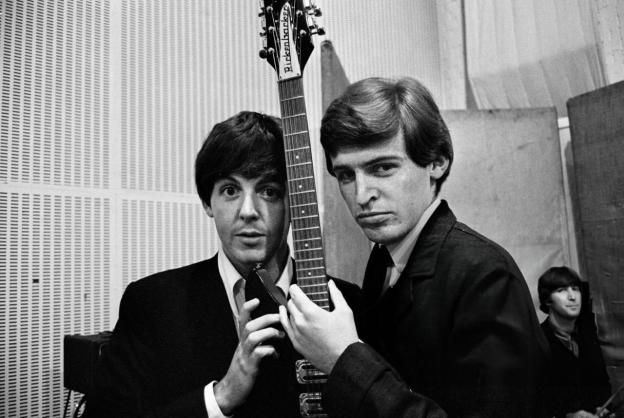
CREDIT: The photo at the top of this post shows Paul McCartney and his brother, Mike, at EMI Studios, in London, on June 3, 1964—the day before the Beatles set off on a world tour. A number of recordings were made that day—sans Ringo, who was ill. The photo is copyright © Larry Ellis. I apologize to Mr. Ellis for violating his copyright, but I really liked this photo and wanted to use it to illustrate the closeness between Paul and Mike, with the younger visiting the elder at his place of business. I find it amusing that the brothers’ expressions are diametrically opposed, with each man committed to his look: Paul giving wide-eyed wonder, Mike evincing eagle-eyed certainty. I doubt there is any deep meaning here, just two bros mugging for the camera. I also love this photo, taken by Ellis the same day: Paul, a huge grin on his face, is raising Mike’s arm and giving a thumbs-up, in seeming approval of his brother.

I Didn’t Mean to Hurt You

This post contains accounts of physical and emotional abuse between partners in a personal relationship. If descriptions of domestic violence leave you feeling vulnerable to anxiety or depression, you might want to skip this one. If you choose to continue, please take care.

As I mentioned in a previous post, the original Paul McCartney chipped his left front tooth in December 1965. For the next three months, the Beatles kept a low profile. When they reemerged into the public eye, in the spring of 1966, fans took notice of Paul’s broken smile. They wanted to know what had happened to him—and when he was going to fix that cracked gnasher.

Word circulated that Paul’s tooth had been damaged in a moped accident in the Wirral, the peninsula in North West England where his father lived. But I don’t buy it. Based on photos, song lyrics, research, and deductive reasoning, I have arrived at a far more disturbing scenario behind Paul’s dental injury.

The Official Story

In the late spring or early summer of 1966, Brian Epstein, the Beatles’ manager, issued a formal explanation for Paul McCartney’s goofier-than-normal grin. Brian’s words appeared in the American teen magazine 16:

Last mid-December, Paul injured his lip and chipped his tooth in the mo-ped accident. He honestly thought no one would notice the chip, for it is so small. I told him three times he should do something about it. It is in a place where there are no nerve ends, so there is no pain. Paul assured me that he would have the tooth capped, but—unfortunately—he has not done so. It is my opinion that he will just let it be.

I couldn’t confirm the publication date of this statement, but it appears in an article that refers to June 5, 1966, as having occurred in the recent past. Around the same time, on June 24, 1966, New Musical Express, a pop periodical in the UK, published Paul’s version of events:

It was quite a serious accident at the time. It probably sounds daft, having a serious accident on a motorised bicycle, but I came off hard and I got knocked about a bit. My head and lip were cut and I broke the tooth. I was only doing about 30 at the time, but it was dark and I hit a stone and went flyin’ through the air. It was my fault all right. It was a nice night and I was looking at the moon!

Later, Paul’s replacement embellished the story—which was expanded to include Tara Browne, a British socialite and an heir to the Guinness fortune, who died in December 1966 (two months after Paul):

We were riding along on the mopeds. I was showing Tara the scenery. He was behind me, and it was an incredible full moon; it really was huge. I said something about the moon and he said ‘yeah,’ and I suddenly had a freeze-frame image of myself at that angle to the ground when it’s too late to pull back up again: I was still looking at the moon and then I looked at the ground, and it seemed to take a few minutes to think, ‘Ah, too bad—I’m going to smack that pavement with my face!’ Bang!

Paul’s replacement would have been wise to check which phase the moon was in that night. On December 26, 1965, the accepted date of the “accident,” Earth’s satellite was a “waxing crescent.” It would have looked like a small, illuminated sliver—not the kind of perfectly glowing orb that might upend a man’s motorbike. The full moon had occurred over two weeks earlier, on December 8, when the Beatles were performing two shows at Gaumont Cinema, in Sheffield, England.

We can guess why Paul’s replacement might have added details to the original story: he was surely questioned, with some regularity, about the incident in which “he” broke “his” tooth. But why would Brian Epstein and Paul McCartney have lied about what happened? What terrible truth might they have been hiding?

A Photo That Told a Different Story

A few years ago, I came across a photograph of Paul McCartney taken right after his alleged wipeout on a moped. I have seen this image credited to Paul’s brother, Mike. It makes sense that Paul and Mike would have been together the day after Christmas, at their father’s house, which was in the vicinity of the supposed motorbike accident. As a photographer, Mike certainly would have had his camera on hand.

But as I studied Paul’s face in the photo, a thought entered my mind, unbidden: “This looks like a man who has been beaten up.” Paul appeared to have been punched on the left side of the mouth and in the left eye. More recently, I encountered a photo from the same occasion but with less contrast, offering a clearer view of Paul’s injuries—which also included a laceration on the left side of the bridge of his nose.

In both photos, Paul’s expression is one of desolation and despair, rather than: “I can’t believe I came off that bike! What an arse!” And why take a picture at such a moment—to capture, for all time, the result of Paul’s lack of coordination? I believe Paul, or someone else, had the idea to document his wounds, in case charges were to be filed against his attacker.

Assuming Paul was assaulted, who would have—and could have—done it? Who would have had the motive and the access? I mentally explored scenarios in which a stranger might have ambushed Paul McCartney. Ultimately, however, I settled on the likelier possibility that the assailant was someone “on the inside.” Then a really awful thought began to nag at me—an unthinkable thought! One that would shock Beatles fans.

Over time, the pieces of the story fell together.

Paul Meets Jane

On April 18, 1963, Paul McCartney met Jane Asher. He was twenty; she had just turned seventeen. The Beatles were big enough to be part of a lineup at London’s Royal Albert Hall (billed second) but were not household names yet. While Paul was onstage with the band, Jane was in the audience providing commentary for the Radio Times, a weekly magazine that listed radio and television programs. Prompted by the publication’s photographer, Jane was snapped screaming for the Beatles—like the girls around her. After the event, she went backstage and was invited to keep company with the group that night.

I might have had a dream memory related to this initial meeting between Paul and Jane—viewed from her perspective. I wonder if Jane might recognize the following scene, as recorded in my journal on September 14, 2023:

I had several Beatles-related dreams [this morning]. In the first dream, I was in a room. I might have been standing, but I feel more like I was sitting on a couch. I was aware that standing behind me, about ten feet away, were members of the Beatles—definitely including the original Paul McCartney. I wasn’t looking at them; my back was to them. I am trying to put my finger on my feeling in the moment. I think I was slightly awed by their presence—but “awe” is too strong a word. I was aware of them, and I knew they were members of the Beatles. There was the sense that they were waiting for something; maybe they were waiting for some kind of an engagement to start.

I have read that during Paul’s first encounter with Jane, he impressed her by quoting Chaucer. Specifically, he said, “Ful semely hir wimpel pinched was.” This line appears in the General Prologue of The Canterbury Tales, in Chaucer’s description of the Prioress (a nun). While the words sound a bit salacious, all they mean is that the Prioress, a sharp dresser, wore a well-pressed cloth around her neck. I believe I am the only one to proffer a theory as to why Paul quoted this particular line, from among the 17,000 lines in the medieval masterpiece. I imagine that after an evening spent talking, Paul and Jane had an exchange like the following:

Jane: I’d like to go home now.
Paul: Of course! I’ll see you to your door. Where do you live?
Jane: In Wimpole Street.
Paul: Oh! “Ful semely hir wimpel pinched was.”
Jane: Paul! You’re so clever and well-read! [writer’s embellishment]

If you missed it, Jane lived on Wimpole Street; the Prioress wore a wimpel.

In my last post, I mentioned that John, Paul, George, and Ringo had known—or known of—each other during the Romantic Period (in past lives). Jane was there, too; she and Paul were siblings, though not related by blood. Two hundred years before that, Jane and Paul were both English dramatists, whose plays are still studied and performed today. It makes sense, then, that when they met (again) in 1963, they connected quickly and bonded over literature. As a footnote, Jane Asher is a fine writer in this lifetime. I read one of her novels, The Question (1998), five or six years ago; I can still remember the ending and how it chilled me to the bone.

A Springtime Engagement

At the end of March 1965, Paul McCartney had a photo session with Jane Asher on the set of the Beatles’ movie Help! In the photos, Jane appears to be wearing an engagement ring, on the fourth finger of her right hand. Based on my survey of the images available online, Jane would not be seen wearing this ring again—except in a photo taken two months later, which I will say more about in a bit.

Why was that ring (almost) never spotted on Jane’s finger again? Maybe Paul and Jane wanted to keep their engagement private. Or maybe Brian Epstein asked Jane not to wear the ring in public, so Paul would still appear “available.” Ringo had tied the knot with Maureen Cox just a month earlier, and perhaps Brian wasn’t ready to lose one of the group’s two remaining bachelors quite yet. I’m not sure it really mattered, though: John’s status as a married man, wed to Cynthia since 1962, hadn’t seemed to dampen enthusiasm for the band.

We get a glimpse of Paul’s feelings for Jane through Beatles songs recorded both before and after their engagement:

  • A love like ours could never die. (“And I Love Her,” 1964)
  • Through thick and thin, she will always be my friend. (“Another Girl,” 1965)
  • If she’s beside me, I know I need never care. (“Here, There and Everywhere,” 1966)
  • I’m so proud to know that she is mine. (“Good Day Sunshine,” 1966)

The sincerity of Paul’s affection for Jane is evident in the following stanza from “Center of Love,” a poem he wrote for her:

And I touched you,
As I caressed your glowing hair.
And the peace I felt in you,
It was as tender as a dove.
And I knew that it would last,
So I whispered in your ear,
That we were lying there,
You and I, in the center of love.

Paul’s replacement published this poem, as his own, in his 2009 memoir.

Within three weeks of his engagement shoot with Jane, Paul purchased a home in the St. John’s Wood neighborhood of London. The three-story Regency townhouse was situated about a mile and a half from where Jane currently lived with her parents and siblings, and where Paul resided in an attic bedroom. It was also an eight-minute walk from EMI Studios, where the Beatles did most of their recording.

The Day Before “Yesterday”

I hope I have successfully conveyed the forward momentum of Paul McCartney’s relationship with Jane Asher in the spring of 1965. To recap, Jane’s engagement ring made its first appearance sometime between March 24 and March 30; on April 13, Paul bought a house. On May 27, Paul and Jane left for a two-week holiday in Portugal—during which, I think, they planned to marry.

On May 26, the day before the couple’s departure, the Beatles recorded their fifty-second and final musical appearance for BBC radio. Between 2:30 and 6:00 p.m., the group rehearsed and recorded seven songs at the BBC’s Piccadilly Studios, in London. When the session was over, I believe Paul informed John of his impending nuptials—probably so John wouldn’t hear it somewhere else, if word got out.

At this point, I speculate, John issued Paul an ultimatum: If he married Jane, he would lose John and the Beatles. Their relationship would be through. And the band would be through.

A Failed Elopement

Paul McCartney’s elopement with Jane Asher started as inauspiciously as it possibly could have. During the five-hour car ride from the airport in Lisbon to the Algarve (Portugal’s southernmost region), John’s warning from the previous day must have been ringing in Paul’s ears: He could marry Jane or be a Beatle, but not both. And if John broke up the Beatles because of Paul, then George and Ringo would suffer, too! By the time Paul and Jane arrived in the coastal city of Albufeira, Paul had penned the lyrics to “Yesterday,” on the back of a brown envelope. (The song’s melody had come to him months earlier.)

Yesterday” gives the impression of being a song about lost love. And it is that, to a certain degree. But more significantly, the verses express how Paul was feeling in the midst of an extremely challenging situation. He felt troubled, a fragment of the man who had seemed to have his life all figured out just the day before, wishing he could hide, with the shadow of a terrible choice hanging over him. The bridge to “Yesterday” includes the line, “I said something wrong.” That something was: “I’m marrying Jane Asher.”

A photo of Paul and Jane in a restaurant in Portugal tells an interesting story. Both have their heads turned to face the camera. Jane appears happy and relaxed, with a knowing look in her eye. Paul, wine glass in hand, looks anxious, barely able to muster a tense smile. If you click the image and zoom in, you will see that Jane appears to be wearing a ring on the fourth finger of her right hand. I believe this is her engagement ring—which she feels free to wear here, in this remote location, in the days or hours leading up to her wedding.

Judging from Jane’s expression in the photo, I doubt Paul had shared his conundrum with her yet. But at some point, he must have told her about John’s conditions for the continuance of the Beatles. I can feel Paul’s deep desire to be married and have a family, and to take responsibility for the three children he had already fathered. I imagine he told Jane that he wanted to stick to their plan to get married in Portugal. Perhaps Jane responded, with compassion and humor, that the mood was sort of ruined, and there would be a better time to exchange vows.

Back to Reality

Brian Epstein asked Paul and Jane to return from Portugal a day early so that all four Beatles would be in Britain on June 11, when it was to be announced they were being awarded an honor called Member of the Order of the British Empire (MBE). I have the sense that Paul and Jane were relieved to shave a day off the saddest non-honeymoon in history. The following morning, on June 12, the Beatles gathered at Twickenham Film Studios to watch a rough edit of Help! Well, all of them but one: John didn’t show.

News outlets were clamoring for the Beatles’ reactions to the MBE announcement, so a press conference was hastily arranged at the studios. John arrived over an hour late, and only after Brian had retrieved him personally from his home. John explained his tardiness to the 150 assembled reporters:

I set the alarm for eight o’clock and then I just laid there. I thought, “Well, if anyone wants me, they’ll phone me.” The phone went lots of times, but that’s the one I never answer. My own phone didn’t go at all, so I just laid there.

You might hear John’s excuse and think, “That John Lennon—what a quirky fellow.” But I believe his absence was entirely deliberate. He didn’t want to see Paul. He thought, “Paul is married, and the Beatles don’t exist anymore.”

Two days later, on the evening of June 14, Paul recorded the song for which he finally had lyrics: “Yesterday.” That afternoon, the group had recorded two other songs featuring Paul: “I’ve Just Seen a Face” and “I’m Down.” This latter track contains the line, “Man buys ring, woman throws it away”—clearly a reference to Paul’s ill-fated elopement with Jane. But Paul and Jane weren’t broken up. After the “Yesterday” session ended, at 10 p.m., they went to a nightclub in South Kensington together. Nevertheless, the fact that John was essentially holding the Beatles hostage must have imposed a serious strain on their relationship.

Paul’s Three “Women”

Toward the end of 1965, Paul McCartney wanted to write a song for Jane Asher called “Woman.” He made several attempts, resulting in at least three songs with that title. One “Woman” would be recorded by the British pop duo Peter and Gordon, while Paul was still alive, with his full permission and—hopefully—apologies. It’s not very good. Perhaps the most redeemable lines are as follows:

Woman, don’t forsake me
Woman, if you take me
Then believe me, I’ll take you
To be my woman

Peter Asher and Gordon Waller did a lovely job with the song, taking it to the top twenty in the United States. These two souls, during the English Renaissance, had been instrumental in preserving the plays of Shakespeare for posterity; so, the least Paul could do was pass along a few tunes. (The earlier “A World Without Love” was a much better gift.)

Two other songs of Paul’s called “Woman” were stolen, after his death, by different artists. John Lennon recorded one of them for his album Double Fantasy (1980). As a single, it reached the top spot in the UK and peaked at number two in the United States. I believe this “Woman” was the one Paul wanted to write for Jane. I think he was satisfied that it expressed what was in his heart.

And what of the third “Woman”? Paul’s brother, Mike, put his name on it, recorded it, and released it as the haunting title track of his 1972 album Woman. Here’s the weird, gross, funny part: The song is intensely intimate, intended to be shared only between lovers—yet Mike’s mother is on the album cover, representing “Woman.” (Of course, Mary McCartney was Paul’s mum, too.) This is not a song about one’s mother. I can’t imagine that the sexual imagery could have been misinterpreted. Here’s the first line: “Woman, I want to go down and drown in you.” The absurdity takes a bit of the sting out of the fraternal betrayal.

A Christmas Promise

I have no proof of the scenario presented in this section, but working back from the larger story, it makes sense to me.

On Christmas morning, 1965, Paul McCartney serenaded Jane Asher with the song “Woman,” as a renewal of his proposal and of their plan to marry. But which “Woman” do you think it was?

  1. The so-so one that Peter and Gordon turned into a respectable song
  2. The expressive one that John Lennon made famous
  3. The erotic one that Paul’s brother recorded

If you guessed number 2, you’re right. If you guessed number 3, you’re making me laugh right now. Indeed, lyrics from the “Woman” Paul sang to Jane on Christmas Day sound very much at home in a marriage proposal:

  • “I’m forever in your debt”
  • “Hold me close to your heart”
  • “My life is in your hands”
  • “It is written in the stars”
  • “I love you…now and forever”

Paul had essentially said, “Sod the Beatles. Let’s just do it.” Jane accepted. By the way, that’s the risk of dating a musician: at the holidays, you’re likely to get a song instead of a real gift.

I read somewhere that Jane Asher’s favorite song is “Woman”—the one recorded by Peter and Gordon. Peter Asher, of Peter and Gordon, is Jane’s brother. And the song was written by her fiancé. So, the choice makes sense. But I like to think that when Jane mentions her favorite song, she is secretly nodding to the “Woman” Paul crooned to her to persuade her to marry him.

Later that day, Jane and Paul traveled from her family’s home in London to be with his relatives in and around Liverpool.

How Paul McCartney Broke His Tooth

Fifty-nine years ago today, on December 26, 1965, John Lennon savagely attacked his bandmate Paul McCartney in a fit of jealousy—breaking Paul’s left front tooth and causing multiple lacerations. I know, I could have told you that right at the top. But I think you’ll appreciate having the foregoing information as you read my speculative dramatization of what happened:

On the day after Christmas, 1965, Paul McCartney and his fiancée, Jane Asher, were at Paul’s father’s house, in Heswall, on the Wirral Peninsula. The festive mood was made even jollier by talk of the future nuptials of two so dear to all who were present.

There was a knock on the door. It was John Lennon. He hadn’t been expected. He wanted to talk to Paul alone, upstairs. He didn’t say why.

The bedroom door closed behind them.

“Is it true?” John asked, quietly. “Is the rumor I heard true?”

“Yes,” Paul said. “It’s true.” He wanted to sound confident, to look John in the eye. But there was a tremor in his voice; his look was askance.

Instantly, a rage rose inside John. He started pummeling Paul, who was too busy defending himself to get off any shots of his own.

“Stop!” Paul cried. “John, stop!” He was scared. He thought his bandmate might kill him.

John hurled insults as he punched Paul in the mouth, the nose, the eye.

Those gathered downstairs became aware of raised voices and a commotion coming from the floor above. They burst in. John ceased his attack.

“Get out of here, Lennon!” snarled Jim, Paul’s father. “I never liked your sort.”

John left. It was obvious that Paul was going to live. Mike McCartney fetched his camera, to document his brother’s injuries—in case charges were to be filed.

Paul went to Accident and Emergency. The doctor on duty, as he put several stitches inside Paul’s mouth, inquired delicately of his famous patient: “You’re not the ‘cute one,’ are you?”

As they say, comedy is tragedy plus time. I should note that Paul sustained injuries to the left side of his face, consistent with the fact that John was right-handed. In a future post, I will describe John’s history of violent acts, including an earlier incident motivated by jealousy over Paul—with even more dire consequences.

A number of years ago, I noted something Ruth McCartney said in an essay that appears in her mother’s memoir Your Mother Should Know (by Angie McCartney). Ruth, Paul’s much younger sister, relates a memory of “John and Paul arguing out a song together in the attic at Cavendish Avenue,” referring to Paul’s home in London. Ruth would have been five years old when John Lennon attacked her brother. Is it possible she has misremembered Jim McCartney’s house as Paul’s house? And the “argument” she heard was John Lennon beating up Paul McCartney? Maybe, as a little girl, she was told that Paul and her uncle John had been fighting about a song.

Mike McCartney took a picture of his father and titled it “Dad doing his Crossword.” I can’t link to it, but I will describe it to you: Jim McCartney sits in an armchair, in a wood-paneled room, his newspaper in front of him. Behind him is a shelf-like projection, possibly the mantel of a fireplace. On this mantel rests a photo of the Beatles, propped up next to what appears to be a framed music award. When I first saw this image, I noticed something strange: There were only three Beatles in the photo on the mantel. I could make out George and Paul, with Ringo in front of Paul. But where was John? His visage must have been hidden (deliberately?) behind the framed music award.

Just a Jealous Guy

Any musician who has covered the song “Jealous Guy” (such as Joe Cocker, Roxy Music, or the Weeknd) has paid tribute to the time John Lennon beat the crap out of Paul McCartney. If you want to know what happened that day, “Jealous Guy” offers some clues:

  • “My heart was beating fast”
  • “I was tryin’ to catch your eyes / Thought that you was tryin’ to hide”
  • “I began to lose control”
  • “I was feeling insecure / You might not love me anymore”
  • “I was swallowing my pain”

Here’s the twisty part: Paul wrote “Jealous Guy” from John’s perspective, for him to sing. Which John did, on his Imagine album (1971).

When I made the connection between “Jealous Guy” and the photo of Paul’s battered face, I felt gratified. At least John had apologized, even if Paul was no longer alive to hear him:

I didn’t mean to hurt you
I’m sorry that I made you cry
I didn’t want to hurt you
I’m just a jealous guy

But then I studied the lyrics. Metrically, the verses were perfectly regular, making it unlikely John had written them. In a previous post, I made the case that the original Paul McCartney was the sole composer of virtually the entire Beatles’ catalog—and many of the members’ best-known solo hits. “Jealous Guy” appears to be one of them. It fits Paul’s “songwriting fingerprint” exactly.

I was confused: Why would Paul have taken his abuser’s point of view? I came up with several possible reasons:

  1. He was accustomed to writing songs for his bandmates.
  2. Writers take inspiration where they can find it.
  3. To control the narrative of a situation in which he had felt helpless.
  4. To help him find compassion for John.
  5. To craft the thoughtful apology he wished to hear from John.

In the third verse of “Getting Better,” on the Beatles’ Sgt. Pepper album (1967), John admits exactly what he did: “I used to be cruel to my woman / I beat her and kept her apart from the things that she loved.” Paul had left “Getting Better” unfinished, but it was clearly about John—that “angry young man.” John filled in the third verse after Paul died.

O My Prophetic Song!

John Lennon’s physical violence against Paul McCartney was foreshadowed—even predicted—by a song on the Beatles’ Rubber Soul album (1965). “Run for Your Life,” with lead vocals by John, is a truly horrifying anthem to domestic abuse. Paul lifted the first two lines, “I’d rather see you dead, little girl / Than to be with another man,” directly from a 1957 Elvis Presley song. Paul must have thought these words encapsulated John’s feelings toward him.

Below are the three unique verses of “Run for Your Life,” followed by its chorus, so you can see how chillingly prescient they were:

I’d rather see you dead, little girl
Than to be with another man
You better keep your head, little girl
Or you won’t know where I am

Well, you know that I’m a wicked guy
And I was born with a jealous mind
And I can’t spend my whole life trying
Just to make you toe the line

Let this be a sermon
I mean everything I’ve said
Baby, I’m determined
And I’d rather see you dead

You better run for your life if you can, little girl
Hide your head in the sand, little girl
Catch you with another man
That’s the end, little girl

Clearly, Paul understood the danger of John’s jealousy. Was “Run for Your Life” a cry for help? Was Paul saying to John, “Look what you’re doing!”? Was he saying to others, “Can’t you imagine what he is capable of?”

Twenty-three days after “Run for Your Life” was released on Rubber Soul, John delivered on the song’s promise.

Broken Tooth, Broken Up

Five days after their altercation, John Lennon and Paul McCartney attended separate New Year’s Eve parties. Five days after that, on January 5, the Beatles were in the studio overdubbing a concert they had performed in New York City the previous summer; footage of the show was to be released as a television movie. The high in London that day was 3.9 degrees Celsius, or 39 degrees Fahrenheit. I have to imagine the atmosphere inside the studio was just as chilly.

A few weeks later, on January 21, George Harrison married Pattie Boyd, whom he had met two years earlier, on the set of A Hard Day’s Night. Paul McCartney and Brian Epstein were George’s best men. At the wedding, Paul’s outward wounds appeared to have healed; but he seemed to be nursing the inward ones with a bit too much alcohol. John and Ringo did not attend, as they were on holiday together with their wives. I think Ringo might have been keeping John busy, and away from Paul. And I like to think that George had threatened John with grievous bodily injury if he ever harmed Paul again.

For the first quarter of 1966, the Beatles were essentially broken up—or at least experimenting with a separation. Additional highlights of this period include the U.S. and UK releases of Peter and Gordon’s “Woman” (January 10 and February 11, respectively); the Beatles’ ten Grammy nominations (February 13); John’s famous “We’re more popular than Jesus” comment (March 4); and a holiday for Paul and Jane in Switzerland (March 6 to March 20).

Spring brought a thawing of relations. On March 24, all four Beatles, with their partners, attended the première of the movie Alfie, in which Jane Asher had a role. The following day, John, Paul, George, and Ringo participated in a photo shoot for the controversial cover of their compilation album Yesterday and Today (1966)—an odd and unsettling collection of songs, if you ask me (but you didn’t).

Paul and John resumed socializing; on April 1, they visited the newly opened Indica Books & Gallery, in which Paul was an investor. Five days later, on April 6, the Beatles were back in the studio, to begin recording the album that would become Revolver (1966).

Little Darling

I believe that Paul McCartney wrote “Here Comes the Sun” during this period (the early spring of 1966). The Beatles would record it after his death, with George singing lead, for the Abbey Road album (1969). In “Here Comes the Sun,” the cold of winter gives way to the warmth of spring—a metaphor Paul uses to represent the thawing of the frostiness between him and John, and within the group as a whole.

The first verse of “Here Comes the Sun” establishes that “it’s been a long, cold, lonely winter.” John had assaulted Paul at the beginning of winter, and the intervening three months were clearly long, cold, and lonely. But Paul is noting a transition out of this frigid season in their relationship: “I feel that ice is slowly melting.” Indeed, a sense of ease is coming back: “The smile’s returning to the faces.” The chorus concludes with Paul’s view of where things stand now: “I say, ‘It’s all right.’”

I’d like to share a relatively recent story about “Here Comes the Sun.” On November 12, 2020, I was driving my dog Grace to puppy camp, for socialization during the coronavirus pandemic. The radio was tuned to NPR, National Public Radio. A story came on about how hospitals in largely rural North Dakota were at capacity due to COVID-19. The show’s host, David Greene, was interviewing the chief medical officer at the state’s largest hospital, who described the heartbreak of losing patients to the virus. The medical officer concluded:

On the upside, we play the song “Here Comes the Sun” any time we have a patient leave the unit or get discharged. And that brings a bit of a smile to people’s faces, and the patients like hearing that.

As the story ended, “Here Comes the Sun” came up. Of course, I wept. It was gratifying to hear that after all these years, my words still meant something to someone. “Yet part of me was frustrated,” I noted in my journal, “that the world believes—and probably always will—that George Harrison wrote that song.”

Same Time, Next Year

When Paul McCartney and Jane Asher got engaged for the second time, on Christmas Day, 1965, they planned to marry exactly one year later. How could I possibly know such a thing? I think I’m about to impress you with my sleuthing—with the caveat that I don’t know for sure that I’m right. Here we go.

In 1980, in Bermuda, John Lennon recorded a demo of “Grow Old with Me.” You guessed it: Paul wrote this one, too. I can’t tell if Paul intended the composition as a poem or a song; John might have provided the melody heard in the recording. Paul borrowed the first two lines of “Grow Old with Me” from a Robert Browning poem. Paul’s first verse reads as follows:

Grow old along with me
The best is yet to be
When our time has come
We will be as one

The remaining verses are equally romantic. But it’s the bridge that provides an important clue:

Spending our lives together
Man and wife together
World without end
World without end

Please try to overlook the outdated expression “man and wife.” It’s the repeated phrase “world without end” that’s important to our investigation. When I read it, I connected it instantly with a favorite Shakespearean monologue of mine, from Love’s Labour’s Lost. In that speech, marriage is characterized as a “world-without-end bargain”—an agreement that lasts forever, so it shouldn’t be entered into hastily (“in heat of blood”). The characters decide to wait a year (“until the twelve celestial signs / Have brought about the annual reckoning”), and if they still feel the same, they will wed:

Then, at the expiration of the year,
Come challenge me, challenge me by these deserts,
And, by this virgin palm now kissing thine
I will be thine…

Were Paul and Jane inspired by Love’s Labour’s Lost to wait a year before exchanging vows? Or did they plan their wedding for one year hence and then recall Shakespeare’s “world-without-end bargain”? Either way, the phrase was top of mind when Paul wrote “Grow Old with Me,” about his lifelong commitment with Jane.

Two years ago, I posted my song about the engagement of Paul and Jane. I didn’t think anyone would understand “The Christmas After This” (video below), especially without knowing the inspiration behind it—which you now do! But then my mom left me the following voicemail, which also references a poem I wrote for my uncle’s birthday:

Hi, Karen. This is your mother speaking. I just had to call you and tell you how much I appreciated the song for Christmas. And, um, I’m just amazed at your talent. And, um, and also, the poem for Stanley was absolutely beautiful. And I’m so proud of what you do, and, um, it’s just amazing to me. You are so talented. And I just wanted to tell you that and to tell you how much I love you. Okay, sweetheart, bye-bye.

I’m glad I wasn’t able to get to the phone at that moment, because now I have a recording of my mother’s sweet words.

Mom’s Voicemail re: the Song for Christmas

Paul McCartney and Jane Asher would not grow old together. Paul died eleven weeks before their wedding day. But that didn’t stop him from writing a song, in his next lifetime, to honor their relationship.

The Christmas After This

Lyrics:

All hark ye, park thee round the tree
To mark this merry comedy

Since we met
I’m in your debt
Now lend me your ear

Take my word
Let it be heard
How I need you here

Next Christmas
We’ll reminisce this
As both
Our troth
Do swear

The Christmas after this one
The Christmas after this, hon
The Christmas after this

A halo round a moonless stone
A glistering to gild your own

Take this ring
We’ll do our thing
For just one more year

Take a chance
On our romance
Forge a new frontier

Next Christmas
We’ll reminisce this
As both
Our troth
Do swear

The Christmas after this one
The Christmas after this, hon
The Christmas after this

An old guitar, romantic jargon
To seal a world-without-end bargain

[Hummed verse]

Take this song
And dream along
With your balladeer

[Instrumental pre-chorus and chorus]

A dress of wool, a suit of lace (“That’s backwards!”)
An oath beside the fireplace (“Egad, that’s hot!”)
Some nog for toasting, “Cheerio!”
A snog beneath the mistletoe

Take my hand
And it is planned
Yea, our day is near

Take my heart
We’ll never part
Nay, nor never fear

Next Christmas
We’ll reminisce this
As both (as both)
Our troth (our troth)
Do swear

I will be thine
Take all that’s mine

The Christmas after this one
The Christmas after this, hon
The Christmas after this

The Christmas after this kiss
The Christmas after this bliss
The Christmas after this

CREDITS: The photo at the top of this post is a screenshot I took of the Beatles’ promotional video for “Paperback Writer.” Many thanks to the photographers who took the pictures that appear in my video for “The Christmas After This.” Henry Grossman took the pictures of Paul McCartney and Jane Asher on the set of Help!

My Heart Will Lead Me Home

I’m pretty sure this blog post is haunted, because it completely disappeared yesterday while I was working on it. Poof! A little while later, it rematerialized. Spooky!

Halloween marks a time for remembering the dead and for celebrating the macabre, so it seems a fitting occasion on which to recount the rather gruesome passing of Paul McCartney, fifty-eight years ago this month.

In my last two posts, I talked about the burial of the original Paul McCartney, his replacement by a lookalike, and his contributions to the Beatles both before and after his death. In these discussions, I attempted to substantiate my assertions with compelling proof. Not so much with today’s post. In developing a theory of how Paul McCartney died, I have relied on psychic impressions, dreams, and flimsy circumstantial evidence.

The Psychic Who Spotted the Difference

My first peek into how Paul McCartney died came in 2018, during a session with my creative coach. I was working with Ziva (not her real name) to self-publish a collection of my blog posts. In addition to being an inspiring guide, Ziva was an intuitive; that is, she was able to access information beyond what is knowable through the traditional five senses. Aware of this talent, I decided to ask her about some strange things that had been happening around the house—curiosities that began shortly after I realized the original Paul McCartney had very likely been replaced.

First, I asked Ziva if she was familiar with the “Paul is dead” urban legend. She laughed. A bit daunted by her apparent skepticism, I produced a sheet of paper on which I had printed side-by-side photos of Paul and his replacement. I was prepared to point out the fine distinctions in their appearances—in face shape, eye color, and the way their hair fell. But I didn’t have to. After studying the page for a few seconds, Ziva announced, “They’re not the same person. They have completely different energies.”

I disclosed to Ziva some of the odd experiences I’d been having of late: intense crying spells; the frequent feeling that there was a being near me, either hovering or directly behind me; the irrational fear that a bloodied Paul McCartney might emerge from the darkness of the backyard when I took the dogs out at night to do their business. I told Ziva about a thought I’d had on the evening of June 3, 2018. As I reported the occasion in my journal:

I was washing the dishes and putting them on the drying rack. I felt like I needed to know what was going on. In my mind, I said, “If there is someone there, give me a sign. But don’t scare me!”

Three days later, on June 6, 2018, I received the first physical sign that something was going on:

I decided to rent Ron Howard’s documentary of the Beatles’ touring years, EIGHT DAYS A WEEK. I remember getting furious at the interview segments with Sir Paul McCartney (whom I strongly suspected was a replacement at that time). His eyes were so green in that movie… It was so obvious, on a gut level, that this guy was a poser. I said out loud, to the screen, “[Something unkind].” Then the lights in the living room, where I was watching the movie, began to flicker. These are six recessed lights. They continued to flicker, with varying degrees of intensity, for the rest of the movie and for a while after. I tried to adjust the dimmer switch to make it stop, but it didn’t. I wondered if the soul of the original Paul McCartney was causing the electrical disturbance. But I remember thinking, “This seems like a John Lennon kind of thing to do.”

Near the very end of that movie [EIGHT DAYS A WEEK], there’s a phrase that comes on the screen: “Three months later,” meaning, three months after the end of the Beatles’ American tour [in August 1966]. The film then presents the Beatles in the studio, recording “Strawberry Fields Forever,” I think. I was frozen [on the couch], and then I broke out in gut-wrenching sobs. How could Ron Howard say, “Three months later”? Didn’t he know what happened in those three months? The original Paul McCartney died and was replaced! You can’t just say, “Three months later.” I still don’t understand how biographers and documentarians miss the fact that there were two different Paul McCartneys.

(Rereading this journal entry, I am struck by how much more anger I used to have about the situation.)

After I shared the foregoing information with Ziva, she said she was going to try to “tune in” and find out how Paul McCartney died. I felt excited and a little panicked by this idea; whatever was happening, it was moving along quickly now! I interjected that the prevailing theory among those in the “Paul is dead” community was that Paul had died in a car crash. But that’s not what Ziva saw at all.

How Paul McCartney Died

My clairvoyant creative coach, in her mind’s eye, saw Paul stepping down and losing his footing because the ground was wet—an action that led to his death. Over time, a fuller picture developed around this premise. I will reveal how I arrived at some of the details in a little bit. But first, I will tell the tale of how Paul McCartney died as if it is fact, and in the spirit of a good, old-fashioned Halloween story:

On a mild October evening, Paul McCartney ran a bath. It was the Swinging Sixties, but the famous bass player was staying in. He was alone in the house—except for Knickers, the sheepdog puppy he had acquired several months earlier. Knickers could be heard howling for Paul, from another room, during a radio interview that aired shortly before the Beatles flew to America for their final tour.

Paul didn’t know it was the night he would die—that the moments leading up to his last would be spent drawing a bath. He was naked. And a little high on marijuana. Had he been able to see into the very near future, he would have wished for a temporary reprieve from gravity—such that water might not pool, or a man might fall up.

Paul lowered himself into the filled tub.

“Bugger!” he swore aloud. He had left his watch on. He considered removing it and putting it on the floor. But Knickers was there, keeping him company. She might think it was a toy—and treat it as such. Paul figured he should place the timepiece safely on the counter, next to the sink.

Paul stood up. He stepped completely over the lip of the tub, which was wide enough to sit on. Regrettably, he slipped on the patterned tiles below and fell back in the direction of the bath. Vertically lining the wall behind the tub were several shiny knobs. Paul’s head made contact with this hardware before he landed, face down, in the water.

Unconscious, he drowned peacefully.

Now outside his body, Paul comforted Knickers. She sensed his presence. On Paul’s submerged watch, the halted hands showed 9:09. As a teenager, Paul had written a ditty called “One After 909,” about a woman and a locomotive. The Beatles performed this song in the early days—at the Cavern Club, in Liverpool; and at the Star-Club, in Hamburg. But there was no train coming after 909; for Paul, 9:09 was the end of the line.

Paul had been expecting company that Sunday night, in the form of his future brother-in-law, Peter Asher, of Peter and Gordon. Paul had written the British pop duo’s debut single, “A World Without Love,” which reached the top spot in the U.K., the United States, and elsewhere.

When Peter arrived at the house, to meet with Paul about a musical matter, he knocked on the front door. Getting no answer, he let himself in; he had the key on him because his sister lived at the same address. Peter called out for Paul. Receiving no response, he began to look from room to room. There were lights on, like someone was home.

Ultimately, Peter discovered Paul in the upstairs bathroom. Knickers was still stationed by her master, where he lay in the bloody water. Peter turned Paul over. It seemed too late; but, of course, an ambulance was summoned. Peter also called his sister Jane, who was in Bristol to rehearse a play; he told her that her fiancé appeared mostly dead.

The ambulance came and took Paul to the hospital. Peter followed. Jane left right away, but London is a drive of several hours from Bristol. For privacy reasons, Peter asked for the Beatle’s identity to be kept quiet. At the hospital, it was confirmed that Paul was quite dead. When Jane arrived, she was devastated.

At this point, it was around midnight. Jane phoned the house of Paul’s father, in Heswall, near Liverpool. She had the lamentable task of waking Jim McCartney from his sleep and telling him that his elder son had died. The line was ringing. Jim’s wife, Angie, picked up. Jane said she had some terrible news and asked to speak to Jim.

In the morning, England awoke to the shocking headline: “Paul McCartney, Beatle, Dead at Twenty-Four.” It seemed like an awful dream. The queen declared a national day of mourning to allow for reflection upon the life of this young man, who had brought so much pride and joy to the nation. As word spread, Beatles fans around the globe grieved the loss of one-quarter of the world’s most famous band.

But nothing in that last paragraph actually happened. Paul’s death would go completely unnoticed by the public—as it largely remains.

A little over a week after he suffocated on his own bathwater, Paul McCartney was buried in an unmarked grave. He was wearing the watch that stopped when he did.

I didn’t want to interrupt the story with supporting links, so here they are:

  • Paul, when he acquired Knickers (in his arms) from the breeder Ann Davis
  • Knickers, howling during a BBC radio interview that aired August 6, 1966. (The howls start at 6:30 and continue for a while; they resume at 8:14, with an imitation by John and an apology from Paul.)
  • Paul’s replacement sitting with baby Mary on the wide lip of the bathtub (sheepdog at the door), in a mirror selfie by Linda McCartney
  • Hardware lining the wall behind Paul’s bathtub, as well as the patterned floor tiles, in a mirror selfie by Linda McCartney (with Paul’s replacement)
  • The Beatles rehearsing “One After 909” at the Cavern Club, in Liverpool, in 1962
  • Peter and Gordon performing “A World Without Love” (written by Paul McCartney), in 1964
  • Jane Asher as Juliet in the Bristol Old Vic Company production of Romeo and Juliet, on November 9, 1966 (exactly one month after Paul’s death)

I was able to flesh out how Paul died, in part, with the help of some dreams I’ve had over the last few years.

Dream Memories of Paul’s Death

If you’ve never heard of a dream memory, it’s probably because I coined the term for my own use, to describe an experience I was having. Here’s my thinking:

  1. The subconscious contains memories of our past lives.
  2. The subconscious fuels our dreams.
  3. Therefore, it is possible to dream about our past lives.

When I have a dream memory from my life as Paul McCartney, I might experience it from Paul’s perspective. Or I might observe it from the outside—even through the eyes of another person in the scene. Sometimes, a dream memory is “pure”; at other times, my thoughts as Karen color my perception. Psychologists are well aware of the symbolic nature of dreams; if you’ve ever dreamt you were walking around naked in public, failing an exam, or losing all your teeth, you’ve come face to face with a classic dream symbol. Similarly, dream memories aren’t always strictly literal.

Please bear these nuances in mind as you read about several dream memories I’ve had concerning the death of Paul McCartney:

DREAM MEMORY #1: At the hospital
Date: 2019 or 2020
Description: This dream memory occurred before I was regularly recording my dreams, but parts of it remain quite vivid. What I remember most was seeing Paul’s face, devastated, through a window in a closed door like they have in hospitals—the ones that swing open. It was like his face was melting or distorting with sadness; his expression was a combination of horror and despair. I wondered if Paul’s soul had followed his body to the hospital and was seeing, now, that nothing could be done to save him. In the same dream, Jane Asher walked across my field of vision; I saw her from above, from the waist up, as she passed at a bit of a downward diagonal, from right to left.

DREAM MEMORY #2: Falling in the bathroom
Date: April 5, 2023
Description (from my journal):

I fed the dogs at 6:00 a.m. When I got back in bed, I turned on SEINFELD. I fell asleep around 6:40 a.m. I dreamt that I was sitting at a computer, absorbed in doing something. Upon reflection, the room and the computer are not familiar to me. Then I remembered I was running the shower. I went into the bathroom, which was the next room. It was my real bathroom, the one here in my house. I kneeled and pulled back the curtain a little. Only a trickle of water was falling. And I couldn’t hear it. I panicked momentarily, worried I was deaf. But then I realized I could hear SEINFELD. (Perhaps I was somewhere between being asleep and being awake, since I could hear the TV in my dream.) I adjusted the faucets.

I found myself standing half outside the shower [which is a shower-tub]. I caught a glimpse of myself in the mirror. I was naked and crouched over, but where I would typically see my long blonde hair, I saw a dark mass. I was aware of losing consciousness as I started to fall toward the floor, onto my left side. My left eye was already closed, and I struggled to keep my right eye open. But it closed. I thought, “I’m dying.” Then I was all the way on the floor. I was SHOCKED to wake up and find it had been a dream. It was 7:10 a.m. I wondered if Paul had given me a very strange gift—the gift of feeling what it was like to lose consciousness before drowning in the bathtub.

DREAM MEMORY #3: Crying with Jane
Date: October 12, 2023
Description (from my journal):

Later in the morning, in a dream, I felt very sentimental about Jane Asher. I had the thought that I could see in her the girl I once knew… It was a dream memory of Jane Asher—a sad one. It was at the hospital… She was sad and crying. She didn’t know I was standing right next to her, also crying.

Upon reflection, maybe JPM [James Paul McCartney] and I were supposed to take away from this memory that people were actually upset we were gone—since any such emotion would have to have been suppressed, at least publicly.

Thankfully, not all my dream memories of Paul are somber. Last year, I had quite a lighthearted one (an encounter between Paul and his brother)—which I was able to verify with a photograph! But that’s a story for another time.

Flimsy Circumstantial Evidence

In my last post, I shared a photo of what I suspected to be Paul’s grave. Posing at the site are Ringo, Yoko, John, George, and Paul’s replacement. The photo was taken by Linda McCartney, at the McCartneys’ home (formerly Paul’s home), for the sleeve of a Beatles single. On that afternoon in April 1969, Linda also photographed the group in what appears to be an upper-story window. I believe that window marks the room where Paul died.

Here’s what I think happened during that shoot: The group posed in the window of the upstairs bathroom, where Paul had been knocked unconscious and drowned two-and-a-half years earlier. Being in this space prompted John, George, and Ringo to meditate upon the death of their former bandmate, in “yon bathtub.” This emotional state inspired them to mark out Paul’s grave, where it lay in the garden below, using various collected items.

Do we know for sure that the window in the group photo is the window in Paul’s bathroom? A few similarities can be noted:

  • The window in the group photo has curtains; the window in Paul’s bathroom also has curtains.
  • The subjects in the group photo seem to be leaning or kneeling; there appears to be a ledge inside the window of Paul’s bathroom that would have provided the necessary support.

Moving on to a different detail of my story, why did I make Paul’s bathwater bloody? The suggestion came from George Harrison’s own lips. If you play the song “Blue Jay Way” backwards, starting about thirty-eight seconds in, George says, “Paul is bloody” and “Paul is very, very bloody,” over and over. I was going to count how many times, but the extremely clear pronouncement of “Paul is bloody” at 1:20 was enough for me.

Paul wrote “Blue Jay Way” in Los Angeles, in August 1966. He had been separated from his bandmates and dropped off at a borrowed house in the Bird Streets neighborhood of the Hollywood Hills—to be murdered. He was told that John, George, and Ringo would join him later. Paul had already had a very long day of traveling, performing, and cluelessly dodging attempts on his life. Now he was alone, in a remote location, with no protection against the attack of a paid killer. This individual arrived, in the guise of a newspaper reporter. Paul managed to neutralize the assassin, nonviolently, without ever suspecting her original motives.

After the assassin left, surely on her way to be fired, Paul grabbed a piece of stationery (scroll down at the link) and began to write “Blue Jay Way.” The first verse sets up the scene:

There’s a fog upon L.A.
And my friends have lost their way
“We’ll be over soon,” they said
Now they’ve lost themselves instead

Paul had lived to die another day.

[Edit, November 2, 2024: In reexamining the handwritten lyrics at the link, I realized that they appear to have been written by Paul to start, but then George (in a different pen and in a different hand) made an edit to the first line and added a fourth verse (which didn’t make it into the final song). Therefore, Paul’s original first line was, “There’s a fog on Blue Jay Way”—a fitting way to begin a song about being stuck in a house on a street of that name. Note that Paul’s next line also ends in “way” (“And my friends have lost their way”). So, I appreciate George’s edit (changing “on Blue Jay Way” to “upon L.A.”), for the sake of varying the rhyme.

However, I also like the subtlety of Paul’s original intent, to use “way” in successive lines but with somewhat different meanings. Paul triples down on “way” by writing, in the fourth line of that first verse, “they’ve lost their way.” By the time the song is recorded, however, George changes this lyric to, “they’ve lost themselves”—which I quite like. It suggests a fog so thick you can’t even find yourself.

I want to point out that George’s added fourth verse is metrically sound; that is, it matches the rhythm of the first three verses, written by Paul. I’m not sure why it wasn’t used in the final song, but I might have an idea. Paul, in his verses, refers to his friends (the ones he’s waiting for) in the third person (“they”). George, in his verse, refers to his friends in the second person (“you”). So, perhaps, in the end, it was decided that the added fourth verse didn’t flow with the others.

Finally, Paul’s name is intoned several times, as an eerie background vocal, when “Blue Jay Way” is played forwards (at 1:54, 1:59, 2:04, and 2:10).

Postscript: The Beatles started recording “Blue Jay Way” on September 6 and 7, 1967; they finished on October 6, 1967, just three days shy of the first anniversary of Paul’s death. Maybe Paul was especially on their minds during this time, so they filled the song with references to him and his passing.]

Mother Mary’s Passing

Halloween is a day for remembering Mary Patricia McCartney, formerly Mohin, who died on October 31, 1956, at the age of forty-seven. Mary was the wife of Jim McCartney, and the mother of Paul and Mike. Mary had been admitted to the hospital for a mastectomy, which never took place; when the surgeon opened her up, he saw the cancer had spread too far. Mike has been quoted as saying: “I can’t remember the details of the day we were told. All I remember is one of us, I don’t remember who, making a silly joke.” I’m pretty sure it was Paul, being a fool.

In a magazine interview, Paul was upfront regarding his feelings about his mother’s death:

Q: Do you live with your parents?
A: My mum passed away when I was 14, so I live with my dad, who is a cotton salesman now, and brother Mike, in a comfortable private home. I deeply regret that my mum did not live to see me succeed.

From what I’ve read, Paul often mentioned the fact that his mother died when he was young. I don’t think he ever got over her loss, in the ten years he survived her.

Bury Paul in Liverpool

My song “If I Roam (Bury Me in Liverpool)” began, very simply, as instructions for what to do with Paul’s body if it was ever found. Quickly, however, it became an anthem to Paul’s hometown of Liverpool, England.

I have now set the song to photographs taken by Mike McCartney—with a handful taken by his brother, Paul. Below the video, you will find the song’s lyrics, and below those, an important credit.

Next time, I’ll tell you how Paul McCartney really broke his left front tooth, based on clues from primary source materials.


Lyrics:

If I fall and need a hand
Of all the places in the land—
Carry me to Liverpool
Where folks live by the Golden Rule

If the world forgets my name
And I could use some local fame—
Ferry me to Liverpool
Where I grew up and went to school

If I roam, roam, roam
My soul will call me home
If I roam, roam, roam
My heart will lead me home
Lead me home

If I’m feeling gray and sad
Or if I’m feeling fine and glad—
Tarry me in Liverpool
To meet me mates and grab a stool

If you wonder where I’m free
To be myself and very me—
Query me in Liverpool
Where kettles warm and breezes cool

If I roam, roam, roam
My soul will call me home
If I roam, roam, roam
My heart will lead me home
Lead me home

If you like the way I look
And if I kiss not by the book—
Marry me in Liverpool
G’wed and wed in Mersey’s jewel

If I die in London Town
Don’t let them put me in the ground—
Bury me in Liverpool
St. Peter’s, welcome back your fool!

If I roam, roam, roam
My soul will call me home
If I roam, roam, roam
My heart will lead me home
Lead me home (oh-oh)

If I roam, roam, roam
(Roam, roam, roam)
My soul will call me home
If I roam, roam, roam
(Roam, roam, roam)
My heart will lead me home
Lead me home
Lead me home

CREDIT: The image at the top of this post, of the McCartneys’ restored kitchen at 20 Forthlin Road, Liverpool, is from the National Trust Photographic Library, credited to the photographer Dennis Gilbert. I have “borrowed” it without permission; if challenged, I am fully prepared to grovel and beg forgiveness.