
Earlier this month, I came as close as I ever will to being on America’s Next Top Model (though the current season does feature a preternaturally youthful forty-two-year-old). I had found myself in need of a self-portrait for—wait for it—the back cover of my upcoming self-published compilation of blog posts! I include “self-published” as a sort of qualifier or apology; I haven’t sought or attracted the attention of a Big Five trade house or even a small press. Still, I have enjoyed applying my developmental editing skills, honed for others, to my own book.

Writer Judy Blume, chin on hand
I needed a photo in which I looked professional, or at least authorly (perhaps resting my chin on my hand or smoking a pipe). Anyone who has tried to capture my visage knows I am intensely camera-shy. When pictures are being taken, I try to slip in behind someone else—which is pretty easy, since I’m five-foot-three and have a small head. I knew I would require help with hair, makeup, and clothing, and I found a photographer who provided that—and had excellent Yelp reviews! And she turned out to be the daughter of a woman I have known for many years.
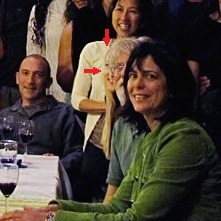
Hidden in a group photo
Here’s where a simple head shot morphed into a production worthy of reality TV. I mentioned to the photographer that in addition to wanting a “personal branding” image, I was about to turn fifty—so the session could be an opportunity to document, visually, the end of my first half-century (before, I assume, everything really turns to s#!t). As the date of the shoot approached, I hit upon the idea that maybe I could even use a photo of myself—gasp!—on the book’s front cover. To ramp up the crazy, each of five wardrobe changes would represent a different aspect of the book (more on that in a future post).
Turning fifty is in my comfort zone. Being the subject (object?) of a photo shoot is not. To get through it, I think I entered a fugue state, or one of my other personalities stepped forward. As if through a filter of tulle, I recall snippets from that afternoon. I remember panicking a bit when I saw how heavily my face was made up; my typical regimen involves relatively minimal goop. I wore only two of the ensembles I brought; the other looks came from the photographer’s collection. I donned as many dresses in three hours as I had in the previous three years. One of the gowns I got into was an experimental garment made of book pages.
The creative shutterbug who directed me so patiently specializes in making women feel beautiful, showing them how their loved ones see them. Apparently, our loved ones have Photoshop vision.
I’ll view my retouched likeness tomorrow, when I return to the studio to meet with the photographer!

 Novel-Gazing