
 My recently published book appears to be a collection of blog posts but is actually a devious plot to expose people to the idea of archetypes. Determined to Be Visible reveals the twelve “psychological patterns” that govern my existence, inspiring my every thought and action. These mental motivators are derived from “historical roles in life” (to quote modern-day expert Caroline Myss). My unique combination of archetypes includes the Artist, Clown, Daydreamer, Student, and Teacher.
I know what you’re thinking: “How can I find out what my archetypes are?” What you should do is read Caroline Myss’s New York Times best seller Sacred Contracts. But since you’re (still somehow) reading this post, I’m happy to share my unofficial approach to determining the dozen spiritual energies that rule your life. Regardless of who you are, I already know four of them: Child, Prostitute, Saboteur, and Victim. (We all share these survival-related archetypes.) That leaves eight for you to identify, by following these steps.
- Agree to see yourself honestly. Prepare to dig deep.
- Review the accompanying list of archetypes. Yes, the one on the blue background there.
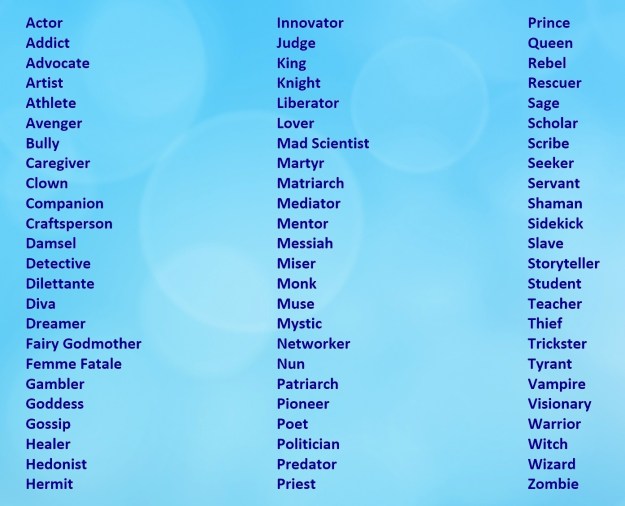
- Try each archetype on for size. Does it fit? Does it fit a little? Keep in mind that archetypes may be lifelong forces, occupational identifiers, or other influences.
- Think beyond the options presented here. For example, if you have always viewed yourself as a daredevil (or a philosopher or a counselor), consider that a possible archetype.
- Make a list of the archetypes that fit well or fit a little. Now is not the time for editing.
- Narrow down the list to the eight archetypes that fit best. Now is the time for editing. In the paring-down process, be wary of wishful thinking and of avoiding archetypes that seem negative. Some of us are martyrs, not mystics—and that’s okay! There are light and shadow aspects to every archetype.
- Ask a few friends for feedback. Sometimes (and by “sometimes,” I mean most of the time), others can be more objective about us than we can.
- Play with your final lineup until it feels right. Getting authentic with yourself, you might let go of an archetype that truly doesn’t suit you. Or upon reflection, you might bring back an archetype you eliminated earlier.
So, how did you do? Are you ready to embrace the wisdom of your Goddess, Hermit, or Vampire?

 Novel-Gazing