
Category Archives: Beatles

A Crown of Daisies

SPOILER ALERT: There are new sonnets, below, in honor of William Shakespeare’s birthday!

The actor and producer William Shakespeare was born four hundred and sixty years ago today, on April 23, 1564, in Stratford-upon-Avon, England. William’s father, John Shakespeare, was a glove-maker and wool dealer who also had a number of other occupations. William’s mother, Mary Arden, was the daughter of a gentleman farmer.

Less than three months after John and Mary welcomed baby William, Stratford-upon-Avon received a most unwelcome visitor: the bubonic plague. That year, over two hundred townspeople, representing one seventh of the population, would succumb to the devastating bacterial infection.

In November 1582, eighteen-year-old William Shakespeare married Anne Hathaway, a woman who lived in a village about a mile outside of town. Anne, born Agnes, came from a family of successful sheep farmers. William and Anne were best friends who wanted to create a family together. Theirs was the “marriage of true minds” the poet wrote about in Sonnet 116. Indeed, the two would remain wed for almost thirty-four years, until William’s passing, in 1616.

A daughter, Susanna, was born six months into their union. Hamnet and Judith arrived twenty months later. The twins were named after Hamnet and Judith Sadler, a couple with whom William and Anne were friends. The Sadlers would go on to name a son after William.

Undoubtedly, the greatest tragedy faced by the young Shakespeare family was the crushing loss of their Hamnet, in 1596, due to plague. He was just eleven years old.

In Elizabethan England, 30 to 40 percent of children died before their first birthday, and only three in five survived past the age of ten. Given these statistics, you might think the sudden death of a child would have been almost expected—and, therefore, met with a certain degree of detachment or resignation. You would be wrong.

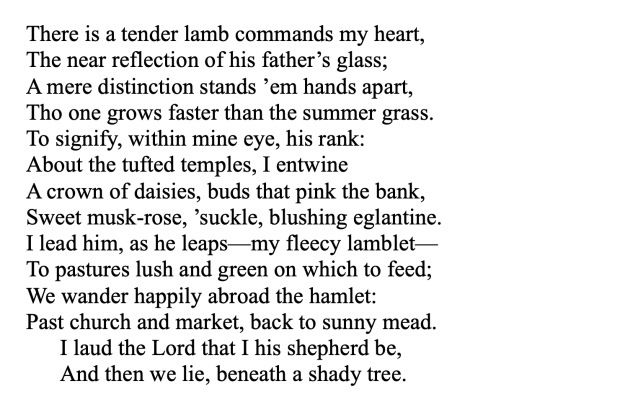
Today I am sharing two sonnets that might have been written about Hamnet Shakespeare: the first while the poet’s son was still alive; and the second after young Hamnet had been buried in the yard at Holy Trinity Church, in Stratford-upon-Avon.

While Hamnet, the poet’s son, lived:
And after Hamnet died:
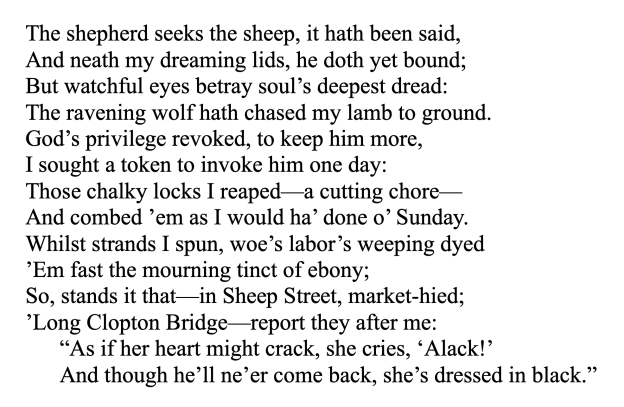
You might notice something unusual about these two sonnets as well as the last three I posted: They conclude with lyrics from the Beatles. The poems in this post, for example, borrow from “Good Day Sunshine” and “Baby’s in Black.” If you’d like, take a moment to observe how neatly the song lyrics fit into the rhythm of the poetry.

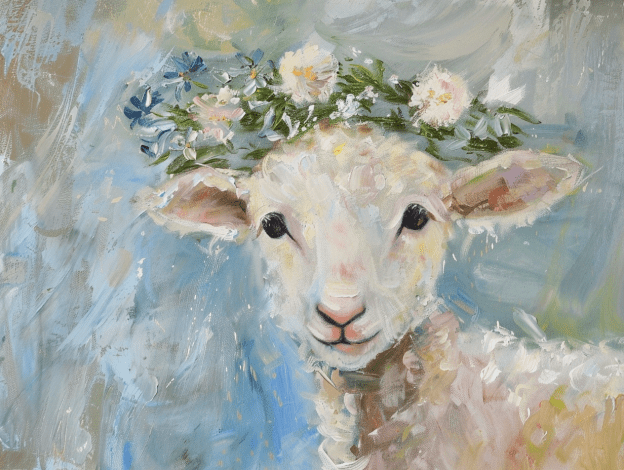
CREDITS: The image of a lamb was generated by Jay Schwartz. Information about John Shakespeare and Mary Arden came from Wikipedia. Statistics regarding the bubonic plague came from the Shakespeare Birthplace Trust and this site. Information about Hamnet and Judith Sadler came from this site. Statistics regarding child mortality in Elizabethan England came from this site.
Your Daddy’s Here

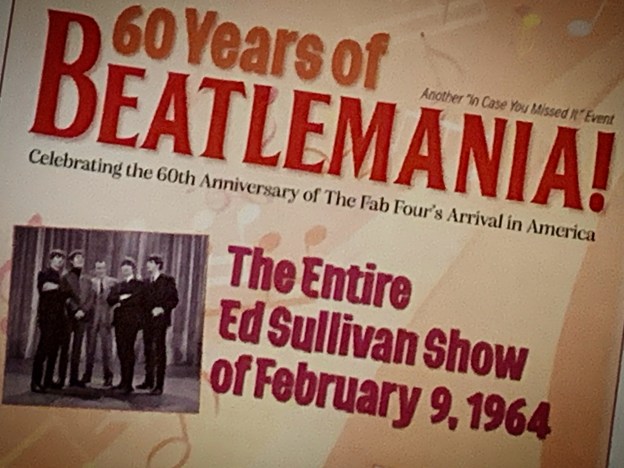
Last night I attended an event, at a theater here in Santa Barbara, commemorating the sixtieth anniversary of the Beatles’ first appearance on The Ed Sullivan Show. The entire CBS broadcast, including commercials (for Anacin and Pillsbury), was shown at the event. The original program aired live from New York City on Sunday, February 9, 1964, at 8:00 p.m., to an audience of 73 million viewers.

The night that John, Paul, George, and Ringo took the stage for the first time in America was also the night Paul’s son would be born, in Liverpool, England, where it was already the next day. These concurrent events inspired my song “Your Old Acoustic,” the first verse of which begins and ends: “You came the night all eyes were watching me… / But you could find me only on TV.”

During their two-week trip, the Beatles would also perform at the Washington Coliseum; Carnegie Hall; and the Deauville Beach Resort, in Miami Beach. While still on American soil, twenty-one-year-old Paul penned a song for his new son: “Beautiful Boy.” Reflecting on the circumstances of becoming a father exactly as the Beatles were striving to take their success to the next level, he wrote: “Life is what happens to you / While you’re busy making other plans.” In another lyric, “Out on the ocean, sailing away / I can hardly wait to see you come of age,” Paul refers to the Atlantic, the ocean that was separating him from his child at that moment.

Am I just making up a story? I might be. I am entirely capable of it. But in case I’m not: happy birthday, my son.

Fly Across a Starry Sky

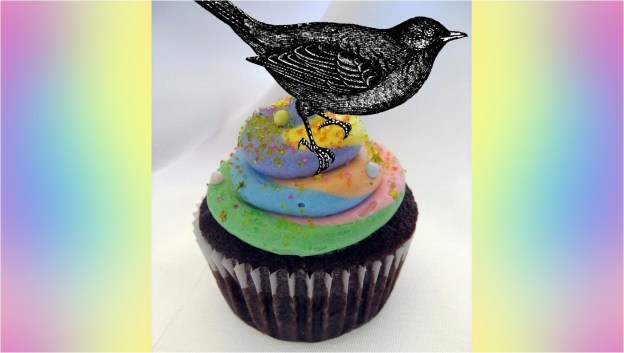
My creative outlet used to be cupcakes, and the crazier the better—especially considering that I was not, nor have I since become, a baker. I simply imagined the cupcakes I wanted to create and made them happen, despite my embryonic skills—the half-baked embodiment of “where there’s a will, there’s a way.” I went so far as to print business cards and establish an online presence, under the humble moniker Cupcake Queen. I had a few paid gigs, but mostly, I just wanted to make people happy. As my long-abandoned Twitter page has reminded me, I loved baking cupcakes for “anyone who would make yummy sounds while eating them.”

See my step-by-step instructions for “caramel apple” cupcakes.

I know what you’re thinking: “baker,” “songwriter”—we have quite a Renaissance woman on our hands here! It probably shouldn’t come as a surprise that when I took a songwriting class a year ago, I went all “cupcake” on the first assignment. Here’s the lofty plan I shared with my peers:

I would like to write the blackbird’s response to the Beatles’ “Blackbird”—basically, a “translation” of what the bird is singing (in the dead of night). My goal is for the song to stand on its own but also to complement the original, so that the two songs can be played simultaneously. My “vibe,” therefore, is acoustic guitar with fingerpicking. I realize this will be quite a challenge for a newbie songwriter and guitar player.

I took it a step further: the last word (or syllable) of each line in “Blackbird” would become the first word of the corresponding line in the new song, and the two words would probably be sung together. I pictured two people on a stage, one performing “Blackbird” and the other performing the blackbird’s response. The only factor remotely in my favor was that “Blackbird” was one of the only songs I could play on the guitar (and still is).

I know what you’re thinking now: “There’s no way she pulled it off.” And you’re right, but not entirely. I did write “The Blackbird’s Response,” with the scheme I proposed. I came up with a melody and recorded the composition. Due only partly to a jaunty harpsichord interlude (listen below!), the finished product did not melodically complement the original; that aspect of my plan was beyond my ability, especially within the few days allotted for the assignment. I have not attempted it since. I invite anyone interested to write a melody for “The Blackbird’s Response,” such that the song can be performed simultaneously with “Blackbird” but also stand on its own. I would love to hear it!

The lyrics for “The Blackbird’s Response” are below, with an interpolation of the two sets of lyrics below that. Below that is the jaunty harpsichord interlude from the original recording of “The Blackbird’s Response,” just for fun.

The Blackbird’s Response

Night, hold close, my bosom friend!
Fly? If but these wings could mend
Life—a time too long to spend
Rise? And wither wend?

Night, you bring me gentle word
See you hope for such a bird?
Life—the saddest ballad heard
Free what you have stirred

Fly across a starry sky
Fly and watch the world on high

Fly across a starry sky
Fly and watch the world go by

Night, I need no more thy cloak
Fly I must, from neath this yoke
Life began when I awoke
Rise, for morning broke

“The Blackbird’s Response” Interpolated with “Blackbird”

Blackbird singing in the dead of night

Night, hold close, my bosom friend!

Take these broken wings and learn to fly

Fly? If but these wings could mend

All your life

Life—a time too long to spend

You were only waiting for this moment to arise

Rise? And wither wend?


Blackbird singing in the dead of night

Night, you bring me gentle word

Take these sunken eyes and learn to see

See you hope for such a bird?

All your life

Life—the saddest ballad heard

You were only waiting for this moment to be free

Free what you have stirred


Blackbird fly

Fly across a starry sky

Blackbird fly

Fly and watch the world on high

Into the light of a dark black night


Blackbird fly

Fly across a starry sky

Blackbird fly

Fly and watch the world go by

Into the light of a dark black night


Blackbird singing in the dead of night

Night, I need no more thy cloak

Take these broken wings and learn to fly

Fly I must, from neath this yoke

All your life

Life began when I awoke

You were only waiting for this moment to arise

Rise, for morning broke

You were only waiting for this moment to arise

Rise, for morning broke

You were only waiting for this moment to arise

Jaunty Harpsichord Interlude