
This post contains accounts of physical and emotional abuse between partners in a personal relationship. If descriptions of domestic violence leave you feeling vulnerable to anxiety or depression, you might want to skip this one. If you choose to continue, please take care.
As I mentioned in a previous post, the original Paul McCartney chipped his left front tooth in December 1965. For the next three months, the Beatles kept a low profile. When they reemerged into the public eye, in the spring of 1966, fans took notice of Paul’s broken smile. They wanted to know what had happened to him—and when he was going to fix that cracked gnasher.
Word circulated that Paul’s tooth had been damaged in a moped accident in the Wirral, the peninsula in North West England where his father lived. But I don’t buy it. Based on photos, song lyrics, research, and deductive reasoning, I have arrived at a far more disturbing scenario behind Paul’s dental injury.
The Official Story
In the late spring or early summer of 1966, Brian Epstein, the Beatles’ manager, issued a formal explanation for Paul McCartney’s goofier-than-normal grin. Brian’s words appeared in the American teen magazine 16:
Last mid-December, Paul injured his lip and chipped his tooth in the mo-ped accident. He honestly thought no one would notice the chip, for it is so small. I told him three times he should do something about it. It is in a place where there are no nerve ends, so there is no pain. Paul assured me that he would have the tooth capped, but—unfortunately—he has not done so. It is my opinion that he will just let it be.
I couldn’t confirm the publication date of this statement, but it appears in an article that refers to June 5, 1966, as having occurred in the recent past. Around the same time, on June 24, 1966, New Musical Express, a pop periodical in the UK, published Paul’s version of events:
It was quite a serious accident at the time. It probably sounds daft, having a serious accident on a motorised bicycle, but I came off hard and I got knocked about a bit. My head and lip were cut and I broke the tooth. I was only doing about 30 at the time, but it was dark and I hit a stone and went flyin’ through the air. It was my fault all right. It was a nice night and I was looking at the moon!
Later, Paul’s replacement embellished the story—which was expanded to include Tara Browne, a British socialite and an heir to the Guinness fortune, who died in December 1966 (two months after Paul):
We were riding along on the mopeds. I was showing Tara the scenery. He was behind me, and it was an incredible full moon; it really was huge. I said something about the moon and he said ‘yeah,’ and I suddenly had a freeze-frame image of myself at that angle to the ground when it’s too late to pull back up again: I was still looking at the moon and then I looked at the ground, and it seemed to take a few minutes to think, ‘Ah, too bad—I’m going to smack that pavement with my face!’ Bang!
Paul’s replacement would have been wise to check which phase the moon was in that night. On December 26, 1965, the accepted date of the “accident,” Earth’s satellite was a “waxing crescent.” It would have looked like a small, illuminated sliver—not the kind of perfectly glowing orb that might upend a man’s motorbike. The full moon had occurred over two weeks earlier, on December 8, when the Beatles were performing two shows at Gaumont Cinema, in Sheffield, England.
We can guess why Paul’s replacement might have added details to the original story: he was surely questioned, with some regularity, about the incident in which “he” broke “his” tooth. But why would Brian Epstein and Paul McCartney have lied about what happened? What terrible truth might they have been hiding?
A Photo That Told a Different Story
A few years ago, I came across a photograph of Paul McCartney taken right after his alleged wipeout on a moped. I have seen this image credited to Paul’s brother, Mike. It makes sense that Paul and Mike would have been together the day after Christmas, at their father’s house, which was in the vicinity of the supposed motorbike accident. As a photographer, Mike certainly would have had his camera on hand.
But as I studied Paul’s face in the photo, a thought entered my mind, unbidden: “This looks like a man who has been beaten up.” Paul appeared to have been punched on the left side of the mouth and in the left eye. More recently, I encountered a photo from the same occasion but with less contrast, offering a clearer view of Paul’s injuries—which also included a laceration on the left side of the bridge of his nose.
In both photos, Paul’s expression is one of desolation and despair, rather than: “I can’t believe I came off that bike! What an arse!” And why take a picture at such a moment—to capture, for all time, the result of Paul’s lack of coordination? I believe Paul, or someone else, had the idea to document his wounds, in case charges were to be filed against his attacker.
Assuming Paul was assaulted, who would have—and could have—done it? Who would have had the motive and the access? I mentally explored scenarios in which a stranger might have ambushed Paul McCartney. Ultimately, however, I settled on the likelier possibility that the assailant was someone “on the inside.” Then a really awful thought began to nag at me—an unthinkable thought! One that would shock Beatles fans.
Over time, the pieces of the story fell together.
Paul Meets Jane
On April 18, 1963, Paul McCartney met Jane Asher. He was twenty; she had just turned seventeen. The Beatles were big enough to be part of a lineup at London’s Royal Albert Hall (billed second) but were not household names yet. While Paul was onstage with the band, Jane was in the audience providing commentary for the Radio Times, a weekly magazine that listed radio and television programs. Prompted by the publication’s photographer, Jane was snapped screaming for the Beatles—like the girls around her. After the event, she went backstage and was invited to keep company with the group that night.
I might have had a dream memory related to this initial meeting between Paul and Jane—viewed from her perspective. I wonder if Jane might recognize the following scene, as recorded in my journal on September 14, 2023:
I had several Beatles-related dreams [this morning]. In the first dream, I was in a room. I might have been standing, but I feel more like I was sitting on a couch. I was aware that standing behind me, about ten feet away, were members of the Beatles—definitely including the original Paul McCartney. I wasn’t looking at them; my back was to them. I am trying to put my finger on my feeling in the moment. I think I was slightly awed by their presence—but “awe” is too strong a word. I was aware of them, and I knew they were members of the Beatles. There was the sense that they were waiting for something; maybe they were waiting for some kind of an engagement to start.
I have read that during Paul’s first encounter with Jane, he impressed her by quoting Chaucer. Specifically, he said, “Ful semely hir wimpel pinched was.” This line appears in the General Prologue of The Canterbury Tales, in Chaucer’s description of the Prioress (a nun). While the words sound a bit salacious, all they mean is that the Prioress, a sharp dresser, wore a well-pressed cloth around her neck. I believe I am the only one to proffer a theory as to why Paul quoted this particular line, from among the 17,000 lines in the medieval masterpiece. I imagine that after an evening spent talking, Paul and Jane had an exchange like the following:
Jane: I’d like to go home now.
Paul: Of course! I’ll see you to your door. Where do you live?
Jane: In Wimpole Street.
Paul: Oh! “Ful semely hir wimpel pinched was.”
Jane: Paul! You’re so clever and well-read! [writer’s embellishment]
If you missed it, Jane lived on Wimpole Street; the Prioress wore a wimpel.
In my last post, I mentioned that John, Paul, George, and Ringo had known—or known of—each other during the Romantic Period (in past lives). Jane was there, too; she and Paul were siblings, though not related by blood. Two hundred years before that, Jane and Paul were both English dramatists, whose plays are still studied and performed today. It makes sense, then, that when they met (again) in 1963, they connected quickly and bonded over literature. As a footnote, Jane Asher is a fine writer in this lifetime. I read one of her novels, The Question (1998), five or six years ago; I can still remember the ending and how it chilled me to the bone.
A Springtime Engagement
At the end of March 1965, Paul McCartney had a photo session with Jane Asher on the set of the Beatles’ movie Help! In the photos, Jane appears to be wearing an engagement ring, on the fourth finger of her right hand. Based on my survey of the images available online, Jane would not be seen wearing this ring again—except in a photo taken two months later, which I will say more about in a bit.
Why was that ring (almost) never spotted on Jane’s finger again? Maybe Paul and Jane wanted to keep their engagement private. Or maybe Brian Epstein asked Jane not to wear the ring in public, so Paul would still appear “available.” Ringo had tied the knot with Maureen Cox just a month earlier, and perhaps Brian wasn’t ready to lose one of the group’s two remaining bachelors quite yet. I’m not sure it really mattered, though: John’s status as a married man, wed to Cynthia since 1962, hadn’t seemed to dampen enthusiasm for the band.
We get a glimpse of Paul’s feelings for Jane through Beatles songs recorded both before and after their engagement:
- A love like ours could never die. (“And I Love Her,” 1964)
- Through thick and thin, she will always be my friend. (“Another Girl,” 1965)
- If she’s beside me, I know I need never care. (“Here, There and Everywhere,” 1966)
- I’m so proud to know that she is mine. (“Good Day Sunshine,” 1966)
The sincerity of Paul’s affection for Jane is evident in the following stanza from “Center of Love,” a poem he wrote for her:
And I touched you,
As I caressed your glowing hair.
And the peace I felt in you,
It was as tender as a dove.
And I knew that it would last,
So I whispered in your ear,
That we were lying there,
You and I, in the center of love.
Paul’s replacement published this poem, as his own, in his 2009 memoir.
Within three weeks of his engagement shoot with Jane, Paul purchased a home in the St. John’s Wood neighborhood of London. The three-story Regency townhouse was situated about a mile and a half from where Jane currently lived with her parents and siblings, and where Paul resided in an attic bedroom. It was also an eight-minute walk from EMI Studios, where the Beatles did most of their recording.
The Day Before “Yesterday”
I hope I have successfully conveyed the forward momentum of Paul McCartney’s relationship with Jane Asher in the spring of 1965. To recap, Jane’s engagement ring made its first appearance sometime between March 24 and March 30; on April 13, Paul bought a house. On May 27, Paul and Jane left for a two-week holiday in Portugal—during which, I think, they planned to marry.
On May 26, the day before the couple’s departure, the Beatles recorded their fifty-second and final musical appearance for BBC radio. Between 2:30 and 6:00 p.m., the group rehearsed and recorded seven songs at the BBC’s Piccadilly Studios, in London. When the session was over, I believe Paul informed John of his impending nuptials—probably so John wouldn’t hear it somewhere else, if word got out.
At this point, I speculate, John issued Paul an ultimatum: If he married Jane, he would lose John and the Beatles. Their relationship would be through. And the band would be through.
A Failed Elopement
Paul McCartney’s elopement with Jane Asher started as inauspiciously as it possibly could have. During the five-hour car ride from the airport in Lisbon to the Algarve (Portugal’s southernmost region), John’s warning from the previous day must have been ringing in Paul’s ears: He could marry Jane or be a Beatle, but not both. And if John broke up the Beatles because of Paul, then George and Ringo would suffer, too! By the time Paul and Jane arrived in the coastal city of Albufeira, Paul had penned the lyrics to “Yesterday,” on the back of a brown envelope. (The song’s melody had come to him months earlier.)
“Yesterday” gives the impression of being a song about lost love. And it is that, to a certain degree. But more significantly, the verses express how Paul was feeling in the midst of an extremely challenging situation. He felt troubled, a fragment of the man who had seemed to have his life all figured out just the day before, wishing he could hide, with the shadow of a terrible choice hanging over him. The bridge to “Yesterday” includes the line, “I said something wrong.” That something was: “I’m marrying Jane Asher.”
A photo of Paul and Jane in a restaurant in Portugal tells an interesting story. Both have their heads turned to face the camera. Jane appears happy and relaxed, with a knowing look in her eye. Paul, wine glass in hand, looks anxious, barely able to muster a tense smile. If you click the image and zoom in, you will see that Jane appears to be wearing a ring on the fourth finger of her right hand. I believe this is her engagement ring—which she feels free to wear here, in this remote location, in the days or hours leading up to her wedding.
Judging from Jane’s expression in the photo, I doubt Paul had shared his conundrum with her yet. But at some point, he must have told her about John’s conditions for the continuance of the Beatles. I can feel Paul’s deep desire to be married and have a family, and to take responsibility for the three children he had already fathered. I imagine he told Jane that he wanted to stick to their plan to get married in Portugal. Perhaps Jane responded, with compassion and humor, that the mood was sort of ruined, and there would be a better time to exchange vows.
Back to Reality
Brian Epstein asked Paul and Jane to return from Portugal a day early so that all four Beatles would be in Britain on June 11, when it was to be announced they were being awarded an honor called Member of the Order of the British Empire (MBE). I have the sense that Paul and Jane were relieved to shave a day off the saddest non-honeymoon in history. The following morning, on June 12, the Beatles gathered at Twickenham Film Studios to watch a rough edit of Help! Well, all of them but one: John didn’t show.
News outlets were clamoring for the Beatles’ reactions to the MBE announcement, so a press conference was hastily arranged at the studios. John arrived over an hour late, and only after Brian had retrieved him personally from his home. John explained his tardiness to the 150 assembled reporters:
I set the alarm for eight o’clock and then I just laid there. I thought, “Well, if anyone wants me, they’ll phone me.” The phone went lots of times, but that’s the one I never answer. My own phone didn’t go at all, so I just laid there.
You might hear John’s excuse and think, “That John Lennon—what a quirky fellow.” But I believe his absence was entirely deliberate. He didn’t want to see Paul. He thought, “Paul is married, and the Beatles don’t exist anymore.”
Two days later, on the evening of June 14, Paul recorded the song for which he finally had lyrics: “Yesterday.” That afternoon, the group had recorded two other songs featuring Paul: “I’ve Just Seen a Face” and “I’m Down.” This latter track contains the line, “Man buys ring, woman throws it away”—clearly a reference to Paul’s ill-fated elopement with Jane. But Paul and Jane weren’t broken up. After the “Yesterday” session ended, at 10 p.m., they went to a nightclub in South Kensington together. Nevertheless, the fact that John was essentially holding the Beatles hostage must have imposed a serious strain on their relationship.
Paul’s Three “Women”
Toward the end of 1965, Paul McCartney wanted to write a song for Jane Asher called “Woman.” He made several attempts, resulting in at least three songs with that title. One “Woman” would be recorded by the British pop duo Peter and Gordon, while Paul was still alive, with his full permission and—hopefully—apologies. It’s not very good. Perhaps the most redeemable lines are as follows:
Woman, don’t forsake me
Woman, if you take me
Then believe me, I’ll take you
To be my woman
Peter Asher and Gordon Waller did a lovely job with the song, taking it to the top twenty in the United States. These two souls, during the English Renaissance, had been instrumental in preserving the plays of Shakespeare for posterity; so, the least Paul could do was pass along a few tunes. (The earlier “A World Without Love” was a much better gift.)
Two other songs of Paul’s called “Woman” were stolen, after his death, by different artists. John Lennon recorded one of them for his album Double Fantasy (1980). As a single, it reached the top spot in the UK and peaked at number two in the United States. I believe this “Woman” was the one Paul wanted to write for Jane. I think he was satisfied that it expressed what was in his heart.
And what of the third “Woman”? Paul’s brother, Mike, put his name on it, recorded it, and released it as the haunting title track of his 1972 album Woman. Here’s the weird, gross, funny part: The song is intensely intimate, intended to be shared only between lovers—yet Mike’s mother is on the album cover, representing “Woman.” (Of course, Mary McCartney was Paul’s mum, too.) This is not a song about one’s mother. I can’t imagine that the sexual imagery could have been misinterpreted. Here’s the first line: “Woman, I want to go down and drown in you.” The absurdity takes a bit of the sting out of the fraternal betrayal.
A Christmas Promise
I have no proof of the scenario presented in this section, but working back from the larger story, it makes sense to me.
On Christmas morning, 1965, Paul McCartney serenaded Jane Asher with the song “Woman,” as a renewal of his proposal and of their plan to marry. But which “Woman” do you think it was?
- The so-so one that Peter and Gordon turned into a respectable song
- The expressive one that John Lennon made famous
- The erotic one that Paul’s brother recorded
If you guessed number 2, you’re right. If you guessed number 3, you’re making me laugh right now. Indeed, lyrics from the “Woman” Paul sang to Jane on Christmas Day sound very much at home in a marriage proposal:
- “I’m forever in your debt”
- “Hold me close to your heart”
- “My life is in your hands”
- “It is written in the stars”
- “I love you…now and forever”
Paul had essentially said, “Sod the Beatles. Let’s just do it.” Jane accepted. By the way, that’s the risk of dating a musician: at the holidays, you’re likely to get a song instead of a real gift.
I read somewhere that Jane Asher’s favorite song is “Woman”—the one recorded by Peter and Gordon. Peter Asher, of Peter and Gordon, is Jane’s brother. And the song was written by her fiancé. So, the choice makes sense. But I like to think that when Jane mentions her favorite song, she is secretly nodding to the “Woman” Paul crooned to her to persuade her to marry him.
Later that day, Jane and Paul traveled from her family’s home in London to be with his relatives in and around Liverpool.
How Paul McCartney Broke His Tooth
Fifty-nine years ago today, on December 26, 1965, John Lennon savagely attacked his bandmate Paul McCartney in a fit of jealousy—breaking Paul’s left front tooth and causing multiple lacerations. I know, I could have told you that right at the top. But I think you’ll appreciate having the foregoing information as you read my speculative dramatization of what happened:
On the day after Christmas, 1965, Paul McCartney and his fiancée, Jane Asher, were at Paul’s father’s house, in Heswall, on the Wirral Peninsula. The festive mood was made even jollier by talk of the future nuptials of two so dear to all who were present.
There was a knock on the door. It was John Lennon. He hadn’t been expected. He wanted to talk to Paul alone, upstairs. He didn’t say why.
The bedroom door closed behind them.
“Is it true?” John asked, quietly. “Is the rumor I heard true?”
“Yes,” Paul said. “It’s true.” He wanted to sound confident, to look John in the eye. But there was a tremor in his voice; his look was askance.
Instantly, a rage rose inside John. He started pummeling Paul, who was too busy defending himself to get off any shots of his own.
“Stop!” Paul cried. “John, stop!” He was scared. He thought his bandmate might kill him.
John hurled insults as he punched Paul in the mouth, the nose, the eye.
Those gathered downstairs became aware of raised voices and a commotion coming from the floor above. They burst in. John ceased his attack.
“Get out of here, Lennon!” snarled Jim, Paul’s father. “I never liked your sort.”
John left. It was obvious that Paul was going to live. Mike McCartney fetched his camera, to document his brother’s injuries—in case charges were to be filed.
Paul went to Accident and Emergency. The doctor on duty, as he put several stitches inside Paul’s mouth, inquired delicately of his famous patient: “You’re not the ‘cute one,’ are you?”
As they say, comedy is tragedy plus time. I should note that Paul sustained injuries to the left side of his face, consistent with the fact that John was right-handed. In a future post, I will describe John’s history of violent acts, including an earlier incident motivated by jealousy over Paul—with even more dire consequences.
A number of years ago, I noted something Ruth McCartney said in an essay that appears in her mother’s memoir Your Mother Should Know (by Angie McCartney). Ruth, Paul’s much younger sister, relates a memory of “John and Paul arguing out a song together in the attic at Cavendish Avenue,” referring to Paul’s home in London. Ruth would have been five years old when John Lennon attacked her brother. Is it possible she has misremembered Jim McCartney’s house as Paul’s house? And the “argument” she heard was John Lennon beating up Paul McCartney? Maybe, as a little girl, she was told that Paul and her uncle John had been fighting about a song.
Mike McCartney took a picture of his father and titled it “Dad doing his Crossword.” I can’t link to it, but I will describe it to you: Jim McCartney sits in an armchair, in a wood-paneled room, his newspaper in front of him. Behind him is a shelf-like projection, possibly the mantel of a fireplace. On this mantel rests a photo of the Beatles, propped up next to what appears to be a framed music award. When I first saw this image, I noticed something strange: There were only three Beatles in the photo on the mantel. I could make out George and Paul, with Ringo in front of Paul. But where was John? His visage must have been hidden (deliberately?) behind the framed music award.
Just a Jealous Guy
Any musician who has covered the song “Jealous Guy” (such as Joe Cocker, Roxy Music, or the Weeknd) has paid tribute to the time John Lennon beat the crap out of Paul McCartney. If you want to know what happened that day, “Jealous Guy” offers some clues:
- “My heart was beating fast”
- “I was tryin’ to catch your eyes / Thought that you was tryin’ to hide”
- “I began to lose control”
- “I was feeling insecure / You might not love me anymore”
- “I was swallowing my pain”
Here’s the twisty part: Paul wrote “Jealous Guy” from John’s perspective, for him to sing. Which John did, on his Imagine album (1971).
When I made the connection between “Jealous Guy” and the photo of Paul’s battered face, I felt gratified. At least John had apologized, even if Paul was no longer alive to hear him:
I didn’t mean to hurt you
I’m sorry that I made you cry
I didn’t want to hurt you
I’m just a jealous guy
But then I studied the lyrics. Metrically, the verses were perfectly regular, making it unlikely John had written them. In a previous post, I made the case that the original Paul McCartney was the sole composer of virtually the entire Beatles’ catalog—and many of the members’ best-known solo hits. “Jealous Guy” appears to be one of them. It fits Paul’s “songwriting fingerprint” exactly.
I was confused: Why would Paul have taken his abuser’s point of view? I came up with several possible reasons:
- He was accustomed to writing songs for his bandmates.
- Writers take inspiration where they can find it.
- To control the narrative of a situation in which he had felt helpless.
- To help him find compassion for John.
- To craft the thoughtful apology he wished to hear from John.
In the third verse of “Getting Better,” on the Beatles’ Sgt. Pepper album (1967), John admits exactly what he did: “I used to be cruel to my woman / I beat her and kept her apart from the things that she loved.” Paul had left “Getting Better” unfinished, but it was clearly about John—that “angry young man.” John filled in the third verse after Paul died.
O My Prophetic Song!
John Lennon’s physical violence against Paul McCartney was foreshadowed—even predicted—by a song on the Beatles’ Rubber Soul album (1965). “Run for Your Life,” with lead vocals by John, is a truly horrifying anthem to domestic abuse. Paul lifted the first two lines, “I’d rather see you dead, little girl / Than to be with another man,” directly from a 1957 Elvis Presley song. Paul must have thought these words encapsulated John’s feelings toward him.
Below are the three unique verses of “Run for Your Life,” followed by its chorus, so you can see how chillingly prescient they were:
I’d rather see you dead, little girl
Than to be with another man
You better keep your head, little girl
Or you won’t know where I amWell, you know that I’m a wicked guy
And I was born with a jealous mind
And I can’t spend my whole life trying
Just to make you toe the lineLet this be a sermon
I mean everything I’ve said
Baby, I’m determined
And I’d rather see you deadYou better run for your life if you can, little girl
Hide your head in the sand, little girl
Catch you with another man
That’s the end, little girl
Clearly, Paul understood the danger of John’s jealousy. Was “Run for Your Life” a cry for help? Was Paul saying to John, “Look what you’re doing!”? Was he saying to others, “Can’t you imagine what he is capable of?”
Twenty-three days after “Run for Your Life” was released on Rubber Soul, John delivered on the song’s promise.
Broken Tooth, Broken Up
Five days after their altercation, John Lennon and Paul McCartney attended separate New Year’s Eve parties. Five days after that, on January 5, the Beatles were in the studio overdubbing a concert they had performed in New York City the previous summer; footage of the show was to be released as a television movie. The high in London that day was 3.9 degrees Celsius, or 39 degrees Fahrenheit. I have to imagine the atmosphere inside the studio was just as chilly.
A few weeks later, on January 21, George Harrison married Pattie Boyd, whom he had met two years earlier, on the set of A Hard Day’s Night. Paul McCartney and Brian Epstein were George’s best men. At the wedding, Paul’s outward wounds appeared to have healed; but he seemed to be nursing the inward ones with a bit too much alcohol. John and Ringo did not attend, as they were on holiday together with their wives. I think Ringo might have been keeping John busy, and away from Paul. And I like to think that George had threatened John with grievous bodily injury if he ever harmed Paul again.
For the first quarter of 1966, the Beatles were essentially broken up—or at least experimenting with a separation. Additional highlights of this period include the U.S. and UK releases of Peter and Gordon’s “Woman” (January 10 and February 11, respectively); the Beatles’ ten Grammy nominations (February 13); John’s famous “We’re more popular than Jesus” comment (March 4); and a holiday for Paul and Jane in Switzerland (March 6 to March 20).
Spring brought a thawing of relations. On March 24, all four Beatles, with their partners, attended the première of the movie Alfie, in which Jane Asher had a role. The following day, John, Paul, George, and Ringo participated in a photo shoot for the controversial cover of their compilation album Yesterday and Today (1966)—an odd and unsettling collection of songs, if you ask me (but you didn’t).
Paul and John resumed socializing; on April 1, they visited the newly opened Indica Books & Gallery, in which Paul was an investor. Five days later, on April 6, the Beatles were back in the studio, to begin recording the album that would become Revolver (1966).
Little Darling
I believe that Paul McCartney wrote “Here Comes the Sun” during this period (the early spring of 1966). The Beatles would record it after his death, with George singing lead, for the Abbey Road album (1969). In “Here Comes the Sun,” the cold of winter gives way to the warmth of spring—a metaphor Paul uses to represent the thawing of the frostiness between him and John, and within the group as a whole.
The first verse of “Here Comes the Sun” establishes that “it’s been a long, cold, lonely winter.” John had assaulted Paul at the beginning of winter, and the intervening three months were clearly long, cold, and lonely. But Paul is noting a transition out of this frigid season in their relationship: “I feel that ice is slowly melting.” Indeed, a sense of ease is coming back: “The smile’s returning to the faces.” The chorus concludes with Paul’s view of where things stand now: “I say, ‘It’s all right.’”
I’d like to share a relatively recent story about “Here Comes the Sun.” On November 12, 2020, I was driving my dog Grace to puppy camp, for socialization during the coronavirus pandemic. The radio was tuned to NPR, National Public Radio. A story came on about how hospitals in largely rural North Dakota were at capacity due to COVID-19. The show’s host, David Greene, was interviewing the chief medical officer at the state’s largest hospital, who described the heartbreak of losing patients to the virus. The medical officer concluded:
On the upside, we play the song “Here Comes the Sun” any time we have a patient leave the unit or get discharged. And that brings a bit of a smile to people’s faces, and the patients like hearing that.
As the story ended, “Here Comes the Sun” came up. Of course, I wept. It was gratifying to hear that after all these years, my words still meant something to someone. “Yet part of me was frustrated,” I noted in my journal, “that the world believes—and probably always will—that George Harrison wrote that song.”
Same Time, Next Year
When Paul McCartney and Jane Asher got engaged for the second time, on Christmas Day, 1965, they planned to marry exactly one year later. How could I possibly know such a thing? I think I’m about to impress you with my sleuthing—with the caveat that I don’t know for sure that I’m right. Here we go.
In 1980, in Bermuda, John Lennon recorded a demo of “Grow Old with Me.” You guessed it: Paul wrote this one, too. I can’t tell if Paul intended the composition as a poem or a song; John might have provided the melody heard in the recording. Paul borrowed the first two lines of “Grow Old with Me” from a Robert Browning poem. Paul’s first verse reads as follows:
Grow old along with me
The best is yet to be
When our time has come
We will be as one
The remaining verses are equally romantic. But it’s the bridge that provides an important clue:
Spending our lives together
Man and wife together
World without end
World without end
Please try to overlook the outdated expression “man and wife.” It’s the repeated phrase “world without end” that’s important to our investigation. When I read it, I connected it instantly with a favorite Shakespearean monologue of mine, from Love’s Labour’s Lost. In that speech, marriage is characterized as a “world-without-end bargain”—an agreement that lasts forever, so it shouldn’t be entered into hastily (“in heat of blood”). The characters decide to wait a year (“until the twelve celestial signs / Have brought about the annual reckoning”), and if they still feel the same, they will wed:
Then, at the expiration of the year,
Come challenge me, challenge me by these deserts,
And, by this virgin palm now kissing thine
I will be thine…
Were Paul and Jane inspired by Love’s Labour’s Lost to wait a year before exchanging vows? Or did they plan their wedding for one year hence and then recall Shakespeare’s “world-without-end bargain”? Either way, the phrase was top of mind when Paul wrote “Grow Old with Me,” about his lifelong commitment with Jane.
Two years ago, I posted my song about the engagement of Paul and Jane. I didn’t think anyone would understand “The Christmas After This” (video below), especially without knowing the inspiration behind it—which you now do! But then my mom left me the following voicemail, which also references a poem I wrote for my uncle’s birthday:
Hi, Karen. This is your mother speaking. I just had to call you and tell you how much I appreciated the song for Christmas. And, um, I’m just amazed at your talent. And, um, and also, the poem for Stanley was absolutely beautiful. And I’m so proud of what you do, and, um, it’s just amazing to me. You are so talented. And I just wanted to tell you that and to tell you how much I love you. Okay, sweetheart, bye-bye.
I’m glad I wasn’t able to get to the phone at that moment, because now I have a recording of my mother’s sweet words.
Mom’s Voicemail re: the Song for Christmas
Paul McCartney and Jane Asher would not grow old together. Paul died eleven weeks before their wedding day. But that didn’t stop him from writing a song, in his next lifetime, to honor their relationship.
The Christmas After This
Lyrics:
All hark ye, park thee round the tree
To mark this merry comedySince we met
I’m in your debt
Now lend me your earTake my word
Let it be heard
How I need you hereNext Christmas
We’ll reminisce this
As both
Our troth
Do swearThe Christmas after this one
The Christmas after this, hon
The Christmas after thisA halo round a moonless stone
A glistering to gild your ownTake this ring
We’ll do our thing
For just one more yearTake a chance
On our romance
Forge a new frontierNext Christmas
We’ll reminisce this
As both
Our troth
Do swearThe Christmas after this one
The Christmas after this, hon
The Christmas after thisAn old guitar, romantic jargon
To seal a world-without-end bargain[Hummed verse]
Take this song
And dream along
With your balladeer[Instrumental pre-chorus and chorus]
A dress of wool, a suit of lace (“That’s backwards!”)
An oath beside the fireplace (“Egad, that’s hot!”)
Some nog for toasting, “Cheerio!”
A snog beneath the mistletoeTake my hand
And it is planned
Yea, our day is nearTake my heart
We’ll never part
Nay, nor never fearNext Christmas
We’ll reminisce this
As both (as both)
Our troth (our troth)
Do swearI will be thine
Take all that’s mineThe Christmas after this one
The Christmas after this, hon
The Christmas after thisThe Christmas after this kiss
The Christmas after this bliss
The Christmas after this
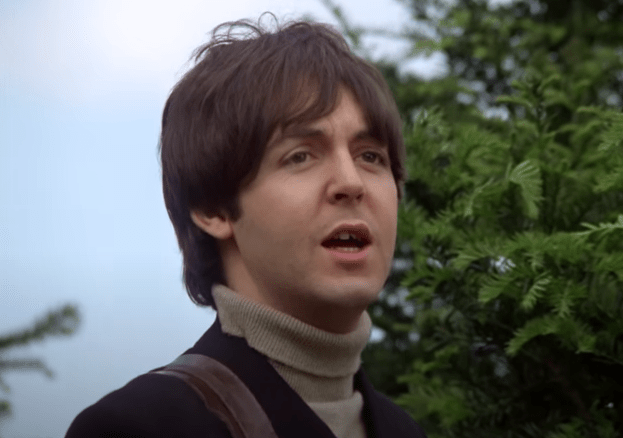
CREDITS: The photo at the top of this post is a screenshot I took of the Beatles’ promotional video for “Paperback Writer.” Many thanks to the photographers who took the pictures that appear in my video for “The Christmas After This.” Henry Grossman took the pictures of Paul McCartney and Jane Asher on the set of Help!
 Novel-Gazing
Pingback: Paul’s Big Day in the Studio | Novel-Gazing