I want to start by saying that I’m not publishing this series of posts in order to reveal myself as a former Beatle to my friends and loved ones. They are not my audience, necessarily. Rather, I would like to share what I have learned with people who care about, have a curiosity about, and can keep an open mind about what happened to James Paul McCartney.
The original Paul McCartney of the Beatles was buried fifty-eight years ago today, on Tuesday, October 18, 1966—or thereabouts.
As I mentioned in my last post, Paul might have been assassinated on multiple occasions as the Beatles toured America in August 1966. But he got lucky; he lived to return to the U.K. at the end of that month. Sadly, he passed away just thirty-nine days later. There’s a sense of relief that Paul didn’t die in the United States—that his remains weren’t weighted down to the bottom of the East River or dumped in the Mojave Desert, where every passing mile looks the same. He made it back to England, Shakespeare’s “precious stone set in the silver sea.” I think Paul loved the feeling of being at home. In this regard, his burial place was perversely apt.
As I reported last week, when I realized six years ago that Paul McCartney had been replaced, my first thought was, “Where is he?” A person can’t just disappear, right? At the time, I wasn’t sure if Paul had removed himself from society, perished, or met some other fate. Gradually, I came to accept that Paul had died, toward the end of 1966. And if he died, there had to be a body—which had to be somewhere.
Before continuing, I will reiterate a clarification I made in my last post: I am a writer. I am able to distill both flights of fancy and truths into words. Therefore, what is written here might be fiction. Or it might represent reality. Either way, it’s my story.
How I Figured Out Where Paul Is (Probably) Buried
For me, three elements came together to suggest the location of Paul’s corpse: my own reasoning, Paul’s replacement’s memoir, and a photograph from 1969.
At the time of Paul McCartney’s death, in 1966, the members of the Beatles were pursuing separate interests: John was acting in a movie in Spain; Ringo was visiting him there. George was in India, learning how to play the sitar. Paul had attended an awards luncheon in London in mid-September; wherever he was a few weeks later, on October 9 (his final day), he likely would have been focused on preparing songs for the Beatles’ return to the studio.
John’s famous “I buried Paul” message, at the end of “Strawberry Fields Forever,” told me two things: First, there had been a burial service for Paul. Second, John must have traveled from Spain (presumably with Ringo) to witness the interment—and possibly to toss, respectfully, a handful of dirt on the lowered coffin (hence, “I buried Paul”). George, returning from India four days later, would have missed the solemnities. The news was surely a terrible blow: his Beatle brother had died and been buried while he was away.
As I pondered where Paul might have been laid to rest, I asked myself a few questions:
- Where could Paul’s intimate but star-studded burial service have taken place privately, and unobserved?
- Where could Paul have been buried anonymously, and without the risk of being unearthed accidentally?
Paul’s replacement was hiding in plain sight, as a member of arguably the most well-known band in the world at that time. Had Paul’s corpse been stashed somewhere similarly obvious? I had a location in mind. Ultimately, my suspicion would be confirmed—with help from the man who took Paul’s place.
In 2009, Paul’s replacement published an account of his life, centering on his experiences with the Beatles, called The Memoirs of Billy Shears. This title borrows from the song “Sgt. Pepper’s Lonely Hearts Club Band,” in which “Billy Shears” is, I assume, the original Paul’s nickname for William Shakespeare. This assumption is supported by the fact that, on the Sgt. Pepper album, after the title track introduces Billy Shears, it goes straight into “With a Little Help from My Friends”—the first verse of which quotes from Shakespeare’s Julius Caesar (“Lend me your ears.”)
In The Memoirs of Billy Shears, Paul’s replacement hints at where Paul is buried. He states:
If it is Paul you are looking for, he is buried in a field of grass pushing up rhododendrons. I am not him.
Paul’s replacement mentions these specific flowers again, in the same context, when he asserts that Paul’s “rotting corpse pushes up daisies, or, in his case, rhododendrons.” (In the first quote, “field of grass” is a reference to Paul’s unfinished song “Mother Nature’s Son,” which the Beatles recorded after his death; the specific line is, “Find me in my field of grass.”)
I must explain that, according to Paul’s replacement, The Memoirs of Billy Shears is a mixture of fact and fiction; indeed, it contains a number of reprehensible lies. The presence of rhododendrons at Paul’s grave, however, appears to be true.
In pinpointing Paul’s burial site by way of rhododendrons, my first promising discovery was of a photo taken in 1980 of Paul’s replacement settled amidst lovely pink flowers that resembled rhododendrons. Eventually, however, I would stumble upon a truly incriminating image, from eleven years earlier, that chilled me to the bone.
A photo snapped in 1969, in a shoot for a non-album Beatles single, shows what I take to be the site of Paul’s grave. In the photo, John, George, Ringo, Yoko Ono, and Paul’s replacement are posing in a garden. Behind the camera is the replacement’s new bride, Linda. Objects collected from the nearby area—stones, overturned flowerpots, a periwinkle blue umbrella, a statue of the Cheshire Cat from Alice’s Adventures in Wonderland—are arranged in an oval to suggest the location of Paul’s corpse, six feet down. Because the earth there had been dug up two-and-a-half years earlier, to receive Paul’s coffin, the ground cover within the oval looks less mature than that around it. Most importantly, what appears to be a pink rhododendron bush is visible to the left of the grave. The same flowers seem to peek over John’s left shoulder, as well. As Paul’s replacement implied in his memoir: where you find Paul’s body, you will find rhododendrons.
A Few More Clues for You All
I will stop short of providing an address you can Google, but here are some additional indicators as to where Paul is (likely) buried:
- John, George, Ringo, and Paul’s replacement recorded Abbey Road and other albums just a stone’s throw (if you have a good arm) from Paul’s grave.
- If you had a small pet who died, you might bury it in a similar place.
- Paul’s body might be found someday, if someone decides to put in a swimming pool.
- Paul’s replacement knew where his predecessor was buried, even though he wouldn’t have attended the burial service.
My hope is that, eventually, enough people will figure out where Paul is (probably) buried that it becomes common knowledge. Then there might be a general call for him to be disinterred—and reburied along with his name.
How Would We Recognize Paul’s Remains?
If we were to find Paul McCartney’s body in an unmarked grave, how would we positively identify it? Presumably, skeletonization has occurred by now. Long gone are the mop of dark brown hair, thick eyelashes, and Cupid’s bow lips. Luckily for us, Paul’s corpse might have a name tag on it—in the form of Paul’s ID bracelet. This trinket, engraved with “Paul,” can be seen on Paul’s left wrist in photos from 1964, including on the sets of The Ed Sullivan Show and A Hard Day’s Night. Paul’s ID bracelet probably wouldn’t have fit his larger-boned replacement, at least not in the same way (pretty loose), so burying it with him might have seemed like a sensible idea at the time; or it could have been a sentimental choice made by Paul’s family. (My song “Silver Bracelet” addresses the possibility that Paul is still wearing his ID bracelet.)
Another distinguishing feature of Paul’s corpse would be a left front tooth that appears to have been broken and repaired. Paul chipped this tooth in an incident in December 1965 (which was not a moped accident, as officially reported). He was said to have feared the dentist, which might be why he didn’t fix the tooth. Five months later, the break is still visible, for example, in the Beatles’ videos for “Rain” (at 0:34, 2:02, and 2:41) and “Paperback Writer” (throughout, but for a lingering closeup that Paul probably didn’t appreciate, see 1:35–1:44). When Paul’s death and replacement were imminent, the tooth was hastily repaired—as his lookalike didn’t also have a chipped left front tooth. Indeed, Paul’s smile appeared intact again on September 13, 1966, at the Melody Maker Awards, in London.
Finally, the location of Paul’s corpse would be a “dead giveaway” (pardon the pun) as to his identity.
What Happened When I Visited Paul’s Grave
At the beginning of 2019, I got as close as I could to Paul’s suspected resting place. The next year, on the fifty-fourth anniversary of Paul’s burial (so, exactly four years ago), I recorded my memories of that day:
On January 18, 2019, I found myself in the part of the world where the original Paul McCartney of the Beatles is buried. (I know the date because of an Instagram post I made that day.) At the time, I was in denial that I had been Paul, though I felt emotionally connected to his story and believed in reincarnation.
While studying Paul’s death and replacement, I had deduced where he was buried. I set out from my hotel on the two-and-a-half-mile walk to the location. The navigation feature on my phone drained the battery, and I became lost. I almost turned around. But then I saw “PAUL” on the awning of a restaurant and decided to keep going in that direction.
After several more missteps, I found the street. I passed the location of the grave twice, on my way to and from a pair of nearby tourist attractions that were my “official” destination, should anyone ask. The first time I walked by, I did so on the opposite side of the street. The second time, about half an hour later, I stopped right outside the gate. Both times, I wept bitterly.
As I returned in the direction I had originally come, I kept repeating, in my mind, “It’s only a place.” Even with my current level of awareness, I’m not sure exactly what I meant by that. Perhaps I was consoling myself that although my physical expression as Paul was gone (buried in that “place”), the eternal part of me had continued.
Only later did I ponder the possibility that a surveillance camera might have caught me gently weeping. But Beatles fans have surely stood in that spot before and displayed strong emotions.
Amazed and Afraid
Spiritual teacher Wayne Dyer often counseled, “Don’t die with your music still in you.” In this maxim, I interpret “music” to be whatever’s inside that wants to be expressed. Of course, it might be actual music.
When Paul died, he had part of “Maybe I’m Amazed” still in him. Based on what he left behind, his replacement released a version of the song on his debut solo album McCartney (1970). Fifty-one years later, in March 2021, I finished writing the lyrics—hopefully capturing what Paul was trying to convey back in the 1960s. The words are approximately 80 percent new (as compared with the replacement’s familiar rendition), including an added third verse.
Below is a video of me performing the new “Maybe I’m Amazed.” This was not necessarily my best take, and there’s an errant sequin on my left shoulder, but it was definitely the dogs’ finest performance. Thanks to Sophie and Grace for distracting from my musical insufficiencies with their adorableness. As they say, “Never work with children or animals,” those unpredictable little scene-stealers. The lyrics appear below the video, and below the lyrics you’ll find some important credits.
I’ll be back here on Halloween, a fitting day to discuss a macabre subject like how the original Paul McCartney died.
Lyrics:
Maybe I’m amazed at the way you love me all the time
Maybe I’m afraid of the way I love you
Maybe I’m amazed at the way you fill my head with rhyme
Turn me on a dime
Maybe I’m afraid of the way I’m turning to youMaybe I’m amazed at the way you need me after all
Maybe I’m afraid of the way I need you
Maybe I’m amazed at the way you raise me when I fall
Run before I crawl
Maybe I’m afraid of the way I’m running to youMaybe I’m a man—maybe I’m a lonely man—
Who’s just a little boy asking,
“Won’t you let me hold your hand?”
Maybe I’m a man, and maybe you’re the only woman
I could ever dream of asking,
“Baby, won’t you help me understand?”Maybe I’m amazed at the way you want me all the same
Maybe I’m afraid of the way I want you
Maybe I’m amazed at the way you seem so glad I came
Draw me like a flame
Maybe I’m afraid of the way I’m drawing to youMaybe I’m a man—maybe I’m a lonely man—
Who’s just a little boy asking,
“Won’t you let me hold your hand?”
Maybe I’m a man, and maybe you’re the only woman
I could ever dream of asking,
“Baby, won’t you help me understand?”
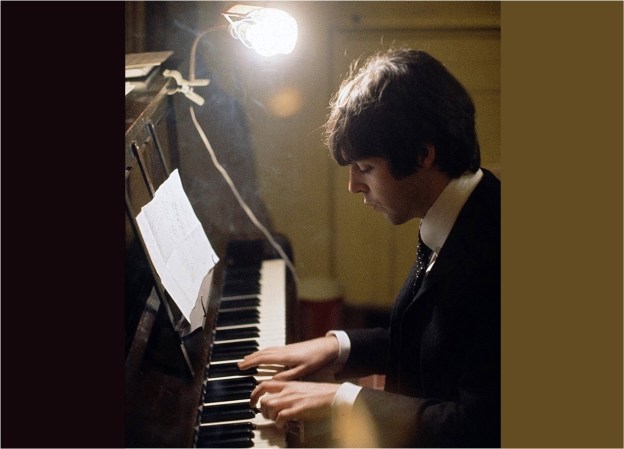
CREDIT: The photo at the top of this post was taken in London, in 1966, by Jean-Marie Périer. I have borrowed this image without permission but with tremendous gratitude and sincere appreciation. In the photographer’s own words (translated from the French): “I really like this photo of Paul, so English, playing the piano in a suit and tie. I called him from Paris and said: ‘I have to do eight pages about you. What day can I come to London?’ He suggests a Thursday… What I like is that he arrives in a suit and tie; it proves that he said to himself: ‘Eight pages on my head [literally, “my apple”]? Okay, let’s play it classic.’” M. Périer: Si vous lisez ceci, merci beaucoup. J’aurais aimé pouvoir me souvenir de nos trois heures ensemble, mais c’était il y a toute une éternité, pour moi.
 Novel-Gazing
Pingback: Is This Town Big Enough for Two Paul McCartneys? | Novel-Gazing